Monochloroacetic acid is produced industrially through controlled chemistry in which acetic acid quality influences reaction water balance, chlorination behavior, purification load and final-product impurities. The production route, catalyst system, recycle strategy and product grade determine the exact feed specification. A buyer should not assume that any material sold as glacial acetic acid will deliver the same selectivity or color. Assay, water, aldehydes, formic acid, metals and nonvolatile residue can affect process performance or accumulate in recycle. Procurement, process engineering, quality and EHS should approve the same raw-material specification and change-control plan. Reaction development must also address heat release, corrosive service, chlorine-containing streams, off-gas and emergency isolation. Supplier qualification should connect multiple incoming acid lots to reaction conversion, dichloroacetic-acid formation, distillation or crystallization behavior and finished-product results. A controlled plant trial is needed before unrestricted approval.
For B2B implementation of Glacial Acetic Acid for Monochloroacetic Acid Production, assign ownership across purchasing, quality, production, engineering, logistics and EHS before the first delivery. Approve receiving tests, compatible handling, deviation response, retained samples and supplier change control in writing. This shared plan helps separate raw-material variation from equipment or operating changes and provides objective evidence for investigations. Record approved concentration, lot identity, shipment condition and receiving results before transfer. During qualification, compare at least several representative lots and document the criteria for full approval, conditional use, quarantine and rejection. Train the people who authorize unloading and recipe changes so commercial urgency cannot bypass the technical control plan.
Define the process and product grade
Specify target monochloroacetic acid assay, dichloroacetic acid limit, water, color, residue and downstream application. The feed limits should be derived from this product profile and the plant’s purification capability rather than copied from a generic acetic acid data sheet.
Complete the acetic acid and water balance
Calculate fresh acid, recycle acid, water entering with feeds and water produced or removed in processing. Small changes in feed water can affect reaction composition, separation duty and recycle. Define concentration on a mass basis and correlate supplier and plant methods.
Link feed impurities to selectivity
Evaluate aldehydes, formic acid, metals, chloride-related species and evaporation residue through controlled trials and mass balance. Distinguish impurities that react, remain in product, concentrate in recycle or foul equipment. Set limits only where data support a process or customer risk.
Control catalyst and recycle interactions
Catalyst activity and selectivity can respond to water and trace contaminants. Establish recycle purge and analytical controls so low-level feed impurities do not accumulate over many campaigns. Track catalyst consumption, induction behavior and by-product formation with each acid lot.
Engineer closed reaction and off-gas handling
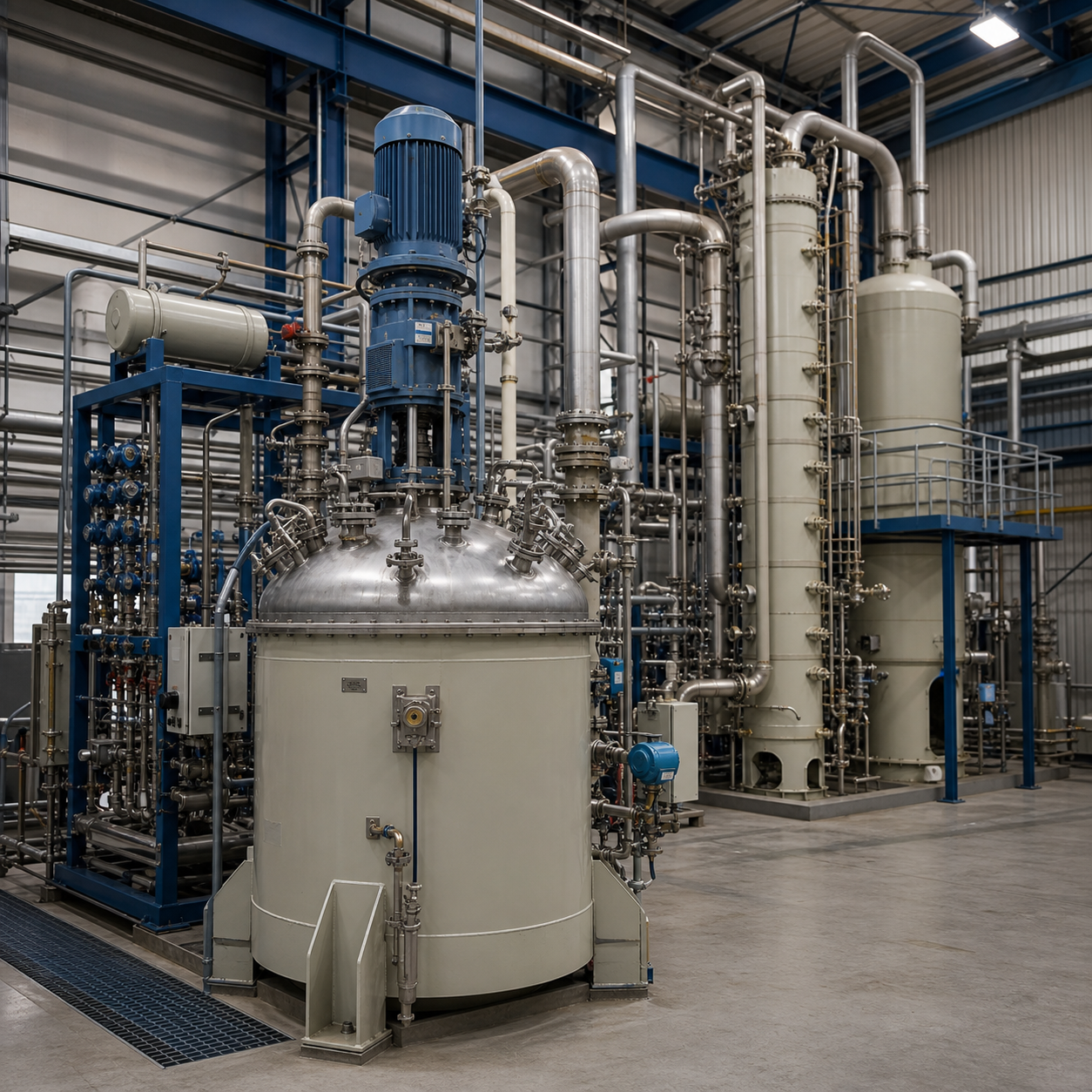
Use compatible closed reactors, metered feeds, agitation, cooling, pressure monitoring and engineered off-gas treatment. Define safe charging sequence and maximum permissible accumulation through reaction calorimetry and hazard review. Do not extrapolate laboratory addition rates directly to plant scale.
Validate separation and product finishing
Distillation, crystallization, filtration and drying redistribute impurities. Monitor mother-liquor recycle, color, crystal behavior, filtration time and residual acid. Retain feed and product samples so deviations can be investigated using evidence.
Use authoritative information carefully
The US EPA monochloroacetic acid technical document notes that chlorination product can contain acetic acid and dichloroacetic acid. It provides hazard and process context, but it does not replace proprietary process design, current regulations or site-specific safeguards.
Protect acetic acid storage and transfer
Glacial acetic acid is corrosive and combustible. Use dedicated compatible tanks, vents, pumps and lines with containment and exposure controls. The NIOSH acetic acid entry summarizes exposure limits, flammability and incompatibilities.
Qualify supply and changes
Review manufacturing site, analytical methods, traceability, retained samples, packaging, complaint handling and continuity. Require advance notification for raw materials, purification, test methods, package or loading point. Approve alternate sources before emergency use.
Prepare a production-grade RFQ
State application, assay, water and impurity limits with methods, shipment volume, package, destination, COA, SDS and change-notification period. Review the Hiacid glacial acetic acid supply page and acetate salts guide, then request a specification-based quotation.
Related glacial acetic acid resources
- Glacial Acetic Acid for Industrial Acetate Salts Manufacturing
- Glacial Acetic Acid for Natural Rubber Latex Coagulation
- Food-Grade Glacial Acetic Acid Supply and Quality Control
Frequently asked questions
Why does water in glacial acetic acid matter?
It changes reaction composition, separation duty and recycle balance.
Which feed impurities require control?
Choose limits from impurity-transfer, selectivity and final-product evidence.
Can an alternate source be used during a shortage?
Only after it completes the approved qualification and plant-trial route.
Why monitor recycle streams?
Trace contaminants can accumulate and change selectivity, color or purification performance.