
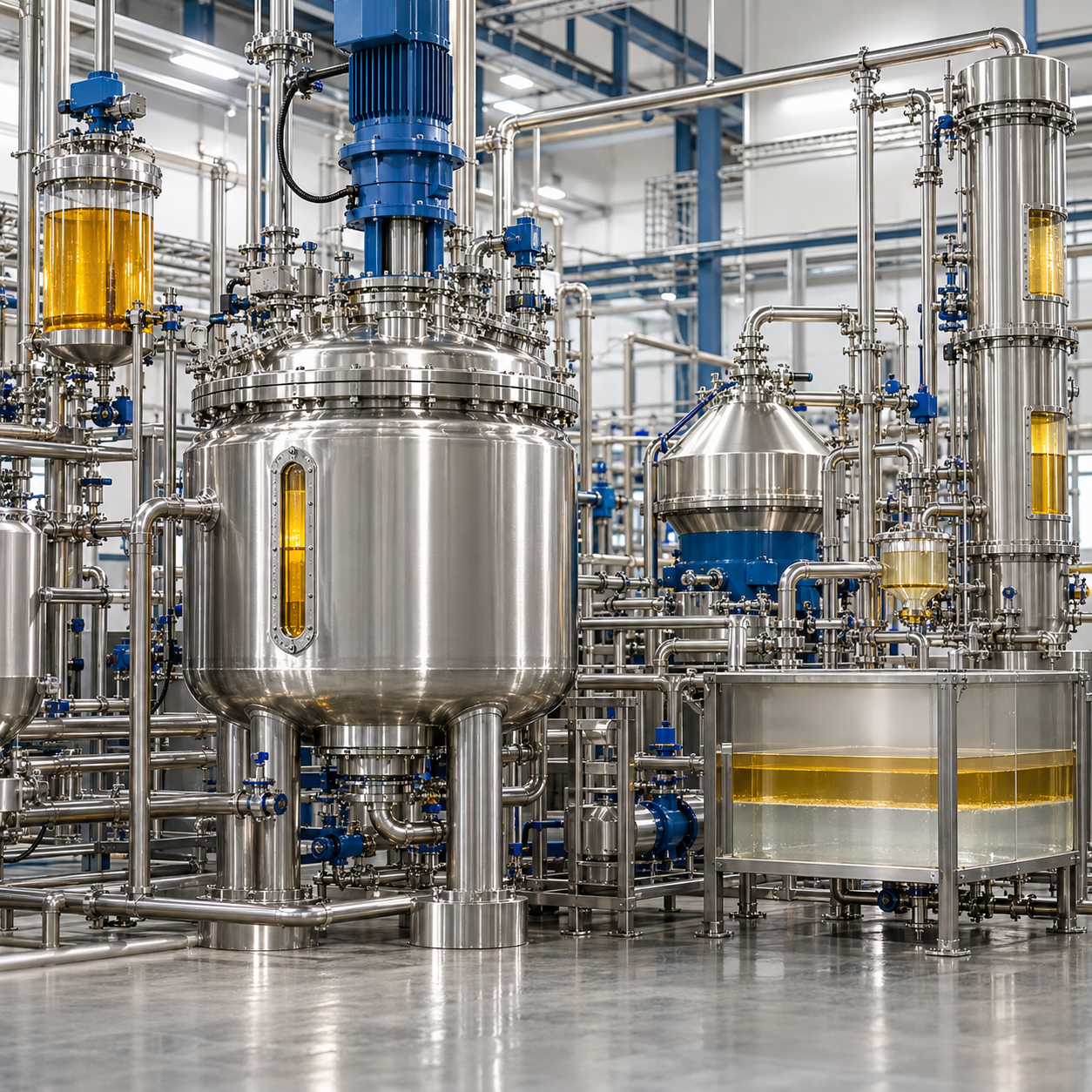
Epoxidized soybean oil is used as a plasticizer, stabilizer and bio-based intermediate. A common route forms a peroxy acid from hydrogen peroxide and a carboxylic acid, which transfers oxygen to unsaturated bonds in the oil. Selectivity depends on soybean-oil iodine value, free fatty acids, water, catalyst, mixing, heat removal and dosing. Epoxide ring opening and residual reagents can lower product quality even when double-bond conversion is high. Procurement must therefore link peroxide quality and stability to oxirane oxygen, acid value, viscosity, color, washing and safe reaction control. This guide is a B2B qualification framework, not a production formula.
For industrial qualification, assign purchasing, quality, engineering, operations, logistics and EHS ownership before the first commercial delivery. Approve hydrogen peroxide concentration, stabilizer expectations, analytical methods, sampling, storage, transfer equipment, deviation response and release authority in writing. Compare representative lots under controlled conditions and record peroxide residual, process performance, heat or gas observations, mass balance, waste and final product quality. This separates reagent variation from changes in water, feedstock, equipment, operator or laboratory method.
Review the chain from supplier release through carrier, package, receiving connection and day tank because contamination or decomposition can occur after final analysis. Reconcile ordered, received, stored and consumed quantities and investigate unexplained assay loss. Supplier scorecards should cover documentation accuracy, delivery condition, corrective-action quality and change notification as well as price. Qualify a contingency source before a disruption using the same methods and process criteria. When buyer and supplier results differ, review sample representativeness, temperature, standards, calibration, detection limits and uncertainty before disposition.
Hydrogen peroxide is a strong oxidizer. Contamination, heat, incompatible materials or confined decomposition can create rapid oxygen release and pressure. Use the current SDS, approved materials, segregation, ventilation, secondary containment, relief protection and an emergency plan. The NIOSH Pocket Guide entry and NIH PubChem record provide general identity and hazard context; local law, site procedures and the process hazard review remain controlling. Confirm emergency contacts, delivery hours and stop-work authority for every shipment. Close qualification with an authorized report, approved-supplier status and routine monitoring.
Use published evidence as context
An industrial-chemistry kinetics study evaluated epoxide ring-opening reactions in soybean-oil epoxidation systems containing hydrogen peroxide and performic acid. Its apparatus and conditions do not define a universal commercial process.
Translate research into a site qualification plan
Define the feed, equipment, analytical methods, acceptance criteria and stop conditions before trials. Scale only after replicated data, a reviewed hazard assessment and documented treatment routes support the decision.
Characterize every soybean-oil lot
Measure iodine value, free fatty acids, moisture, peroxide value, metals, color and insolubles. Seasonal and refinery variation can change oxidant demand and emulsion behavior.
Define a complete ESBO specification
Set oxirane oxygen, residual iodine value, acid value, viscosity, color, moisture, residual peroxide and application testing. Balance conversion with selectivity and stability.
Control peracid formation and heat release
Treat carboxylic acid, catalyst and hydrogen peroxide addition as an integrated reactive system. Use calorimetry, controlled dosing, cooling, agitation and emergency quench or shutdown defined by the hazard study.
Protect the oil-water interface
Mixing determines mass transfer but can also create persistent emulsions. Validate agitation, addition location and phase separation at each scale.
Specify peroxide for selectivity
Define concentration, acidity, stabilizer package, metals and residue. Verify assay at receiving and before use because decomposition changes oxidant equivalents and water input.
Test representative reagent combinations
Evaluate qualified oil, acid, catalyst and peroxide lots together. Record reaction profile, residuals, separation time, washing, yield and final properties.
Validate washing and vacuum drying
Remove acid, residual peroxide and salts to approved endpoints without losing product. Confirm that drying temperature and residence time do not promote ring opening or color change.
Close chemical and wastewater balances
Track peroxide efficiency, organic acid, catalyst, wash water, aqueous organics and off-gas. Include treatment and recovery costs in the scale-up case.
Build commercial supply governance
Require COA, SDS, lot genealogy, retained samples, delivery cleanliness and advance change notification. Qualify a contingency source before relying on it.
Prepare an ESBO supply inquiry
Provide concentration, stabilizer constraints, impurity limits, package, volume and destination. Review the Hiacid hydrogen peroxide page, then request a documented quotation.
Related hydrogen peroxide resources
- Hydrogen Peroxide for Platinum Recovery from Spent Catalysts
- Hydrogen Peroxide for PCB Copper Microetching
- Hydrogen Peroxide for Oxidized Starch Manufacturing
Frequently asked questions
Why is iodine value important to peroxide demand?
It estimates unsaturation, which influences oxidant requirement and achievable epoxide content.
Why can high conversion still produce poor ESBO?
Epoxide ring opening, acidity, color, viscosity and residual reagents can fail even when double bonds are converted.
What makes mixing scale-sensitive?
The oil-water interface controls mass transfer, heat distribution and emulsion formation.
Can supplier lots be compared by assay only?
No. Stabilizers, metals, acidity and process performance must also be qualified.