
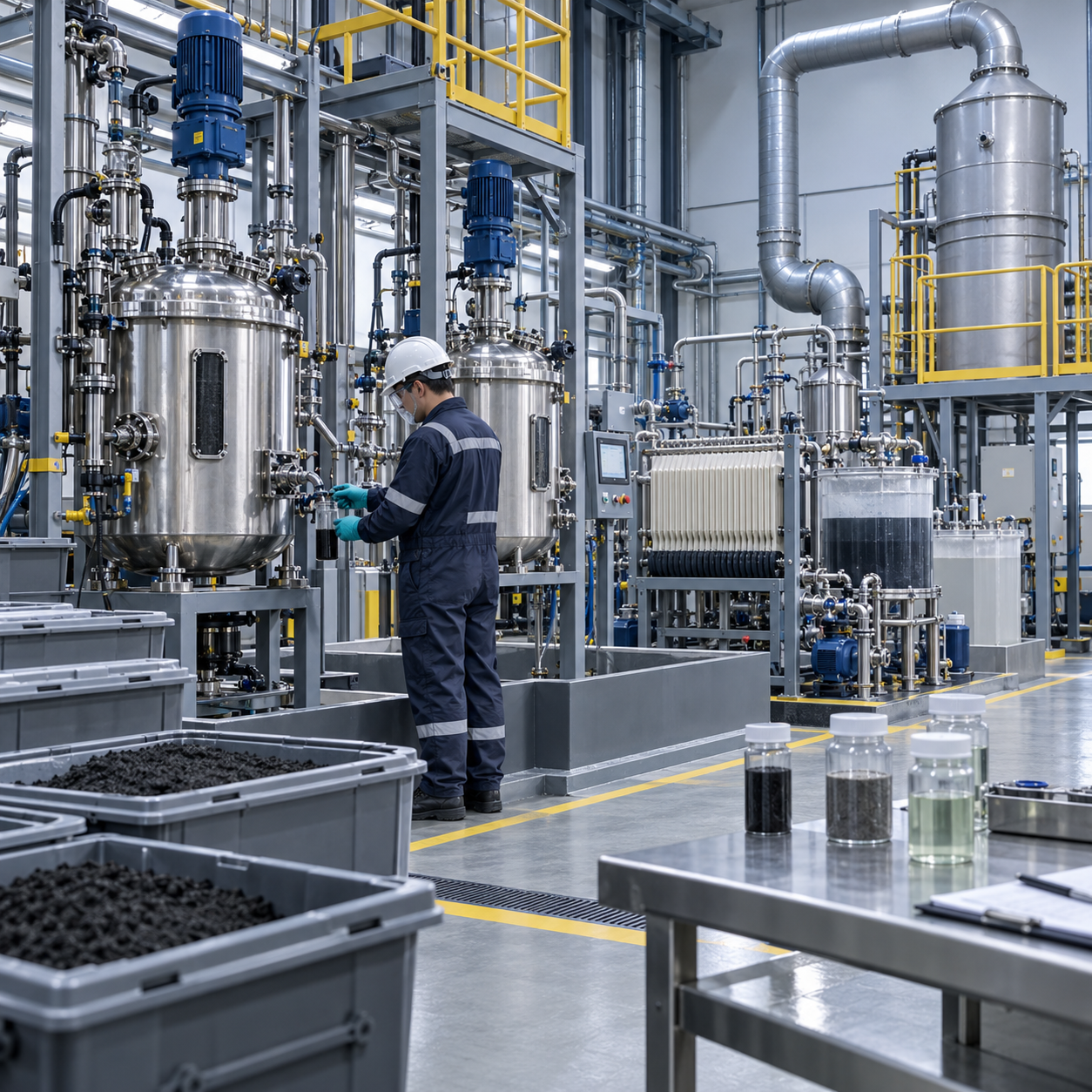
Hydrometallurgical battery recycling dissolves valuable metals from prepared cathode material or black mass before separation and recovery. Nitric acid has been investigated as one possible mineral-acid leachant, but its oxidative behavior, NOx potential and nitrate-rich solutions create distinct engineering and environmental questions. Feed chemistry also varies among lithium cobalt oxide, nickel-manganese-cobalt, nickel-cobalt-aluminum and mixed streams. A serious qualification program must connect recovery with product purity, acid consumption, gas control and downstream treatment. This article covers supplier and pilot governance without presenting operational leaching conditions.
Industrial nitric acid qualification should assign purchasing, quality, engineering, operations, logistics and EHS ownership before the first delivery. Approve concentration, analytical methods, sampling, storage, compatible transfer equipment, deviation response and release authority in writing. Compare representative lots under controlled conditions and record performance, mass balance, emissions-control operation, waste, equipment observations and final product quality. This separates raw-material variation from changes in feedstock, water, equipment, operator or analytical method. Review the chain from supplier release through carrier, package, receiving connection and day tank because contamination or dilution can occur after final analysis. Reconcile ordered, received, stored and consumed quantities and investigate unexplained differences. Supplier scorecards should cover documentation accuracy, delivery condition, corrective-action quality and change notification as well as price. Qualify a contingency source using the same methods before a disruption. When buyer and supplier results differ, review sample representativeness, temperature, standards, calibration, detection limits and measurement uncertainty before disposition. Confirm emergency contacts, unloading hours and stop-work authority for every shipment. Nitric acid is a strong oxidizer and corrosive chemical that can release toxic nitrogen oxides; use the current SDS, compatible segregation, ventilation, containment and an approved emergency plan. The NIOSH Pocket Guide entry and NIH PubChem record provide general hazard and identity context, while local law and site procedures remain controlling. Close qualification with an authorized report, approved-supplier status and a defined routine-monitoring plan.
Define and safely prepare the feed
Document battery chemistry, state of charge controls, disassembly, thermal or mechanical preprocessing, binder, graphite, aluminum, copper, iron, moisture and particle size. Exclude unknown whole cells from chemical trials. Approved specialists should control electrical, fire and powder hazards before material reaches the leach pilot.
Set recovery and product specifications
Define target lithium, nickel, cobalt and manganese products, impurity limits and intended reuse. Include aluminum, copper, fluorine, phosphorus and carbon behavior. High dissolution can still produce an expensive purification train or unsuitable recovered salts.
Compare nitric acid within a full flowsheet
An Energy & Fuels review of lithium-ion battery recycling includes nitric acid among mineral acids studied for cathode leaching and emphasizes that operating variables and downstream recovery matter.
Use stage-gated pilot evidence
Screen representative feeds, then replicate selected cases. Measure leach extraction, selectivity, acid demand, gas, filtration, purification chemicals, water, energy, yield and final product quality. Compare with technically viable alternative chemistries on the same system boundary.
Qualify acid against process sensitivity
Specify concentration, chloride, sulfate, metals, residue and test methods. Incoming chloride can affect corrosion and product purity, while concentration variation changes both water balance and acid dose. Verify acid lots used in development and preserve representative samples.
Close metal and reagent balances
Account for feed, leach liquor, gas scrubber, wash, filter cake, intermediate and recovered products. Establish reconciliation limits and investigate missing mass. Sampling solids with segregated particles requires a validated homogenization and subsampling plan.
Engineer NOx and mixed-hazard controls
Assess reaction heat, NOx, acid mist, residual electrolyte, fluorinated species, combustible carbon and metal powder in a formal hazard review. Use closed compatible reactors, controlled charging, ventilation, scrubbing, heat removal and emergency shutdown.
Plan nitrate and water treatment before scale-up
Map nitrate across raffinate, scrubber liquor, wash water and products. Evaluate acid recovery, water reuse and purge treatment without concentrating fluorides or metals to damaging levels. Include disposal and permit costs in the economic model.
Align commercial supply with campaigns
Move from small documented packages to larger deliveries only after reproducible balances and approved equipment. Require COA, SDS, lot genealogy, retained samples, corrective-action support and advance notice of manufacturing or package changes.
Prepare a battery-recycling inquiry
Provide concentration, impurity limits, trial or annual volume, package, destination, schedule and quality documents. Review the Hiacid nitric acid product page, then request a staged supply quotation.
Related nitric acid resources
- Nitric Acid for Environmental Water Sample Preservation
- Nitric Acid for Cellulose Pulp Feedstock Qualification
- Nitric Acid for Spent Hydrodesulfurization Catalyst Recovery
Frequently asked questions
Can mixed battery black mass use one fixed leach process?
No. Cathode chemistry, preprocessing and impurities require representative feed characterization and validation.
Why is high metal extraction not enough?
Selectivity, purification, acid use, gas control, nitrate treatment and final product quality determine overall viability.
Which incoming acid impurities are important?
Chloride, sulfate, metals and residue should be assessed against corrosion and recovered-product specifications.
Does this article describe a battery leaching recipe?
No. It provides a B2B qualification framework for professionally engineered recycling trials.