
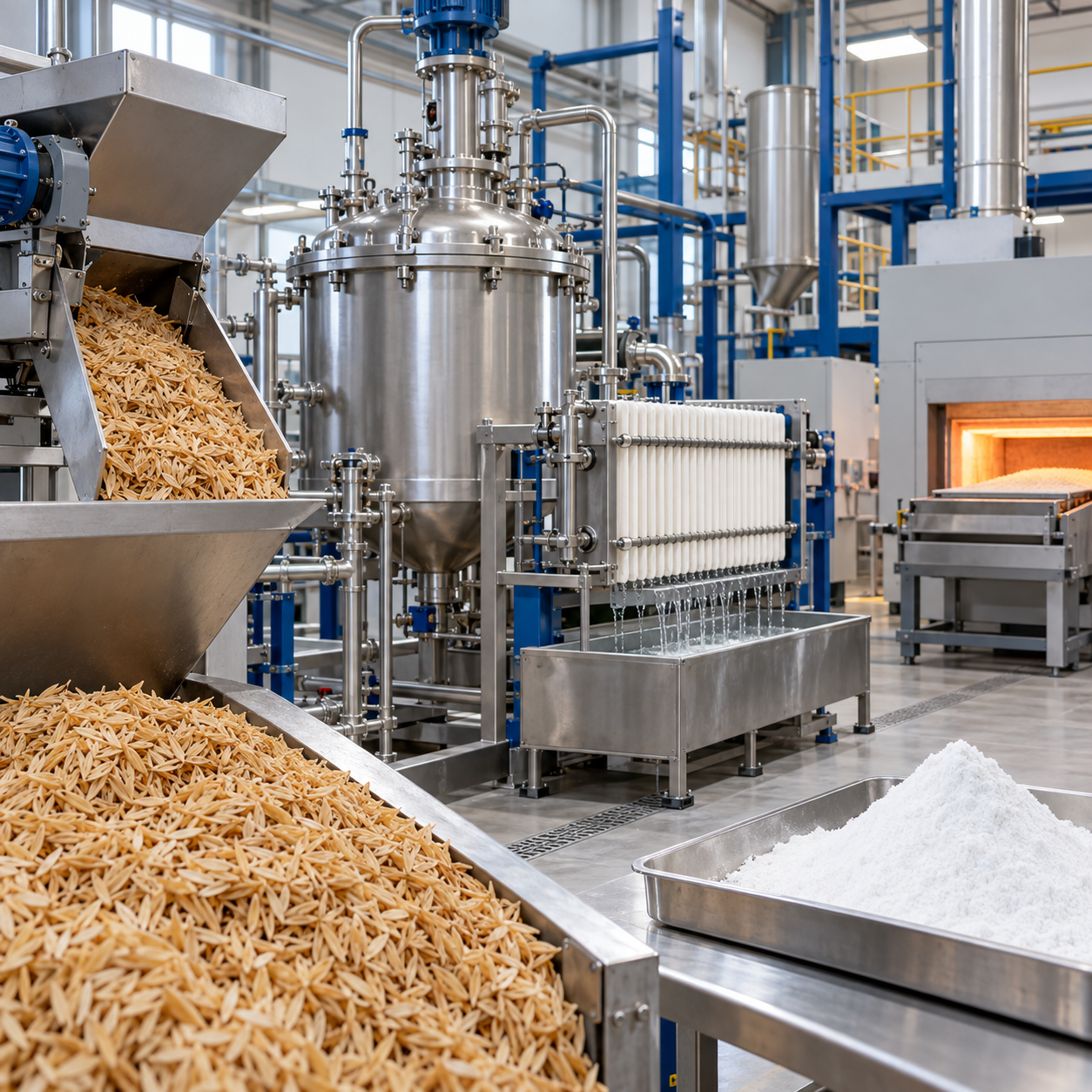
Rice husk contains a silica-rich mineral fraction together with potassium, calcium, iron and organic matter. Controlled acid pretreatment before calcination can remove metals that otherwise lower whiteness, surface area and thermal stability. Hydrochloric acid is frequently studied because soluble metal chlorides can be washed from the biomass before combustion. The result is not determined by acid concentration alone. Feed origin, husk washing, particle size, liquid-to-solid ratio, contact time, wash endpoint, drying and calcination all affect purity and morphology. A commercial program must also measure chloride, water demand, acid reuse and the destination of leach liquor rather than treating the furnace product as the only output.
For B2B implementation, assign owners in process engineering, quality, production, purchasing and EHS before the first delivery. Approve receiving tests, sampling tools, storage, dosing basis, deviation response and retained-sample period in writing. Compare representative hydrochloric acid lots under identical operating conditions and record mass balance, product quality, waste load, emissions, energy and equipment observations. Define who may approve a temporary deviation and what evidence is required before release. Review transport, package integrity, unloading, ventilation and emergency response alongside supplier data. Close qualification with a written conclusion, updated material specification and clear requalification triggers. Procurement should confirm lead time, minimum order, container loading, port documents and contingency stock. Quality teams should trend results rather than checking only pass or fail, while production records actual consumption per tonne of acceptable output. Repeat the trial at expected solids, temperature, residence time and recycle ratio before scale-up. Sample startup, stable operation and shutdown because transient conditions can expose impurity, corrosion or filtration problems. Document calibration, detection limits and calculation formulas so laboratories can reproduce the reported recovery. Include raw material, utilities, labor, maintenance, emissions control, waste treatment and inventory in the economic model. Audit scales, flowmeters or pipettes used to dose acid, since concentration control cannot compensate for inaccurate addition. Confirm unloading connections, segregation from incompatible materials, exposure controls, first response and stop-work authority through a documented site review. These controls turn promising research into an auditable qualification package and support faster buyer-supplier investigations. Before final approval, run at least one campaign using normal operators, production water and routine sampling rather than development-only conditions. Reconcile ordered, received, stored and consumed acid, and investigate unexplained inventory differences. Compare supplier and buyer results by reviewing sample representativeness, temperature, calibration, detection limits and uncertainty. Include maintenance and warehouse observations because seal, vent, hose or pallet issues may not appear on a certificate of analysis. Establish an alternate qualified source before a disruption, using the same analytical and process criteria. Review supplier performance periodically for documentation accuracy, delivery condition, corrective action and change notification, not only price. This additional evidence makes the specification practical for ongoing production.
Characterize rice husk by origin and season
Measure moisture, ash, silica, potassium, calcium, iron and other target impurities across representative lots. Record storage age, soil contamination and prior washing because agricultural residues vary widely.
Define the silica product specification
Set purity, color, surface area, pore volume, particle size, amorphous phase and application tests for rubber, plastics, adsorbents or other markets before selecting pretreatment conditions.
Use current research as a trial boundary
A 2026 South African Journal of Chemical Engineering study compares fresh and reused hydrochloric acid for producing high-purity amorphous rice-husk silica. Its feed and equipment require independent replication.
Build a controlled pretreatment matrix
Vary acid concentration, time, temperature and liquid-to-solid ratio with untreated controls, duplicates and multiple husk lots. Track metal removal in both washed solids and leach liquor.
Design washing and calcination together
Define wash endpoints for pH, conductivity and chloride rather than using a fixed number of rinses. Measure water consumption and metal loss through every stage.
Control thermal history
Record drying, furnace atmosphere, heating rate, peak temperature, hold time and bed depth. Excess temperature can change amorphous silica, porosity and color even when pretreatment was effective.
Close acid, chloride and impurity balances
Analyze potassium, calcium, iron, phosphorus and chloride in feed, liquor, wash water, silica and emissions-control residues. Test acid reuse over repeated cycles to identify impurity accumulation.
Plan corrosion and exposure safeguards
Use compatible closed reactors, pumps, filtration and ventilation. Qualified engineers should assess acid charging, heat, hydrogen chloride exposure, washing, neutralization and emergency containment.
Qualify hydrochloric acid for repeatability
Specify concentration, iron, nonvolatile residue and trace metals relevant to silica color and purity. Require agreed methods, lot COA, sealed packaging, retained samples and change notification.
Prepare a silica-production inquiry
Provide concentration, trial quantity, package, destination and analytical limits. Review the Hiacid hydrochloric acid product page, then request documented pilot and commercial supply.
Related hydrochloric acid resources
- Hydrochloric Acid for Alumina Extraction from Coal Gangue
- Hydrochloric Acid for Calcium Recovery from Waste Cement
- Hydrochloric Acid for NdFeB Magnet Rare-Earth Recycling
Frequently asked questions
Does stronger hydrochloric acid always make purer silica?
No. Feed impurities, washing, acid reuse and calcination can matter as much as acid concentration.
Why measure chloride in the washed husk?
Residual chloride can affect corrosion, emissions, product purity and downstream applications.
Can pretreatment acid be reused?
Potentially, but repeated-cycle testing must confirm impurity buildup, metal removal and product quality.
Which acid impurities may affect silica?
Iron, nonvolatile residue and selected metals can affect color, purity and application performance.