
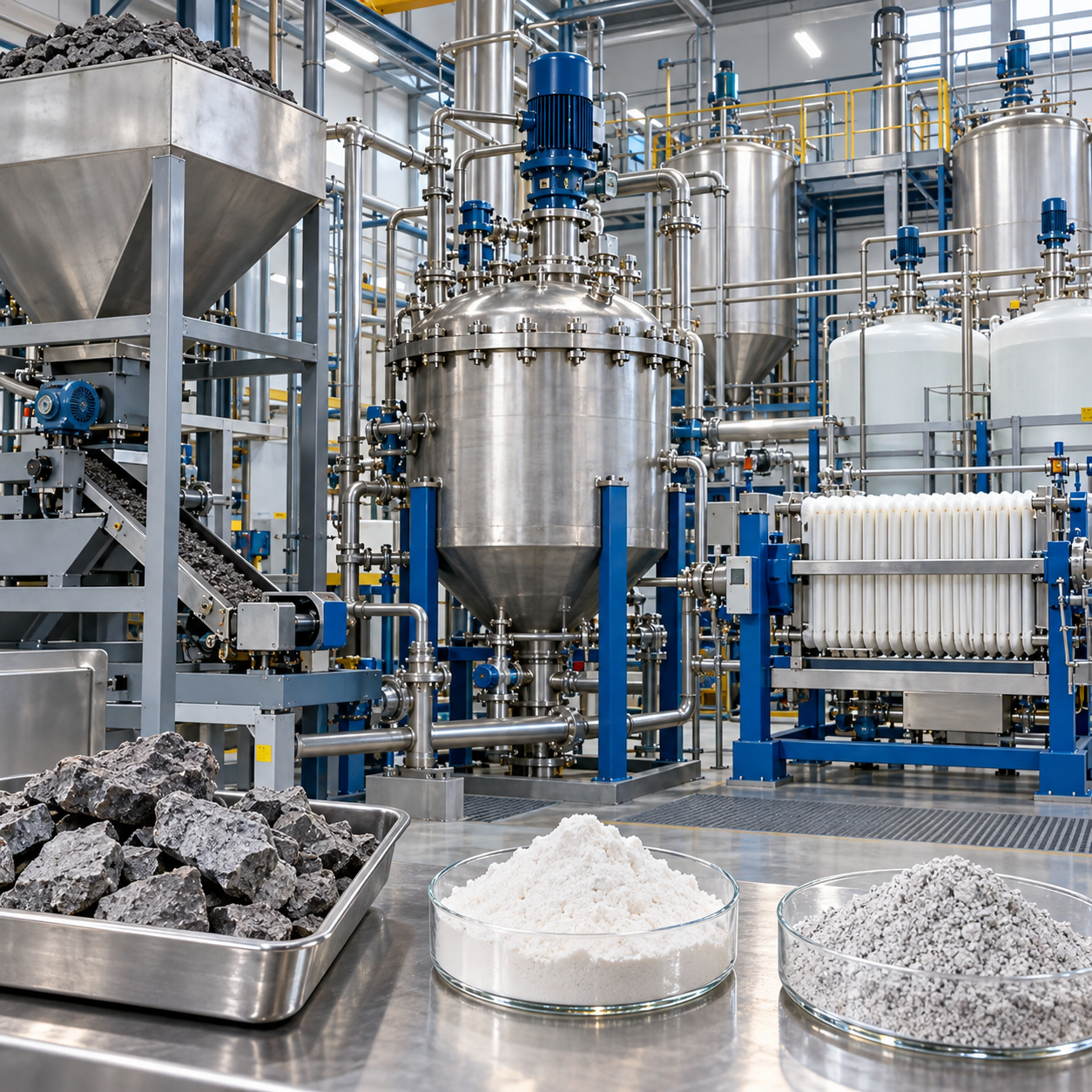
Coal gangue can contain kaolinite and other aluminosilicate phases that become more reactive after controlled thermal activation. Hydrochloric acid can dissolve aluminum from activated material, leaving a silica-rich residue, but it also leaches iron, lithium and other elements. Process value depends on far more than aluminum extraction: calcination energy, acid demand, pressure equipment, liquor purification, aluminum chloride crystallization or conversion, acid recovery and residue use all matter. Feed mineralogy varies by mine and seam, so a plant cannot inherit laboratory conditions without verifying activation and mass balance on representative composites.
For B2B implementation, assign owners in process engineering, quality, production, purchasing and EHS before the first delivery. Approve receiving tests, sampling tools, storage, dosing basis, deviation response and retained-sample period in writing. Compare representative hydrochloric acid lots under identical operating conditions and record mass balance, product quality, waste load, emissions, energy and equipment observations. Define who may approve a temporary deviation and what evidence is required before release. Review transport, package integrity, unloading, ventilation and emergency response alongside supplier data. Close qualification with a written conclusion, updated material specification and clear requalification triggers. Procurement should confirm lead time, minimum order, container loading, port documents and contingency stock. Quality teams should trend results rather than checking only pass or fail, while production records actual consumption per tonne of acceptable output. Repeat the trial at expected solids, temperature, residence time and recycle ratio before scale-up. Sample startup, stable operation and shutdown because transient conditions can expose impurity, corrosion or filtration problems. Document calibration, detection limits and calculation formulas so laboratories can reproduce the reported recovery. Include raw material, utilities, labor, maintenance, emissions control, waste treatment and inventory in the economic model. Audit scales, flowmeters or pipettes used to dose acid, since concentration control cannot compensate for inaccurate addition. Confirm unloading connections, segregation from incompatible materials, exposure controls, first response and stop-work authority through a documented site review. These controls turn promising research into an auditable qualification package and support faster buyer-supplier investigations. Before final approval, run at least one campaign using normal operators, production water and routine sampling rather than development-only conditions. Reconcile ordered, received, stored and consumed acid, and investigate unexplained inventory differences. Compare supplier and buyer results by reviewing sample representativeness, temperature, calibration, detection limits and uncertainty. Include maintenance and warehouse observations because seal, vent, hose or pallet issues may not appear on a certificate of analysis. Establish an alternate qualified source before a disruption, using the same analytical and process criteria. Review supplier performance periodically for documentation accuracy, delivery condition, corrective action and change notification, not only price. This additional evidence makes the specification practical for ongoing production.
Map gangue mineralogy before activation
Measure aluminum, silicon, iron, lithium, calcium, carbon and regulated elements, then identify kaolinite, quartz and other phases by size fraction. Build a representative composite across production periods.
Define the aluminum product route
Specify whether the target is aluminum chloride, alumina or another intermediate. Set recovery, purity, iron, alkali, silica and particle requirements before selecting the leach.
Connect calcination to leaching kinetics
A 2023 Transactions of Nonferrous Metals Society of China study reports hydrochloric-acid leaching kinetics after coal-gangue calcination. Its optimum is feed- and reactor-specific.
Use a designed activation matrix
Vary calcination temperature, time and particle size, then evaluate acid concentration, temperature, pressure, residence time and solids loading with replicated tests.
Close aluminum and impurity balances
Analyze feed, activated solid, pregnant liquor, washes, silica-rich residue and aluminum product. Track iron and lithium because they can create either purification cost or coproduct opportunity.
Validate purification and crystallization
Test evaporation, crystallization, precipitation or solvent-based purification with real liquor. Measure mother-liquor recycle, product washing, chloride entrainment and yield over several cycles.
Engineer high-temperature acid service
Pressurized hot hydrochloric acid requires materials, seals, relief, cooling, off-gas treatment and containment designed by qualified engineers. Pilot the intended solids loading and abrasion.
Plan acid recovery and residue use
Quantify free acid, chloride, water and metals in recycle and purge streams. Characterize silica-rich residue for proposed use, including leachability and performance rather than total composition alone.
Control commercial hydrochloric acid supply
Specify concentration, iron, residue and metals that affect product purity. Define receiving tests, COA, package, traceability, retained samples and requalification triggers.
Prepare a coal-gangue RFQ
Share concentration, pilot and monthly demand, package, destination and impurity limits. Review the Hiacid hydrochloric acid page, then request a staged supply proposal.
Related hydrochloric acid resources
- Hydrochloric Acid for High-Purity Silica from Rice Husk
- Hydrochloric Acid for Calcium Recovery from Waste Cement
- Hydrochloric Acid for NdFeB Magnet Rare-Earth Recycling
Frequently asked questions
Why calcine coal gangue before hydrochloric acid leaching?
Thermal activation can transform kaolinite into more acid-reactive aluminosilicate phases.
Does high aluminum extraction prove a viable process?
No. Energy, acid use, impurity removal, product recovery, recycle and residue value must also be demonstrated.
Why track lithium in the liquor?
Some gangues release lithium with aluminum, affecting purification and possible coproduct recovery.
What should the acid specification control?
Concentration, iron, residue, relevant metals, methods, packaging and change notification should be agreed.