
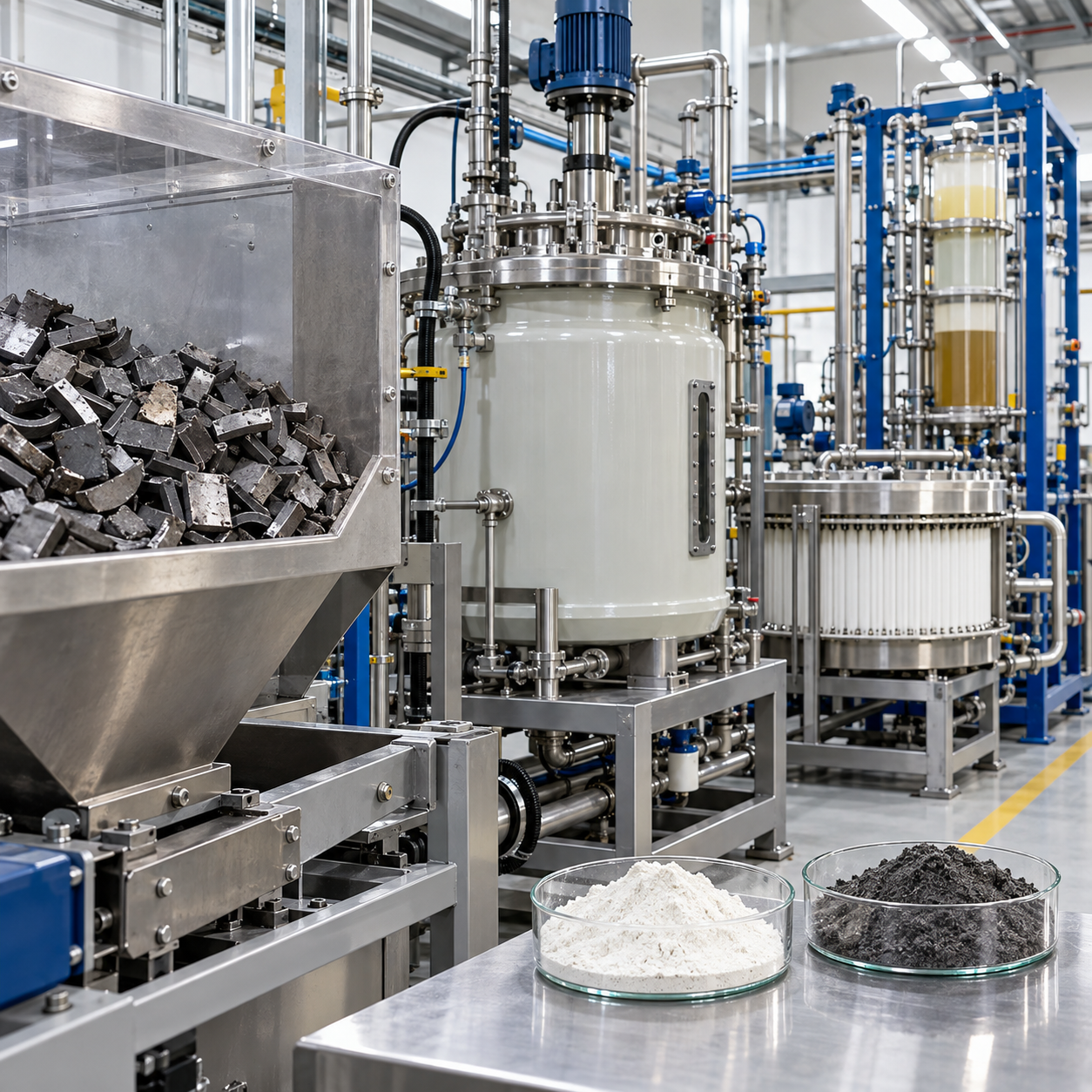
End-of-life neodymium-iron-boron magnets contain neodymium, praseodymium, dysprosium, iron, boron and coating metals. Hydrochloric acid can dissolve rare-earth oxides or prepared magnet material, but iron loading often dominates the liquor and downstream separation. Pretreatment, oxidation state, particle size, acid concentration and selective recovery must be designed as a complete loop. Commercial evaluation also needs safe demagnetization, hydrogen and heat assessment, acid recycle, chloride control and residue classification. Published closed-loop concepts are valuable references, yet mixed magnet grades and coatings require a site-specific mass balance before scale-up.
For B2B implementation, assign owners in process engineering, quality, production, purchasing and EHS before the first delivery. Approve receiving tests, sampling tools, storage, dosing basis, deviation response and retained-sample period in writing. Compare representative hydrochloric acid lots under identical operating conditions and record mass balance, product quality, waste load, emissions, energy and equipment observations. Define who may approve a temporary deviation and what evidence is required before release. Review transport, package integrity, unloading, ventilation and emergency response alongside supplier data. Close qualification with a written conclusion, updated material specification and clear requalification triggers. Procurement should confirm lead time, minimum order, container loading, port documents and contingency stock. Quality teams should trend results rather than checking only pass or fail, while production records actual consumption per tonne of acceptable output. Repeat the trial at expected solids, temperature, residence time and recycle ratio before scale-up. Sample startup, stable operation and shutdown because transient conditions can expose impurity, corrosion or filtration problems. Document calibration, detection limits and calculation formulas so laboratories can reproduce the reported recovery. Include raw material, utilities, labor, maintenance, emissions control, waste treatment and inventory in the economic model. Audit scales, flowmeters or pipettes used to dose acid, since concentration control cannot compensate for inaccurate addition. Confirm unloading connections, segregation from incompatible materials, exposure controls, first response and stop-work authority through a documented site review. These controls turn promising research into an auditable qualification package and support faster buyer-supplier investigations. Before final approval, run at least one campaign using normal operators, production water and routine sampling rather than development-only conditions. Reconcile ordered, received, stored and consumed acid, and investigate unexplained inventory differences. Compare supplier and buyer results by reviewing sample representativeness, temperature, calibration, detection limits and uncertainty. Include maintenance and warehouse observations because seal, vent, hose or pallet issues may not appear on a certificate of analysis. Establish an alternate qualified source before a disruption, using the same analytical and process criteria. Review supplier performance periodically for documentation accuracy, delivery condition, corrective action and change notification, not only price. This additional evidence makes the specification practical for ongoing production.
Characterize and depollute magnet scrap
Separate magnet grade, coating, adhesive and attached steel. Confirm demagnetization and measure rare earths, iron, boron, nickel, copper and regulated contaminants on representative composites.
Define a saleable rare-earth product
Set recovery, neodymium-praseodymium-dysprosium balance, iron limit and final product form. A high leaching percentage is not enough if the precipitate cannot meet refining specifications.
Use closed-loop research as evidence
A Scientific Reports study demonstrates a hydrochloric-acid-based closed-loop concept for rare-earth extraction from NdFeB magnets. Its feed and pretreatment must be validated independently.
Compare pretreatment and leaching sequences
Evaluate oxidation, roasting or corrosion pretreatment, size reduction, acid concentration, temperature, time and solids loading. Track iron selectivity, hydrogen risk and energy as well as rare-earth dissolution.
Design iron rejection and rare-earth recovery
Test solvent extraction, molecular recognition, precipitation or other approved routes with actual concentrated chloride liquor. Measure rare-earth loading, iron carryover, stripping and product washing.
Close the complete metal balance
Analyze feed, leach residue, liquor, washes, separation streams and final product. Report extraction, purification yield and overall recovery separately for each rare earth and iron.
Engineer acid recycle and gas controls
Track free acid, chloride, water and impurities through recycle and purge. Verify that reused acid maintains kinetics and separation performance across multiple cycles.
Review magnet-specific hazards
Assess stored magnetic energy, sharp scrap, combustible coatings, hydrogen formation, exotherm and hydrogen chloride exposure. Use closed equipment, ventilation, compatible materials and qualified process-safety review.
Specify makeup hydrochloric acid
Control concentration, iron, residue and trace metals that affect separation. Require COA, receiving tests, packaging integrity, lot traceability and change notification.
Prepare a magnet-recycling RFQ
Share concentration, trial and projected use, package, destination and quality limits. Review the Hiacid hydrochloric acid page, then request a documented makeup-acid plan.
Related hydrochloric acid resources
- Hydrochloric Acid for High-Purity Silica from Rice Husk
- Hydrochloric Acid for Alumina Extraction from Coal Gangue
- Hydrochloric Acid for Calcium Recovery from Waste Cement
Frequently asked questions
Can hydrochloric acid separate rare earths from iron by itself?
No. Leaching is followed by selective separation, precipitation or another recovery step.
Why demagnetize scrap before processing?
It improves handling safety and helps prevent uncontrolled movement or damage during size reduction and feeding.
What proves a closed-loop process?
Repeated cycles must show stable acid, chloride, impurity, product and purge balances.
Which acid properties need purchasing control?
Concentration, iron, residue, selected metals, test methods, packaging and traceability should be defined.