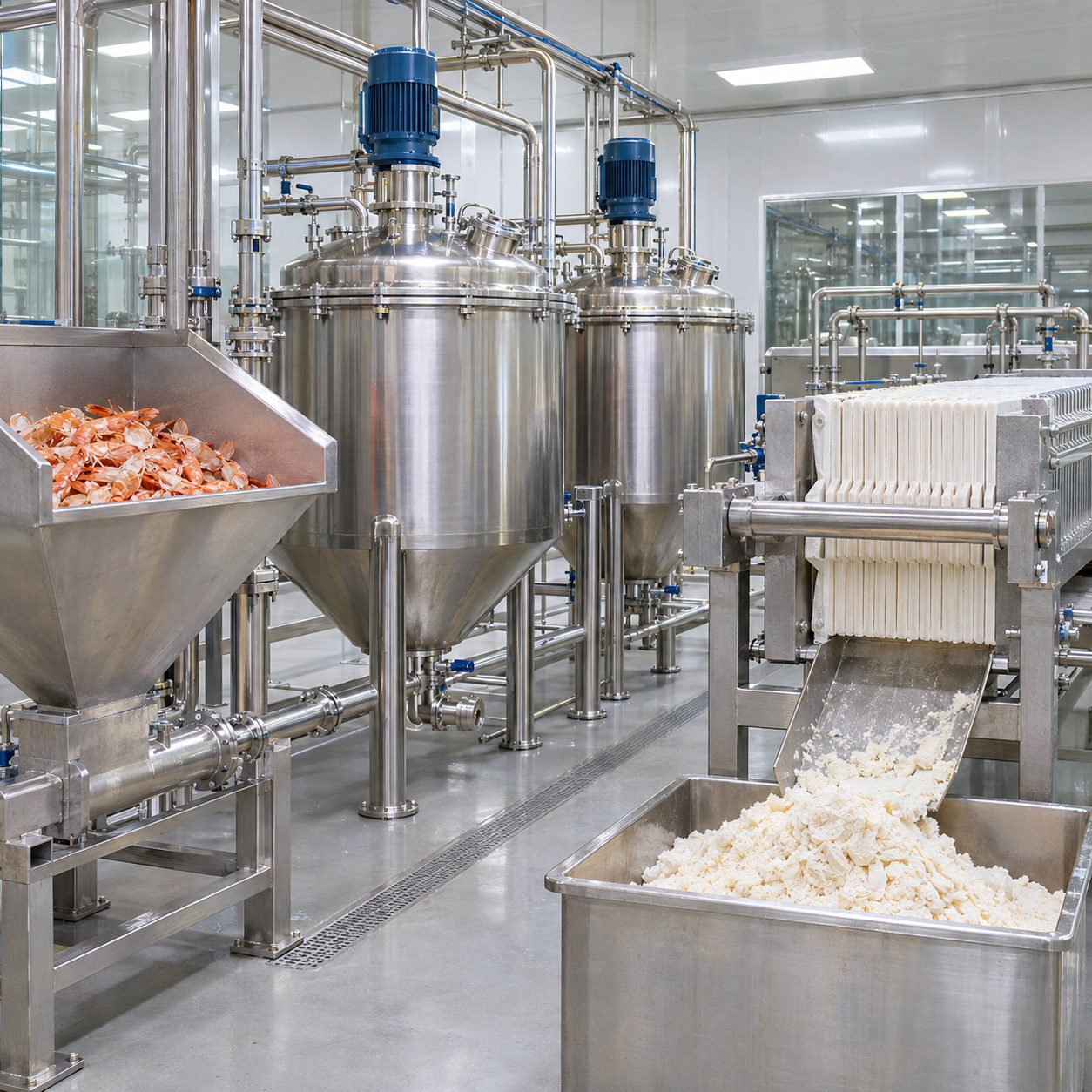
Crustacean and mollusk shells contain chitin, proteins, minerals and pigments. Demineralization removes calcium-rich material before or after deproteinization, depending on the validated process. Organic acids including acetic acid have been studied as alternatives to strong mineral acids because they may support gentler processing and different coproduct strategies. Commercial success still depends on shell variability, particle size, acid utilization, washing, residual ash, degree of acetylation, molecular integrity, color, microbiology and effluent management. Glacial acetic acid must be diluted and controlled within a documented grade system appropriate to the intended chitin market.
For industrial qualification, assign purchasing, quality, engineering, operations, logistics and EHS ownership before the first commercial delivery. Approve assay, impurity limits, analytical methods, sampling, storage, dilution or dosing equipment, deviation response and release authority in writing. Compare multiple representative lots under controlled conditions and record process performance, mass balance, waste, equipment observations and final product quality. This separates raw-material variation from changes in water, feedstock, equipment, operator or laboratory method.
Review the chain from supplier release through carrier, package, receiving connection and point of use because contamination or dilution can occur after final analysis. Reconcile ordered, received, stored and consumed quantities and investigate unexplained differences. Supplier scorecards should cover documentation accuracy, delivery condition, corrective-action quality and change notification as well as price. Qualify a contingency source before disruption using the same methods and process criteria. When buyer and supplier results differ, review sample representativeness, temperature, standards, calibration, detection limits and uncertainty before disposition.
Glacial acetic acid is corrosive and combustible and has a pungent vapor. Its freezing point is near ordinary cool-weather conditions, so crystallization can disrupt delivery or measurement if not controlled. Use the current SDS, compatible materials, ventilation, ignition control, secondary containment and an approved emergency plan. The OSHA acetic acid data page and NIH PubChem record provide general hazard context; local law and site procedures remain controlling.
Use published evidence as context
A Heliyon study examines snail-shell demineralization using acetic acid and shows that particle size influences the controlling mechanism. Its conditions are research evidence, not universal plant settings: peer-reviewed demineralization study.
Translate evidence into site qualification
Define feed, equipment, analytical methods, acceptance criteria and stop conditions before trials. Scale only after replicated data, a reviewed hazard assessment and documented product and waste routes support the decision. Close qualification with an authorized report, approved-supplier status and routine monitoring.
Define the chitin product and market
Set limits for ash, protein, degree of acetylation, molecular weight, color, odor, moisture, microbiology and trace contaminants.
Map regulatory status before trials
Confirm permitted raw materials, processing aids, residues and documentation. Research use does not establish food or medical suitability.
Characterize shell feed variability
Record species, storage history, washing, moisture, mineral content, protein, pigment and particle-size distribution. Use dry-basis balances.
Control particle size and gas release
Calcium carbonate reaction can generate carbon dioxide and foaming. Validate feed, mixing, headspace and venting with formal hazard review.
Specify and prepare the acid consistently
Require appropriate-grade acid identity, assay, water, metals, residue and traceability. Control dilution water, preparation mass and tank cleanliness.
Reconcile acid consumption and calcium removal
Track acid, residual acidity, dissolved calcium, wash demand and final ash. Unexpected consumption may indicate feed variability or dilution error.
Protect polymer quality through finishing
Evaluate deproteinization, washing, decolorization, drying and milling together. Excess severity can improve ash removal while damaging molecular properties.
Qualify coproduct and wastewater routes
Characterize calcium acetate-rich liquor, proteins, pigments, salts and cleaning streams before scale-up.
Build traceable supplier governance
Require COA, SDS, genealogy, retained samples, transport-cleanliness evidence and change notification. Link acid lots to shell lots and released chitin.
Prepare a chitin-project inquiry
Provide grade, impurity limits, package, pilot and annual demand, destination and documentation needs.
Review the Hiacid glacial acetic acid page, then request a specification-led quotation. Include end use, grade, analytical limits, annual volume, package, delivery profile, destination and required documentation so the supplier can respond on a technically comparable basis.
Related glacial acetic acid resources
- Glacial Acetic Acid for Triacetin Manufacturing
- Glacial Acetic Acid for Catalytic Acetone Production
- Food-Grade Glacial Acetic Acid for Casein Precipitation
Frequently asked questions
Why use acetic acid for shell demineralization?
It can remove calcium minerals under a validated process while supporting different coproduct strategies.
Is food-grade acid always required?
The required grade depends on intended use and applicable regulation.
Why does shell particle size matter?
It changes surface area, mass transfer, gas release and washing performance.
Can research conditions be copied to production?
No. Shell composition, equipment, product requirements and safety controls require validation.