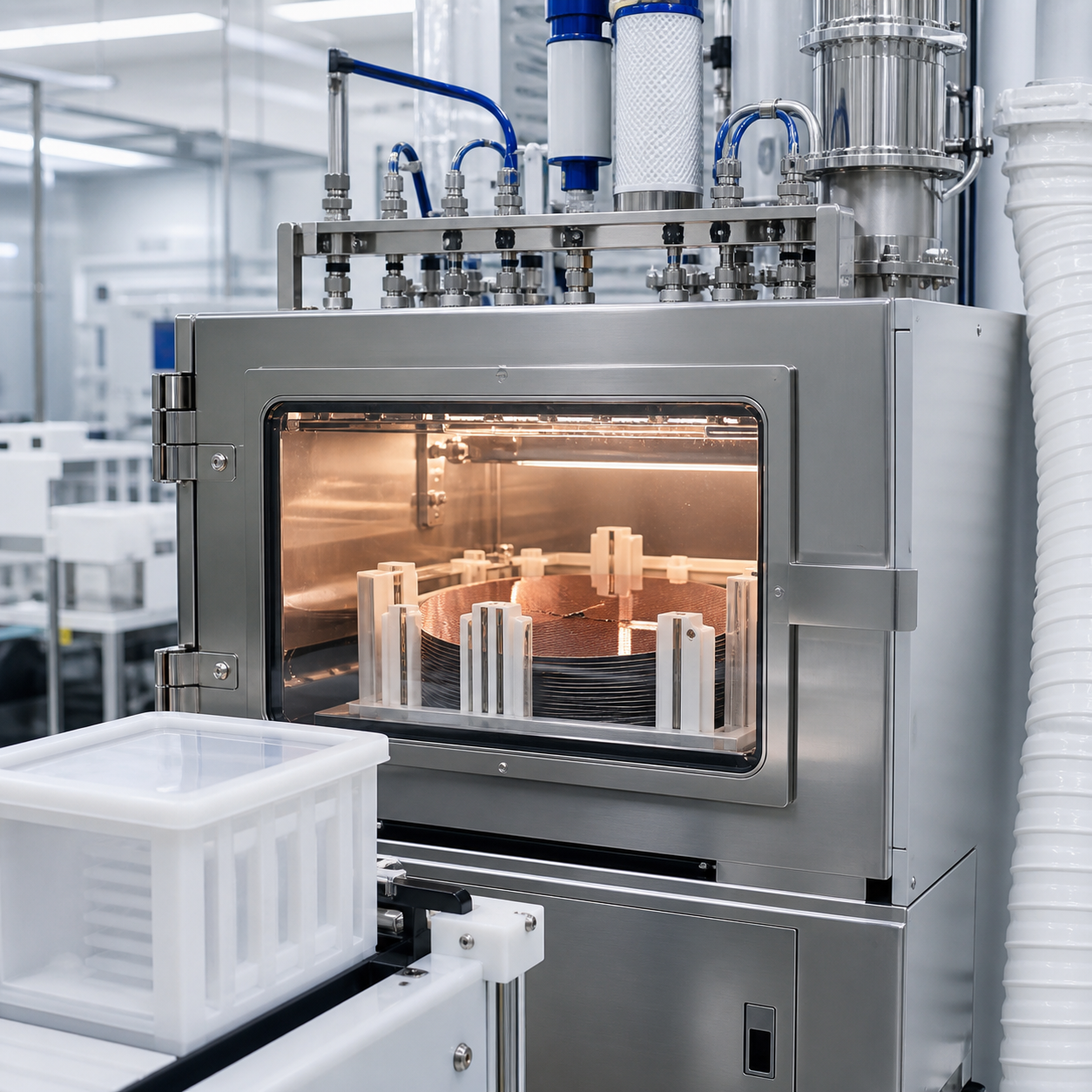
Formic acid vapor has been described for reducing or removing native copper oxides during semiconductor manufacturing. The intent is to prepare a copper surface for a subsequent barrier, bonding or packaging step while limiting reoxidation and contamination. This is a controlled dry-process application, not a general recommendation to expose wafers to commodity acid. Temperature, pressure, exposure time, gas distribution, chamber cleanliness and the interval before the next process all affect the surface. Trace metals, nonvolatile residue and particles can matter even when the acid assay is correct. Semiconductor teams should therefore qualify acid, package, transfer and vapor-generation hardware as one controlled material system. Supplier change, package-size change and cleaning-procedure change need formal review. Procurement documentation should support traceability to the wafer lot and include agreed notification when manufacturing location, raw material or analytical method changes. A useful qualification plan includes blank wafers, patterned test vehicles, edge-to-center mapping and downstream adhesion or contact-resistance results. These controls show whether the process is clean and uniform at production scale, not merely whether bulk oxide removal occurred.
Define the surface and next process step
State copper film or feature type, oxide condition, allowable material loss, particle target and the next deposition or bonding operation. A process designed for blanket copper cannot automatically be applied to fine interconnects. Use approved surface metrology to measure oxide removal and surface condition rather than relying only on visual appearance.
Minimize the reoxidation window
Plan wafer transfer, purge and queue time after cleaning. A successfully reduced surface may reoxidize before the next module if atmosphere and delay are uncontrolled. Record the full sequence in qualification experiments and production travelers.
Control vapor exposure precisely
Map wafer temperature, chamber pressure, formic acid concentration, carrier-gas flow and distribution across the load. Confirm repeatability at the center and edge of wafers and across carrier positions. Purpose-built controls should prevent liquid carryover, uncontrolled condensation and exposure outside the process chamber.
Separate reduction from unwanted etching
Formic acid can participate in reduction and removal pathways depending on conditions. Measure copper loss, roughness, critical dimensions and residues. Select the shortest robust window that meets surface requirements, and use equipment-specific endpoint or time controls.
Write a contamination-focused specification
Set assay and water together with justified limits for metals, particles, halides and nonvolatile residue. Define sampling vessel, analytical method and reporting limit. A generic industrial COA may not contain the evidence required for a semiconductor material review.
Qualify package and transfer materials
Test the actual drum, liner, valve, hose, filter and vapor-source reservoir. Verify extractables and particles where relevant. Use dedicated or validated clean components and positive identification. The same liquid can arrive at the chamber with a different contamination profile if transfer hardware changes.
Use primary process evidence carefully
A semiconductor manufacturing patent describes formic-acid vapor reducing copper oxides and shows how pressure, temperature and gas delivery are integrated. Patent examples demonstrate a possible mechanism and apparatus; they do not replace freedom-to-operate review or process qualification.
Protect equipment and personnel
Review chamber, reservoir, valves, seals, exhaust and abatement for corrosion and condensation. NIOSH identifies inhalation, skin and eye hazards and lists formic acid as corrosive. Closed handling, ventilation, compatible PPE and emergency facilities must follow the current SDS and site rules.
Build change control into supply
Require lot traceability, retained samples, COA history and notification for raw material, process, site, package or method changes. Requalification triggers should be agreed before production. Trend incoming data rather than approving each result in isolation.
Request a documented commercial proposal
Send purity limits, methods, package, forecast, destination, audit needs and change-control expectations. Review the Hiacid formic acid product page and the fluxless reflow guide, then contact Hiacid.
Related formic acid resources
- Formic Acid for Fluxless Soldering and Vacuum Reflow
- Formic Acid for Calcium Formate Cement Additive Production
- Formic Acid Quality for LC-MS Mobile Phase Preparation
Frequently asked questions
Is commodity formic acid automatically suitable for semiconductor processing?
No. Purity, particles, package, transfer and the complete vapor process require application-specific qualification.
What should be measured after oxide removal?
Measure residual oxide, copper loss, roughness, particles, residues and downstream process performance.
Why does queue time matter?
A cleaned copper surface can reoxidize before the next step if transfer atmosphere and delay are uncontrolled.
Does a patent provide a production recipe?
No. It provides technical disclosure; each manufacturer must qualify its own equipment and process.