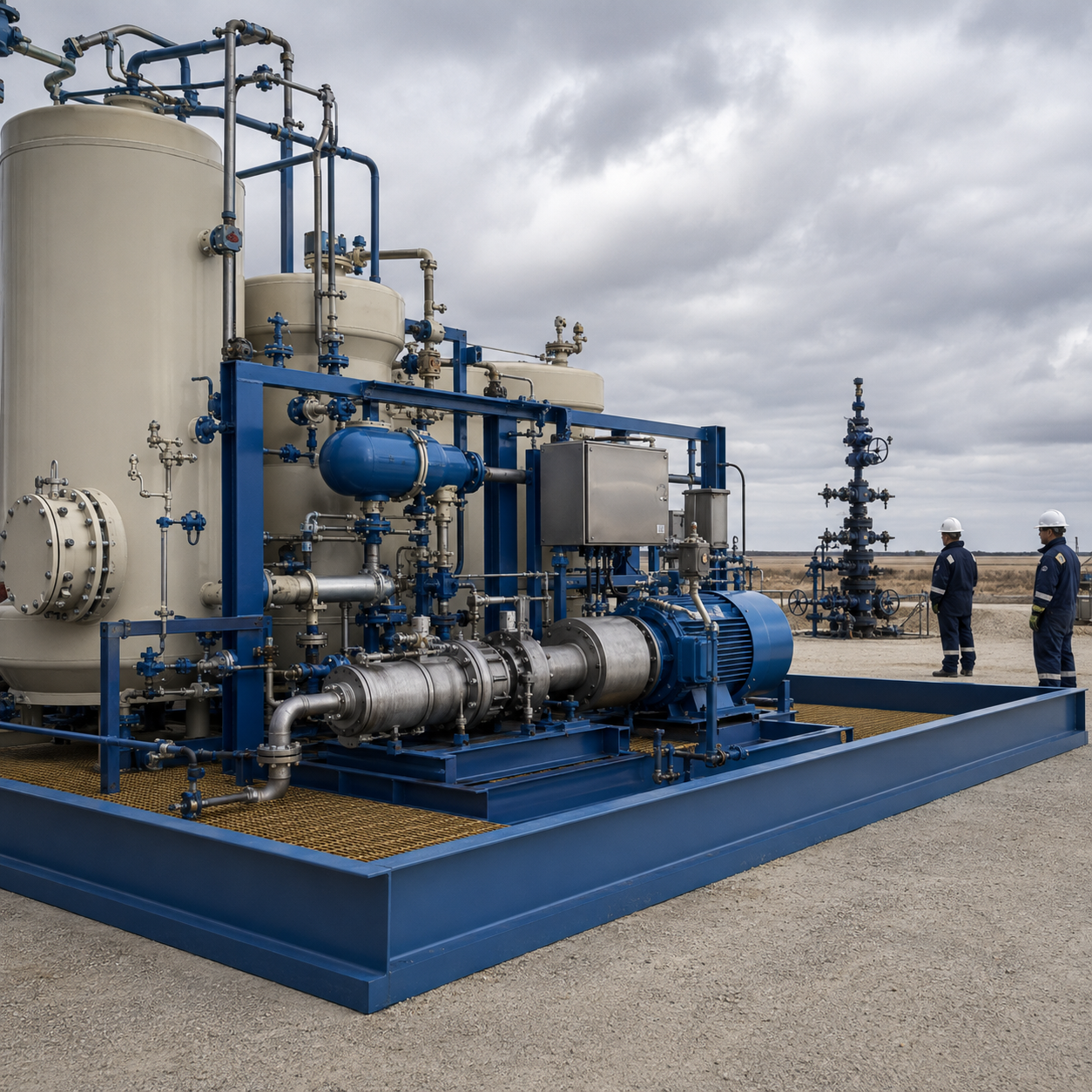
Hydrochloric acid is used in selected oil and gas well treatments to dissolve responsive carbonate minerals or remove certain drilling and completion residues. Treatment design depends on formation mineralogy, temperature, pressure, water chemistry, tubular metallurgy and the desired flow profile. Acid can also intensify corrosion, mobilize iron or react rapidly in the wrong zone. For that reason, procurement cannot be separated from laboratory compatibility work, licensed service-company design and well-control planning. This article discusses supply qualification and logistics only. It does not provide a treatment formula, pumping schedule or field procedure. Those details must remain with qualified petroleum engineers and authorized service personnel.
For B2B implementation, assign purchasing, production, quality, engineering and EHS ownership before the first delivery. Approve receiving tests, sampling tools, storage, transfer, deviation response and retained-sample period in writing. During qualification, compare several representative acid lots under the same conditions and record mass balance, product quality, waste load and equipment observations. This control plan helps separate raw-material variation from operating or analytical changes and provides objective evidence for buyer-supplier investigations. Review transport, package integrity and unloading because contamination can enter after the supplier’s final test. Define who can approve a deviation, which evidence is required before release and which changes trigger requalification. Review complaint response, shelf-life evidence, emergency contacts and delivery scheduling during approval. Purchasers should reconcile ordered, received, stored and consumed quantities; trend concentration and critical impurities by lot; audit transfer connections and sampling cleanliness; and review deviations jointly with operations before changing a specification. Supplier scorecards should include document accuracy, delivery condition, responsiveness and corrective-action quality, not price alone. A controlled alternate source should be qualified before a supply interruption. Training records, instrument calibration and laboratory uncertainty should be reviewed whenever buyer and supplier results disagree. Close each trial with an authorized report, updated specification, assigned actions and clear routine-monitoring decision.
Define the well-specific acid requirement
State commercial HCl concentration, total volume, delivery sequence and impurity limits from the approved treatment design. Confirm active acid after any dilution water or recovered-fluid contribution. Avoid substituting concentration or grade without management of change.
Characterize formation and completion materials
Use mineralogy, core or cuttings, formation water and metallurgy data to assess reactivity, scale, fines and corrosion risk. Validate additives as a complete fluid system at representative conditions rather than qualifying acid in isolation.
Control iron and compatibility
Measure iron in the supplied acid and evaluate iron released from tubulars or formation. The engineered package may require corrosion inhibition, iron control, diversion or other additives, but compatibility must be demonstrated under the service company’s program.
Verify water and additive sequence
Mix water can introduce hardness, sulfate, bacteria or suspended matter. Check water analysis, tank history and additive identity before blending. Use physical segregation and witnessed connection checks to prevent cross-loading.
Plan closed logistics at the wellsite
Confirm tanker access, secondary containment, transfer hose rating, vent management, communications and weather constraints. Keep the acid inventory traceable from supplier lot through staging, blend and recovered fluids.
Use OSHA context appropriately
The OSHA oil-and-gas well-completion guidance lists hydrochloric acid among acids used in stimulation fluids and emphasizes the broader chemical-additive system. Site hazard analysis and employer controls remain decisive.
Measure treatment outcomes and returns
Evaluate pressure response, injectivity or production alongside fluid returns, dissolved metals, solids and corrosion evidence. A successful pumping event is not enough if equipment damage or unmanaged waste follows.
Prepare flowback and waste routes before delivery
Characterize returned acid, chlorides, metals, hydrocarbons and treatment additives. Arrange containment, transport and permitted treatment before mobilization. Never assume neutralization alone resolves every waste constituent.
Apply industrial hygiene and emergency controls
Hydrogen chloride can affect eyes, skin and the respiratory system. Use closed blending and transfer, monitoring where required, suitable PPE, eyewash, drench facilities and trained response. Follow the SDS, NIOSH guidance and operator procedures.
Issue an oilfield-acid RFQ
Provide acid strength, critical impurities, volume, staging dates, delivery point, access limits, COA, SDS and transport requirements. Review the Hiacid hydrochloric acid overview and product specifications, then request availability and export documentation.
Related hydrochloric acid resources
- Hydrochloric Acid for Ion-Exchange Resin Regeneration
- Food-Grade Hydrochloric Acid for Gelatin Processing
- Hydrochloric Acid for Rare-Earth Leaching and Processing
Frequently asked questions
Is hydrochloric acid suitable for every formation?
No. Mineralogy, temperature, fluids, metallurgy and the treatment objective determine suitability.
Can the acid be evaluated without additives?
Supply quality can be tested, but field-fluid compatibility requires the complete approved additive system.
Why analyze returned fluids?
They may contain residual acid, salts, metals, solids, hydrocarbons and treatment additives requiring controlled handling.
Who defines the pumping program?
Qualified petroleum engineers and the authorized service company define and approve it.