
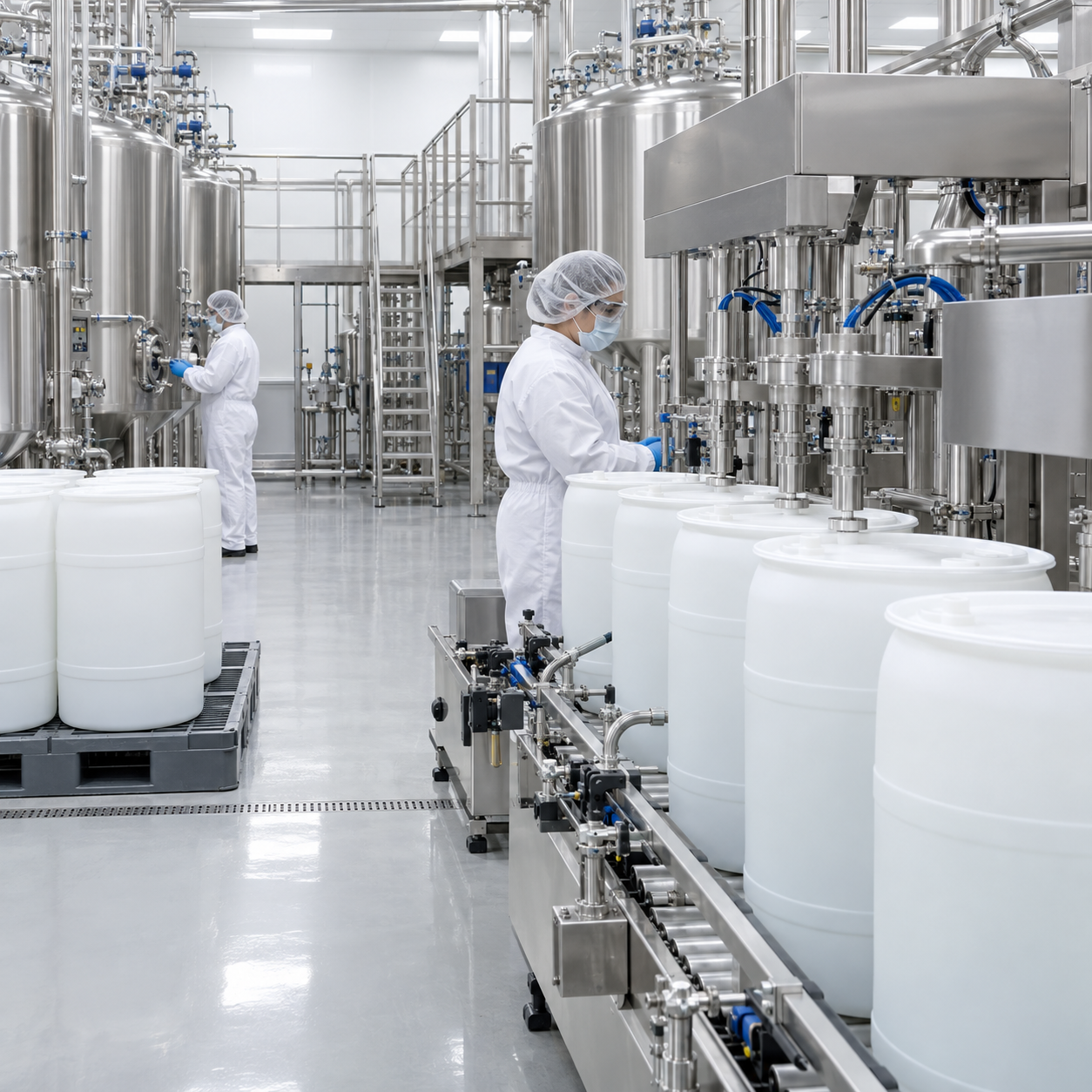
Hydrogen peroxide can appear in legally authorized food-processing or food-contact applications, but a raw-material purchase does not by itself authorize a sanitizer claim or a particular use. The finished formulation, intended application, residual limits, registration status, label and local rules determine compliance. For current US context, the FDA food-additive rule record for hydrogen peroxide documents specified permitted uses and regulatory changes. Other jurisdictions can differ substantially. This article is written for B2B formulators and food-plant procurement teams. It does not provide a use concentration or sanitation procedure. Buyers should work with regulatory counsel, qualified food-safety professionals and the current official rules for every destination market.
For dependable B2B implementation, assign purchasing, quality, engineering, operations and EHS responsibilities before the first shipment. Approve receiving tests, sample points, storage, transfer equipment, deviation response and retained-sample periods in writing. During qualification, compare several representative peroxide lots under controlled conditions and record process response, finished quality, waste load and equipment observations. This approach helps separate raw-material variation from operating or analytical changes and supports buyer-supplier investigations. Review packaging, venting, transport, seal integrity and unloading records with laboratory data because contamination can occur after the supplier’s final test. Define who may release a lot, what requires quarantine, what evidence resolves a dispute and which supplier changes trigger requalification. Include current COA and SDS review, emergency contacts, complaint handling, delivery continuity and document retention. Reconcile ordered, received, stored and consumed quantities; trend assay and critical impurities by lot; inspect vents and dedicated transfer connections; and review deviations jointly with operations. Hydrogen peroxide is a powerful oxidizer that can decompose to oxygen and heat, so clean compatible equipment and contamination control are core quality requirements. Close qualification with an authorized report, controlled specification, assigned follow-up actions and routine performance monitoring.
Define the exact legal use
Document whether the material will be used to manufacture a processing aid, antimicrobial formulation, packaging treatment or other regulated product. Identify the competent authority, applicable rule or registration, permitted substrate, conditions and residual requirements. Do not infer one authorization from another.
Separate raw material from finished-product approval
Confirm what evidence applies to hydrogen peroxide itself and what applies to the complete formulation. Claims, labels and directions must match the authorization for the sold product. Supplier literature cannot replace the formulator’s legal and validation responsibilities.
Set a food-appropriate specification
Define peroxide assay, stabilizers, trace metals, residue and any application-specific impurity limits with agreed analytical methods. Require a lot-specific COA, current SDS, origin and change notification. Review whether every intentionally added component is acceptable for the intended use.
Establish incoming release controls
Verify identity, seal, package condition and selected analytical attributes before production use. Retain samples and link each peroxide lot to formulation batches and customers. A documented quarantine process prevents unreviewed material from entering a regulated production campaign.
Validate the finished formulation
Demonstrate efficacy, compatibility, residues, rinsing where applicable, shelf life and package stability under the authorized conditions. Use recognized methods and representative surfaces or processes. Validation must include foreseeable variation in water quality, temperature, soil load and application equipment.
Control manufacturing hygiene
Use clean compatible closed equipment, validated cleaning and protected filling. Prevent contamination from metals, organic residue and previous products. Reconcile raw material, batch yield and packaged quantity, and investigate unexplained peroxide loss before release.
Manage labeling and customer documentation
Provide only approved claims and directions. Maintain specifications, batch records, COAs, safety information, complaint records and traceability. Customers need enough information to integrate the product into their HACCP, preventive-control or sanitation program without being encouraged to improvise.
Plan market-specific review
A product acceptable in one country or application may not be acceptable elsewhere. Review formula, label, import, transport, workplace and food-contact requirements for each destination before commercial supply. Keep evidence current as rules change.
Qualify raw-material continuity
Approve packaging, lead time, inventory controls and alternative supply through formal change control. Compare several lots for assay and formulation stability. Audit complaint handling and agree on retained-sample testing for disputes.
Request documentation before purchase
State the intended regulated application, approved specification, annual volume, package, destination and required records. Review the Hiacid hydrogen peroxide page and ask the export team for current COA, SDS and available quality information.
Related hydrogen peroxide resources
- Hydrogen Peroxide for UV Advanced Oxidation in Drinking Water
- Hydrogen Peroxide for Copper CMP Slurry Manufacturing
- Hydrogen Peroxide for Lithium Battery Black Mass Leaching
Frequently asked questions
Does buying food-grade peroxide authorize a sanitizer claim?
No. Finished-product authorization, intended use, conditions, label and jurisdiction determine whether a claim is legal.
Why are stabilizers part of the review?
Stabilizers affect peroxide shelf life and may have their own suitability requirements for the intended regulated application.
What records support traceability?
Keep supplier lot, COA, receiving release, formulation batch, packaging, finished test and customer distribution records.
Can one formulation be sold globally without additional review?
No. Food-contact, additive, biocide, labeling and import requirements vary by market.