
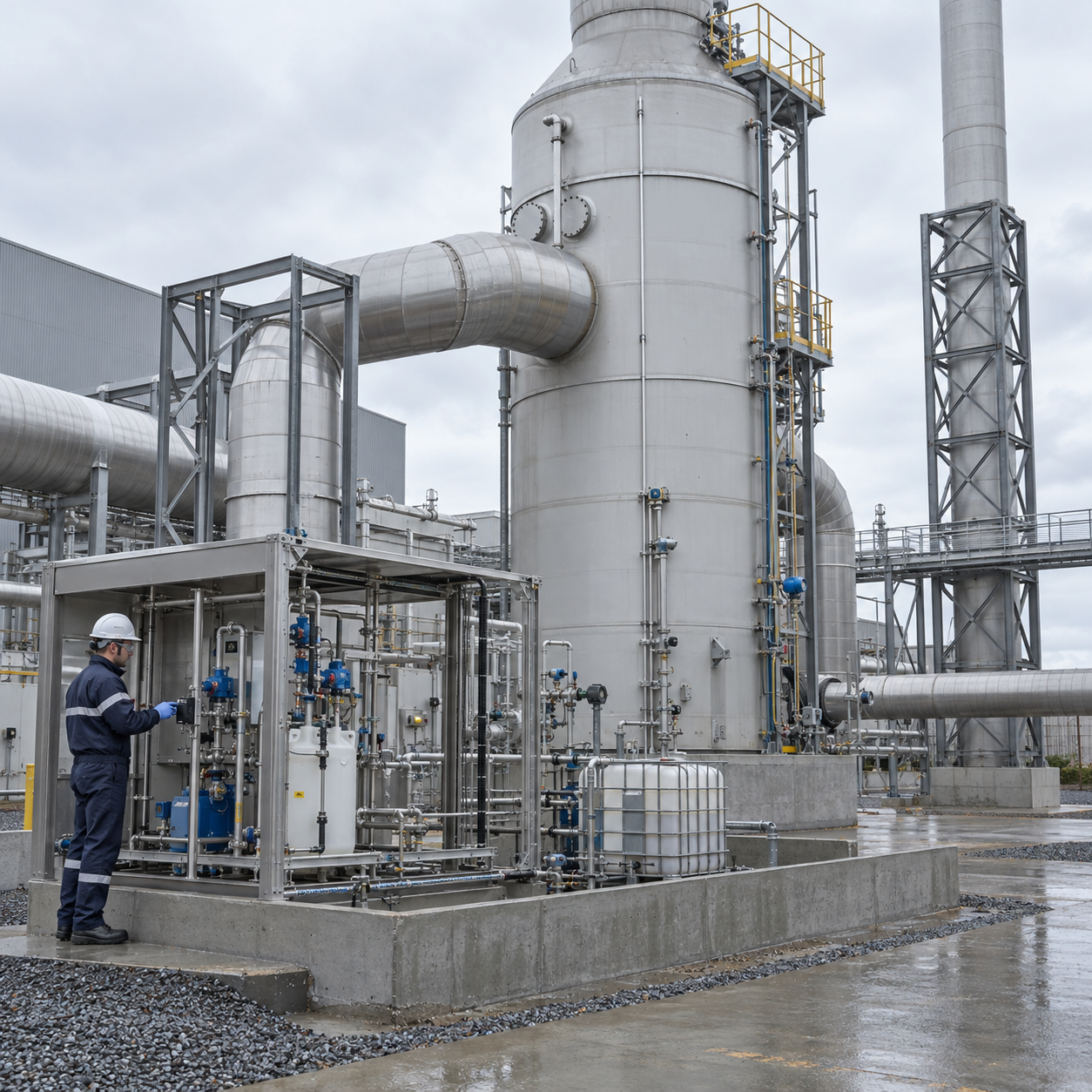
Nitric oxide is relatively difficult to capture in some wet systems, so oxidation to more soluble species has been studied as a pretreatment or integrated absorption step. Hydrogen peroxide has been evaluated in gas-phase injection and peroxide-containing scrubbing liquids. A pilot-scale chemical-engineering study reported enhanced NOx absorption in aqueous and nitric-acid solutions containing peroxide, while also showing that excess peroxide did not indefinitely increase the absorption rate. Real projects must account for flue-gas composition, temperature, particulate, sulfur species, materials, mass transfer and downstream liquid handling. This guide addresses feasibility testing and procurement, not an operating recipe. Emissions controls require qualified process design, permitting and formal hazard review.
For dependable B2B implementation, assign purchasing, quality, engineering, operations and EHS responsibilities before the first shipment. Approve receiving tests, sample points, storage, transfer equipment, deviation response and retained-sample periods in writing. During qualification, compare several representative peroxide lots under controlled conditions and record process response, finished quality, waste load and equipment observations. This approach helps separate raw-material variation from operating or analytical changes and supports buyer-supplier investigations. Review packaging, venting, transport, seal integrity and unloading records with laboratory data because contamination can occur after the supplier’s final test. Define who may release a lot, what requires quarantine, what evidence resolves a dispute and which supplier changes trigger requalification. Include current COA and SDS review, emergency contacts, complaint handling, delivery continuity and document retention. Reconcile ordered, received, stored and consumed quantities; trend assay and critical impurities by lot; inspect vents and dedicated transfer connections; and review deviations jointly with operations. Hydrogen peroxide is a powerful oxidizer that can decompose to oxygen and heat, so clean compatible equipment and contamination control are core quality requirements. Close qualification with an authorized report, controlled specification, assigned follow-up actions and routine performance monitoring.
Define the emissions problem accurately
Measure NO and NO2 separately along with oxygen, moisture, sulfur oxides, particulate, temperature, flow and variability across operating modes. Establish permit limits, averaging periods and measurement quality. A system designed from one stack snapshot is unlikely to remain controlled.
Map the complete treatment train
Document where oxidation, cooling, particulate removal, absorption and wastewater treatment occur. Evaluate how peroxide chemistry affects the scrubber reagent, corrosion, aerosol formation, byproducts and discharge. The best injection point is an engineering decision supported by testing.
Run controlled feasibility trials
Use a bounded pilot with calibrated gas analysis, peroxide flow verification, defined mass balance and stop criteria. Compare baseline and treated operation across representative load. Investigate selectivity and reagent utilization rather than reporting removal percentage alone.
Confirm analytical confidence
Check sampling lines, moisture handling, analyzer interference and calibration. Reconcile inlet and outlet results with liquid-phase nitrate or related products where appropriate. Independent checks reduce the risk of mistaking an analyzer artifact for chemical performance.
Engineer oxidizer storage and addition
Use dedicated compatible vented storage, containment, metering, isolation and backflow prevention. Locate equipment to prevent heat, contamination and exposure to incompatible materials. Interlock peroxide addition with the required gas flow, liquid circulation and monitoring signals.
Assess credible abnormal scenarios
Review loss of flow, blocked lines, overfeed, contamination, high temperature, scrubber upset and loss of utilities. Reaction calorimetry and materials data should inform safeguards. Operators need clear shutdown authority and an approved emergency response plan.
Evaluate materials and liquid management
Oxidizing acidic environments can be aggressive. Verify construction materials, linings, gaskets, pumps and instruments under expected and upset chemistry. Inspect corrosion and erosion during the pilot instead of assuming compatibility from nominal solution data.
Account for downstream residues
Characterize scrubber blowdown, nitrate or sulfate load, residual oxidant, metals and pH. Confirm treatment and discharge capacity before scale-up. A gas-removal improvement that transfers an unmanaged problem to water is not a complete solution.
Plan supply around verified demand
Convert validated reagent use into normal, peak and contingency demand. Specify assay, stabilizer and impurity limits, delivery mode, unloading controls and minimum inventory. Include seasonal and outage scenarios without exceeding approved storage residence time.
Request an emissions-project quotation
Provide the validated specification, forecast volume, package or bulk requirements, destination and documents. Review the Hiacid hydrogen peroxide product page, then contact the export team for supply and logistics information.
Related hydrogen peroxide resources
- Hydrogen Peroxide for UV Advanced Oxidation in Drinking Water
- Hydrogen Peroxide for Copper CMP Slurry Manufacturing
- Hydrogen Peroxide for Lithium Battery Black Mass Leaching
Frequently asked questions
Can peroxide dosage be selected from a published study?
No. Flue-gas composition, equipment, permit and downstream liquid system require project-specific testing and design.
Why analyze NO and NO2 separately?
Oxidation changes speciation, and capture behavior depends on which nitrogen oxides are present.
What should a feasibility trial measure?
Measure gas speciation, reagent use, removal, byproducts, corrosion, scrubber chemistry and wastewater impacts.
Is excess peroxide always beneficial?
No. Research shows diminishing benefit can occur, while excess raises cost, residual and safety concerns.