
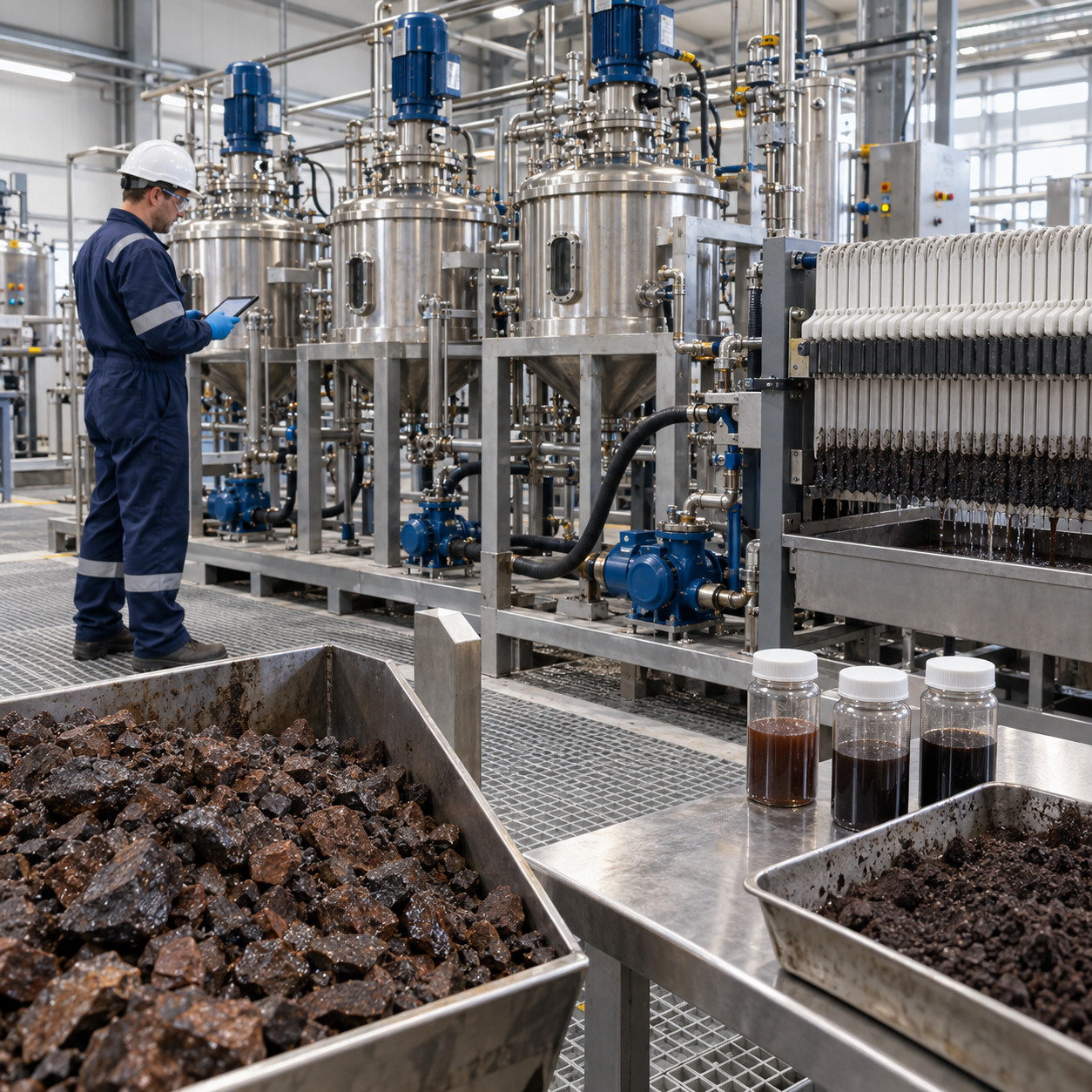
Manganese ores can contain carbonate and higher-valence oxide phases that do not respond identically to acid leaching. In some reductive systems, oxalic acid has been evaluated as a reducing reagent or co-reagent to help convert manganese dioxide phases into soluble divalent manganese. The result depends on mineralogy, particle size, gangue, oxidation state, acid system and precipitation behavior. Oxalate may also bind or precipitate metals, so dissolution and recovery cannot be judged from pH or total acid addition alone. A scale-up program needs mineralogical characterization, redox and carbon balances, impurity mapping, filtration tests and a credible reagent-supply plan.
Industrial qualification should assign responsibilities across purchasing, quality, engineering, operations, logistics and EHS before material is introduced. Approve the oxalic acid hydration state, assay basis, analytical methods, sampling point, retained-sample period, storage conditions, transfer or dissolution equipment, release authority and deviation response. Compare multiple representative lots under controlled conditions and record material balance, process performance, equipment observations, waste and final product quality. This separates reagent variation from changes in water, feedstock, equipment, operator or test method. Review the chain from supplier release through package, carrier, warehouse and day hopper because contamination, moisture exchange or misidentification can occur after manufacture. Reconcile ordered, received, stored and consumed quantities and investigate unexplained differences. Supplier scorecards should include documentation accuracy, delivery condition, corrective-action quality and change notification as well as price. Qualify a contingency source before a disruption using the same methods and process criteria. When buyer and supplier results differ, review sample representativeness, moisture basis, calibration, detection limits and uncertainty before disposition. Confirm emergency contacts, unloading or bag-opening hours and stop-work authority. Include warehouse and maintenance teams in the post-trial review because they often identify dust, seal, vent or handling issues not visible on a certificate of analysis. Close qualification with an authorized report, approved-supplier status and routine monitoring. The NIH PubChem record for oxalic acid provides identity and broad hazard context; the current SDS, local law and site procedures remain controlling.
Characterize manganese phases and gangue
Use quantitative mineralogy and chemical assays to separate manganese carbonate, dioxide and mixed-valence phases. Measure iron, calcium, magnesium, silica, aluminum and trace metals by size fraction.
Link mineral liberation with reagent demand
Coarse locked particles can appear unreactive, while excessive fines increase filtration difficulty and gangue dissolution. Establish a comminution target using recovery and downstream separation, not leaching alone.
Define the redox and acid roles
State whether oxalic acid is being tested as reductant, ligand, acid source or combined reagent. Close electron, carbon and manganese balances and monitor gas evolution in appropriate contained equipment.
Use research as a starting point
A hydrometallurgical manganese-ore study reviews reductive leaching routes that include oxalic acid, and a review of electrolytic manganese residue describes oxalic-acid-assisted leaching. Site-specific evidence remains essential.
Map co-dissolution and precipitation
Analyze manganese, iron, aluminum, calcium, magnesium and trace elements in both liquor and residue. Model and test metal-oxalate precipitation because low dissolved concentration can mean poor leaching or immediate precipitation.
Evaluate the complete recovery flowsheet
Test clarification, filtration, washing, purification and final manganese-product quality. A high extraction number is not valuable if impurity removal or oxalate management becomes impractical.
Scale with pressure, gas and heat safeguards
Measure reaction heat and potential carbon dioxide generation under normal and upset conditions. Review feed rate, agitation, cooling, vent treatment, relief and loss-of-flow scenarios with qualified engineers.
Plan residue and water treatment
Classify washed solids, quantify retained manganese and oxalate, and assess recycle-water buildup. Include reagent carried into purification and waste treatment in the economic model.
Qualify oxalic acid for metallurgical trials
Specify hydration state, assay, insolubles, residue and metals relevant to the product circuit. Require lot-specific COA results, retained samples and change notification.
Prepare a manganese inquiry
Provide grade, package, trial quantity, destination, schedule and quality requirements. Review the Hiacid oxalic acid product page, then request a staged pilot-supply proposal.
Related oxalic acid resources
- Oxalic Acid for Phosphogypsum Purification
- Oxalic Acid as an Ilmenite Flotation Depressant
- Oxalic Acid for Zeolite Dealumination
Frequently asked questions
Can oxalic acid leach every manganese ore effectively?
No. Manganese oxidation state, mineral association, liberation and gangue chemistry strongly affect performance.
Why can low dissolved metal be misleading?
It may reflect weak dissolution or rapid formation of insoluble metal oxalates; solids and liquids must both be analyzed.
What safety data are important before scale-up?
Reaction heat, gas generation, feed-rate sensitivity, agitation, cooling, relief and off-gas treatment should be evaluated.
Why specify oxalic acid hydration state?
It changes active acid per unit mass and affects reagent, water and energy balances.