
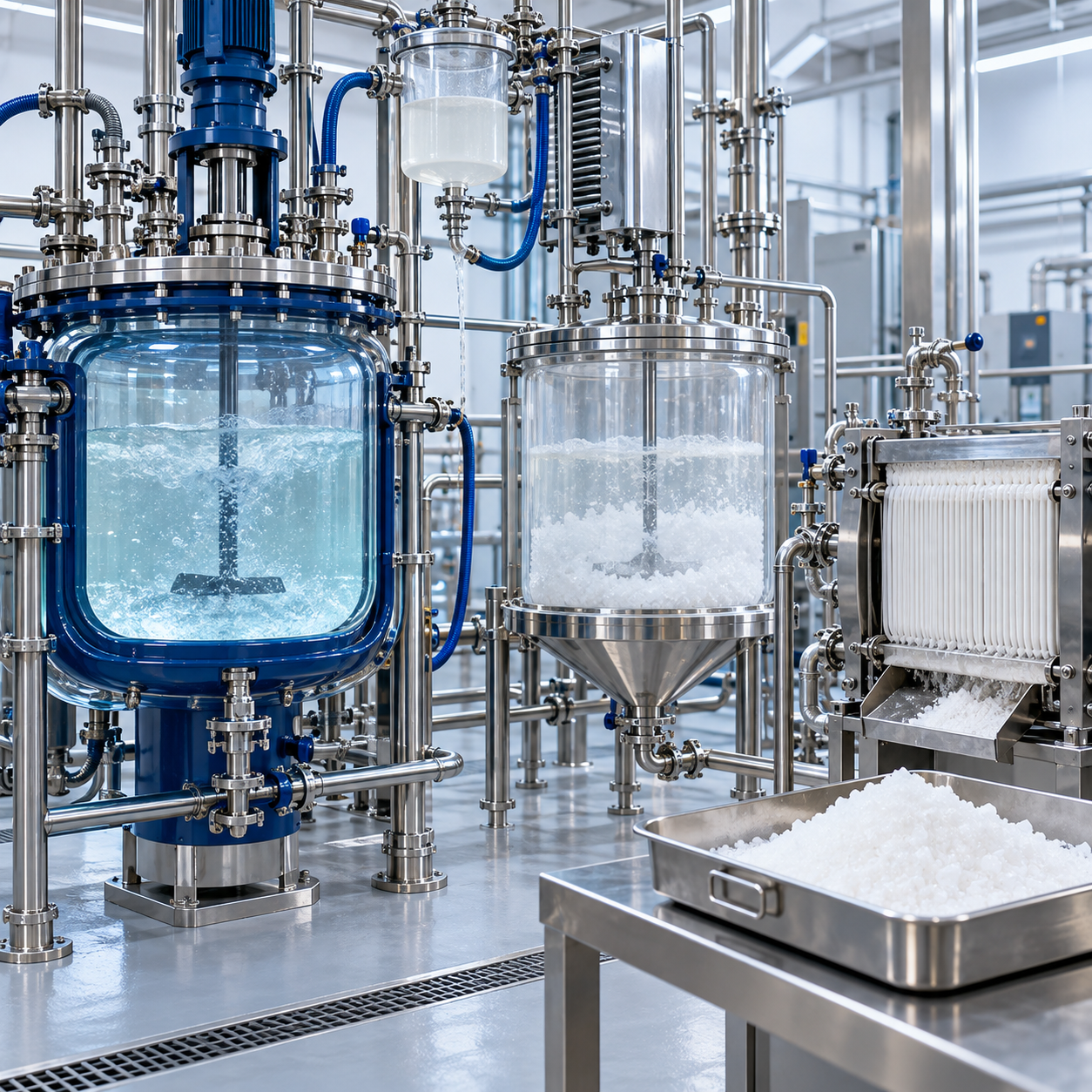
Thiourea dioxide is manufactured by controlled oxidation of thiourea and is used as a reducing agent in textile, paper, mineral and specialty applications. Product yield and quality depend on raw-material purity, temperature history, peroxide addition, mixing, pH, crystallization, washing and drying. Excess oxidation can create sulfate and other quality losses, while inadequate control can leave unreacted feed or unstable material. Hydrogen peroxide procurement must therefore connect incoming feed data to crystal assay, by-products, particle behavior and storage stability. This guide focuses on B2B qualification and quality governance, not a reaction recipe.
An East China University of Science and Technology study reports batch synthesis of thiourea dioxide from thiourea and hydrogen peroxide and discusses variables affecting deeper oxidation. Its conditions require independent plant validation.
Industrial hydrogen peroxide qualification should assign purchasing, quality, engineering, operations, logistics and EHS ownership before the first delivery. Approve concentration, stabilizer package, analytical methods, sampling, storage, compatible transfer equipment, deviation response and release authority in writing. Compare representative lots under controlled conditions and record process performance, mass balance, gas evolution, waste, equipment observations and final product quality. This separates raw-material variation from changes in feedstock, water, equipment, operator or method. Review the chain from supplier release through carrier, package, receiving connection and day tank because contamination or decomposition can occur after final analysis. Reconcile ordered, received, stored and consumed quantities and investigate unexplained differences. Supplier scorecards should cover documentation accuracy, delivery condition, corrective-action quality and change notification as well as price. Qualify a contingency source using the same methods before a disruption. When buyer and supplier results differ, review sample representativeness, temperature, standards, calibration, detection limits and uncertainty before disposition. Confirm emergency contacts, unloading hours and stop-work authority for every shipment. Hydrogen peroxide is a strong oxidizer that can decompose exothermically and release oxygen; use the current SDS, dedicated compatible equipment, contamination control, ventilation, pressure relief, containment and an approved emergency plan. The NIOSH Pocket Guide entry and NIH PubChem record provide general hazard and identity context, while local law and site procedures remain controlling. Close qualification with an authorized report, approved-supplier status and a routine-monitoring plan.
Define the thiourea dioxide specification
Set active content, thiourea, sulfate, moisture, ash, particle size, bulk density, color, solubility and storage-stability criteria appropriate to the intended customer process. Include validated methods and release uncertainty.
Link specification to end-use testing
Evaluate reducing performance in representative textile, paper or specialty systems rather than relying only on chemical assay. Record dissolution, working-life, residue and effect on the customer substrate.
Characterize both reactive feeds
Measure thiourea assay, moisture, ash and relevant impurities alongside peroxide concentration, acidity, stabilizers, metals and nonvolatile residue. Lot variation in either feed can change oxidation and crystallization.
Use traceable pilot genealogy
Record raw-material lots, water, order of addition, temperature profile, sampling, filtration, washing and drying. Retain matched peroxide, thiourea and final-product samples for deviation investigations.
Control oxidation and heat release
Use reaction calorimetry and scale-appropriate mixing to define safe controlled addition and cooling. Monitor temperature, residual peroxide and reaction progress with preapproved stop and alarm criteria.
Prevent local over-oxidation
Confirm feed distribution, agitation and heat removal at each scale. Local excess peroxide or poor cooling can promote by-products even when the batch-average analysis appears acceptable.
Validate crystallization and drying
Trend nucleation, crystal habit, filtration rate, wash efficiency and product loss. Define wash endpoints using sulfate, conductivity or another justified measure instead of a fixed number of washes.
Protect product during drying and packaging
Control temperature, residence time and moisture to avoid degradation, caking or inconsistent dissolution. Verify package barrier, closure, storage conditions and shelf-life with commercial material.
Approve suppliers through replicated batches
Compare multiple peroxide lots under controlled conditions and review yield, active content, sulfate, filtration, particle size and storage. Require COA, SDS, retained samples, corrective-action support and change notice.
Prepare a thiourea dioxide inquiry
Provide peroxide concentration, stabilizer and metals limits, package, batch demand, annual forecast and destination. Review the Hiacid hydrogen peroxide page, then request a documented industrial quotation.
Related hydrogen peroxide resources
- Hydrogen Peroxide for Chlorine Dioxide Generation
- Hydrogen Peroxide for Cyclohexanone Ammoximation
- Hydrogen Peroxide for Calcium Peroxide Manufacturing
Frequently asked questions
Why monitor sulfate in thiourea dioxide?
It can indicate deeper oxidation and can affect active content, purity and customer performance.
Why does peroxide stabilizer chemistry matter?
The stabilizer package may influence reaction behavior, residue and crystallization and should be qualified with the complete process.
Is chemical assay enough for final release?
No. Particle, moisture, solubility, stability and end-use reducing performance may also be important.
Does this article provide a manufacturing formulation?
No. It provides a commercial qualification framework and intentionally omits reaction conditions.