
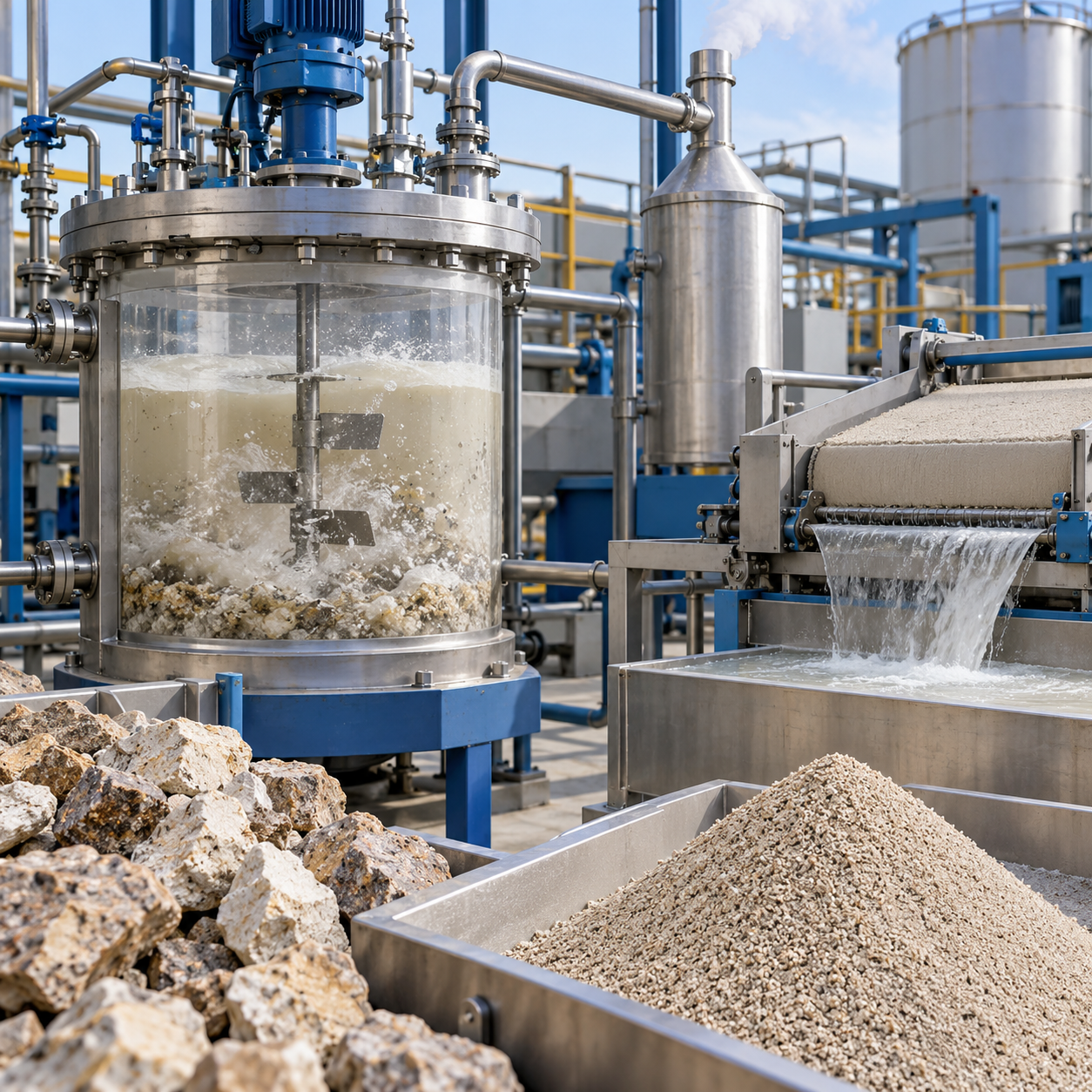
Carbonate-rich phosphate rock and mine waste can require beneficiation before fertilizer or phosphoric-acid processing. Acetic acid has been studied as a selective leachant for calcite and dolomite, leaving a phosphate-enriched solid while placing calcium and magnesium into solution. Results depend on mineralogy, liberation, particle size, acid strength, solids loading, gas evolution, washing and acid recovery. A higher phosphate grade alone does not prove value if phosphorus loss, reagent consumption or liquid-waste load is excessive. This article presents a procurement and pilot-qualification framework rather than leaching conditions.
For industrial qualification, assign purchasing, quality, engineering, operations, logistics and EHS ownership before the first commercial delivery. Approve glacial acetic acid assay, impurity limits, analytical methods, sampling, storage, dilution or dosing equipment, deviation response and release authority in writing. Compare representative lots under controlled conditions and record process performance, mass balance, waste, equipment observations and final product quality. This separates raw-material variation from changes in water, feedstock, equipment, operator or laboratory method.
Review the chain from supplier release through carrier, package, receiving connection and point of use because contamination or dilution can occur after final analysis. Reconcile ordered, received, stored and consumed quantities and investigate unexplained differences. Supplier scorecards should cover documentation accuracy, delivery condition, corrective-action quality and change notification as well as price. Qualify a contingency source before disruption using the same methods and process criteria. When buyer and supplier results differ, review sample representativeness, temperature, standards, calibration, detection limits and uncertainty before disposition.
Glacial acetic acid is corrosive, combustible and has a pungent vapor. Its freezing point is near ordinary cool-weather conditions, so crystallization can disrupt delivery or measurement if not controlled. Use the current SDS, compatible materials, ventilation, ignition control, secondary containment and an approved emergency plan. The OSHA acetic acid data page and NIH PubChem record provide general identity and hazard context; local law, site procedures and the process hazard review remain controlling. Confirm emergency contacts, unloading hours and stop-work authority for every shipment.
Use published evidence as context
A 2026 Sustainability study examines selective carbonate leaching from phosphate mining waste with acetic acid and downstream calcium recovery. Its ore and experimental conditions are site-specific.
Translate research into site qualification
Define feed, equipment, analytical methods, acceptance criteria and stop conditions before trials. Scale only after replicated data, a reviewed hazard assessment and documented product and waste routes support the decision. Close qualification with an authorized report, approved-supplier status and a routine monitoring plan.
Build a representative mineralogical model
Measure phosphate minerals, calcite, dolomite, silica, clay, iron phases, trace elements, particle size and liberation. Use composites that reflect mine plan and stockpile variability.
Define concentrate and loss limits
Set targets for phosphate grade, recovery, MgO, CaO, silica, contaminants, filtration and moisture. Report both enrichment and phosphorus loss across every wash and residue stream.
Measure acid efficiency and gas behavior
Track acid delivered, residual acidity, dissolved calcium and magnesium, carbon dioxide evolution and temperature. Compare productive carbonate dissolution with unproductive acid consumption.
Control foaming and venting
Carbonate reaction can release gas and entrain droplets or solids. Use closed compatible equipment, freeboard, ventilation, demisting and pressure protection under a reviewed hazard basis.
Specify acid for mineral processing
Define assay, water, formic acid, metals and nonvolatile residue using agreed methods. Verify delivered concentration and introduced water so reagent comparisons use actual acid equivalents.
Maintain full test genealogy
Link ore composite, grind, acid lot, water, reactor, dosing history, samples and analyses. Use duplicates and reconciliation limits before claiming a process improvement.
Close phosphorus calcium and water balances
Analyze feed, beneficiated solid, filtrate, wash, precipitates and purge. Confirm liquid volume and moisture corrections. Characterize residues and any recovered calcium product.
Evaluate acid recycle realistically
Test regenerated or recycled acid over multiple loops and monitor water, salts, organics and metals. Define purge and makeup requirements instead of assuming full recycle.
Stage supply with pilot maturity
Start with traceable trial containers and move to pilot or bulk delivery only after replicated recovery, acid efficiency, filtration and safe operation. Require COA, SDS and change notification.
Prepare a beneficiation inquiry
Provide acid concentration, impurity limits, package, trial volume, schedule and destination. Review the Hiacid glacial acetic acid page, then request a mining-project quotation.
Related glacial acetic acid resources
- Glacial Acetic Acid for Hemodialysis Acid Concentrates
- Glacial Acetic Acid for CFRP Recycling Trials
- Glacial Acetic Acid for Blast Furnace Slag Recovery
Frequently asked questions
Why can acetic acid enrich phosphate ore?
It may selectively dissolve carbonate gangue such as calcite and dolomite while leaving more phosphate in the solid.
Is phosphate grade the only success measure?
No. Phosphate recovery, acid use, impurity rejection, filtration, water and residues also matter.
Why does ore mineralogy control performance?
Carbonate type, liberation, clays and reactive impurities determine acid demand and selectivity.
Can acid recycle be assumed from one test?
No. Multiple loops are needed to measure water, salt and impurity accumulation and define purge needs.