
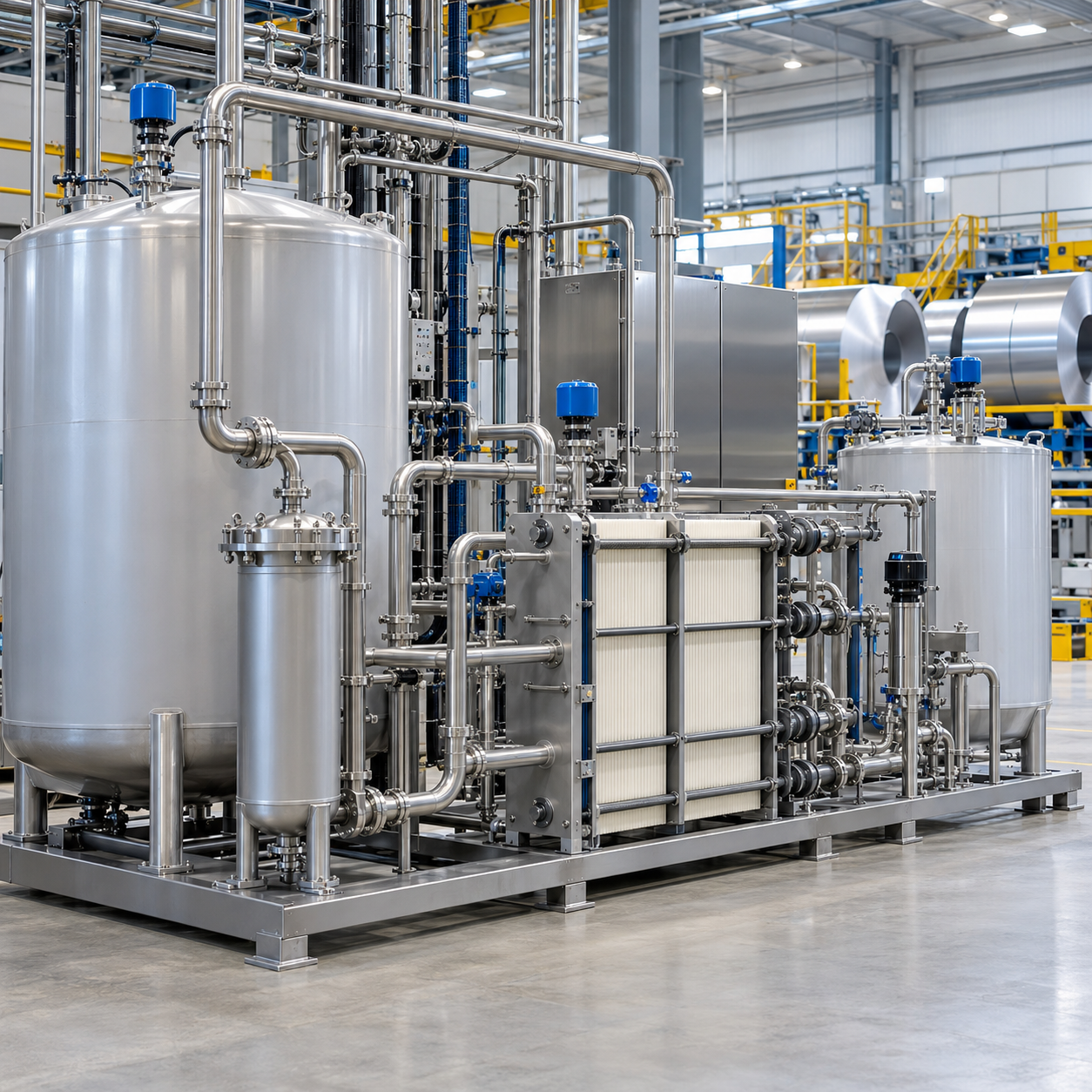
Stainless-steel pickling liquors lose effectiveness as dissolved iron, chromium and nickel accumulate, even when useful nitric acid remains. Diffusion dialysis and related membrane systems can recover an acid-rich stream for return to pickling while producing a metal-rich reject for treatment. The practical result depends on the mixed-acid composition, suspended solids, membrane selectivity, water balance and the receiving bath’s tolerance for metals. A successful project must therefore establish a stable feed window, reliable pretreatment, recovered-acid quality, makeup rules and a treatment route for the remaining nitrate and metals.
For B2B implementation, assign owners in process engineering or laboratory management, quality, purchasing and EHS before the first delivery. Approve receiving tests, sampling tools, storage, dosing or analytical basis, deviation response and retained-sample period in writing. Compare representative nitric acid lots under identical conditions and record mass balance or analytical recovery, product quality, waste load, emissions and equipment observations. Define who may approve a temporary deviation and what evidence is required before release. Review transportation, package integrity, unloading, ventilation and emergency response alongside the supplier’s laboratory results. Close each qualification with a written conclusion, an updated material specification and defined requalification triggers. Procurement should confirm lead time, minimum order, container loading, port documentation and contingency stock. Quality teams should trend incoming results instead of recording only pass or fail, while users record actual consumption and performance. Before scale-up or routine adoption, repeat the trial at expected load, residence time and recycle ratio. Sample startup, stable operation and shutdown because transient conditions can reveal corrosion, impurity or filtration problems. Document calibration, detection limits and calculation formulas so results can be reproduced. Include raw material, utilities, labor, maintenance, emissions control, waste treatment and inventory in the economic review. This disciplined approach separates acid-lot variation from feed, equipment, matrix or operating changes and supports faster buyer-supplier investigations. Confirm unloading connections, storage capacity and segregation from incompatible materials through a documented site review. Train operators on the current safety data sheet, exposure controls, first response and notification routes. Audit scales, flowmeters or pipettes used to dose acid, because concentration control cannot compensate for inaccurate addition. Review results jointly with the supplier before approving a long-term specification, and keep the agreed test methods attached to the purchase contract. Where recycled process liquor is involved, distinguish fresh-acid consumption from total circulating inventory. Schedule periodic requalification after equipment, packaging, raw-material source or process changes. These additional controls make performance evidence transferable from development into routine purchasing and production.
Profile spent liquor across production
Measure free nitric acid, any hydrofluoric or sulfuric acid, iron, chromium, nickel, suspended solids, temperature and density over complete campaigns. Record steel grade and bath age.
Set recovered-acid acceptance limits
Define acid strength, metal carryover, water dilution and flow required by the pickling line. Link those limits to surface finish, pickling rate and bath-control tests rather than membrane output alone.
Use operating evidence as a starting point
A published industrial report on diffusion dialysis describes recovery and reuse of nitric-acid-containing stainless pickling liquor. Modern equipment still requires site-specific trials.
Pilot feed conditioning and membranes
Test cooling, settling, filtration and membrane area with representative liquor. Track acid recovery, metal rejection, water transfer, pressure drop and fouling over extended operation and cleaning cycles.
Integrate recovery with bath control
Create rules for recovered acid, virgin acid and water addition based on analytical results. Trial the return stream through several bath turnovers while monitoring pickling rate, surface condition and dissolved-metal accumulation.
Close nitrate, acid and metal balances
Reconcile incoming acid, recovered stream, dialysate, rinses, scrubber liquor and treatment sludge. Include entrainment and sampling so claimed savings are not offset by increased wastewater volume.
Design for mixed-acid hazards
Select membrane, piping, pumps, tanks and instruments for actual acid and metal concentrations. Provide secondary containment, ventilation, leak detection and controlled maintenance.
Keep the reject treatment in scope
The metal-rich stream still contains nitrate and acid. Characterize neutralization, metal precipitation, sludge dewatering and discharge requirements before calculating payback.
Specify reliable makeup nitric acid
Recovered acid does not eliminate fresh makeup. Define concentration, chloride, metals and residue, then align delivery size and inventory with normal recovery, startup and outage scenarios.
Prepare an acid-recovery supply plan
Share concentration, consumption, package, destination and recovery assumptions. Review the Hiacid nitric acid page, then request a resilient makeup-acid proposal.
Related nitric acid resources
- Nitric Acid for Rare Earth Recovery from CRT Phosphors
- Nitric Acid for Scandium Recovery from Red Mud
- Nitric Acid for Indium Recovery from Waste LCD Glass
Frequently asked questions
Does diffusion dialysis remove every dissolved metal?
No. Rejection depends on membrane, speciation and operating conditions, so recovered acid needs routine analysis.
Can recovered acid replace all virgin nitric acid?
Usually not. Makeup is required for process losses, dilution, startup and recovery downtime.
Why run a long pilot instead of a short membrane test?
Fouling, cleaning, water transfer and bath accumulation appear over repeated operation.
What belongs in the project mass balance?
Include virgin acid, recovered acid, dialysate, rinses, scrubber liquor, sludge, water and dissolved metals.