
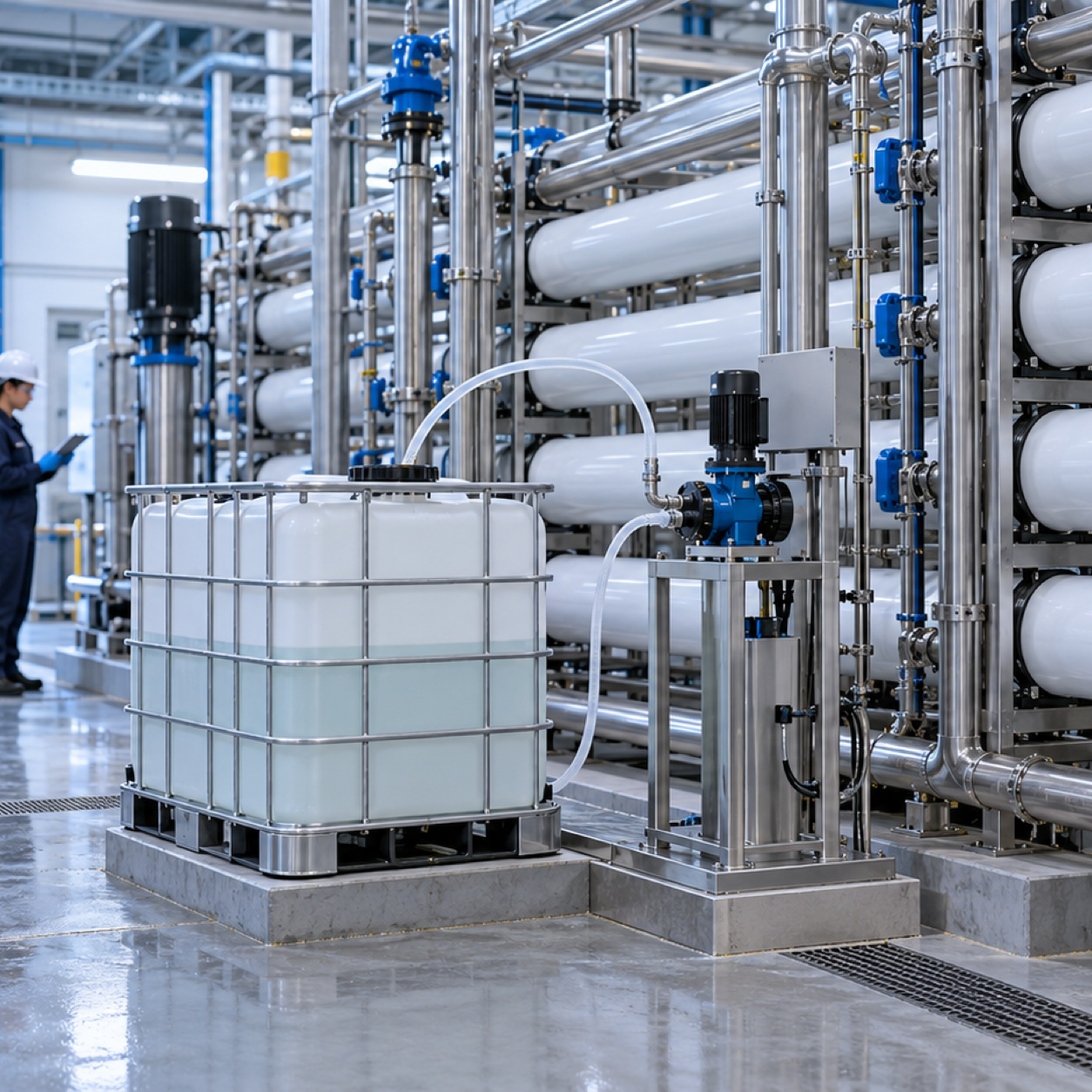
Reverse osmosis and nanofiltration plants may use hydrogen peroxide in a validated sanitization program when biological contamination threatens normalized flow, salt rejection or product-water quality. The oxidant cannot be treated as a universal cleaner. Membrane chemistry, temperature, pH, contact time, deposits, dissolved metals and equipment materials all influence compatibility. A shipment that meets nominal assay can still change performance through stabilizers, trace metals or nonvolatile residue. Industrial buyers should therefore link peroxide specifications to the membrane supplier’s limits, the site’s cleaning sequence and evidence from representative modules. This guide focuses on procurement, validation and supplier governance rather than prescribing a cleaning recipe.
A DuPont FilmTec technical manual describes hydrogen peroxide sanitization for compatible RO and NF membranes and emphasizes temperature, iron removal and periodic rather than continuous exposure. The membrane manufacturer’s current instructions remain controlling.
Industrial hydrogen peroxide qualification should assign purchasing, quality, engineering, operations, logistics and EHS ownership before the first delivery. Approve concentration, stabilizer package, analytical methods, sampling, storage, compatible transfer equipment, deviation response and release authority in writing. Compare representative lots under controlled conditions and record process performance, mass balance, gas evolution, waste, equipment observations and final product quality. This separates raw-material variation from changes in feedstock, water, equipment, operator or method. Review the chain from supplier release through carrier, package, receiving connection and day tank because contamination or decomposition can occur after final analysis. Reconcile ordered, received, stored and consumed quantities and investigate unexplained differences. Supplier scorecards should cover documentation accuracy, delivery condition, corrective-action quality and change notification as well as price. Qualify a contingency source using the same methods before a disruption. When buyer and supplier results differ, review sample representativeness, temperature, standards, calibration, detection limits and uncertainty before disposition. Confirm emergency contacts, unloading hours and stop-work authority for every shipment. Hydrogen peroxide is a strong oxidizer that can decompose exothermically and release oxygen; use the current SDS, dedicated compatible equipment, contamination control, ventilation, pressure relief, containment and an approved emergency plan. The NIOSH Pocket Guide entry and NIH PubChem record provide general hazard and identity context, while local law and site procedures remain controlling. Procurement documents should also define shelf life, minimum remaining life at delivery, storage-temperature expectations, seal condition and rejection criteria. Delivery planning should consider seasonal temperature, transit time, customs delay and unloading capacity. Train receiving personnel to compare the shipment, seal and documentation with the purchase order before connection. Close qualification with an authorized report, approved-supplier status and a routine-monitoring plan.
Start with the membrane supplier envelope
Record membrane model, polymer, element age, pressure-vessel materials and the manufacturer’s approved oxidant limits. Define whether the objective is sanitization after cleaning, preservation, recovery from a biological event or routine hygiene.
Separate cleaning from sanitization
Mineral scale, organic deposits and biofilm mass may shield microorganisms or consume oxidant. Validate the required cleaning and rinsing steps before peroxide exposure so the sanitant is not asked to remove an unidentified foulant.
Qualify peroxide beyond concentration
Specify assay, acidity, stabilizer system, iron and other transition metals, nonvolatile residue and appearance with agreed methods. Review how the selected package affects water contribution and rinse demand.
Control iron and catalytic contamination
Iron, copper, rust and incompatible residues can accelerate decomposition and intensify membrane attack. Audit the receiving connection, storage tank, pumps, valves and transfer hose as part of raw-material approval.
Validate the complete sanitization sequence
Use representative elements or an approved pilot to evaluate normalized permeate flow, salt passage, pressure drop, microbiological indicators and rinse endpoint before and after repeated cycles.
Track cumulative exposure
Record concentration, temperature, pH, contact time and cycle count for each sanitization. A single acceptable cycle does not establish compatibility across the expected membrane life.
Design safe controlled dosing
Use dedicated compatible storage, metering, ventilation, pressure relief and backflow prevention. Isolate peroxide from reducing agents, organics, alkali, rust and incompatible cleaners.
Define release and restart criteria
Require acceptable peroxide residual, rinse quality, conductivity, microbiological status and normalized membrane performance before returning the train to service. Investigate unusual heat, bubbles, odor or pressure immediately.
Build a documented supply program
Require COA, SDS, lot genealogy, retained samples and advance notice of manufacturing-site, concentration, stabilizer, analytical-method or packaging changes. Revalidate critical changes against the approved sequence.
Prepare an RO membrane inquiry
Provide required concentration, impurity and stabilizer limits, package, annual demand, destination and membrane supplier constraints. Review the Hiacid hydrogen peroxide product page, then request a documented quotation.
Related hydrogen peroxide resources
- Hydrogen Peroxide for Ion Exchange Resin Sterilization
- Hydrogen Peroxide for Biogas Hydrogen Sulfide Scrubbing
- Hydrogen Peroxide for Activated Sludge Bulking Control
Frequently asked questions
Can hydrogen peroxide clean every RO membrane?
No. Compatibility depends on the specific membrane, operating history and the membrane manufacturer’s current limits.
Why does iron matter during sanitization?
Transition metals can catalyze peroxide decomposition and may increase oxidative damage to the membrane.
Should peroxide be dosed continuously?
Only when the system and membrane supplier explicitly validate that mode; many programs use controlled periodic exposure.
Is peroxide assay alone enough for purchasing?
No. Stabilizers, metals, residue, package cleanliness and delivery controls should also be qualified.