
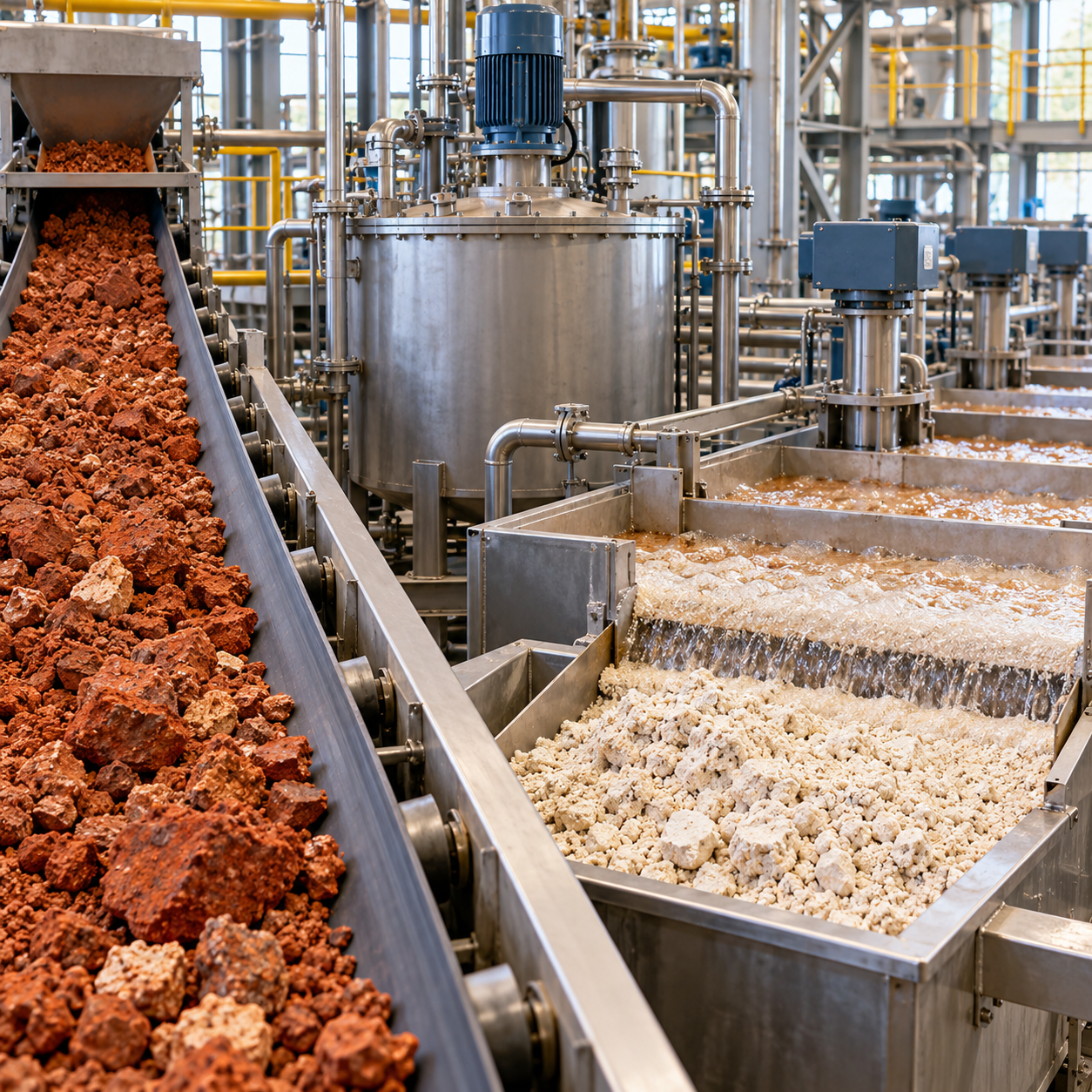
Low-grade diasporic bauxite contains alumina minerals mixed with kaolinite, quartz, iron oxides and other gangue. Flotation selectivity depends on mineral liberation, surface chemistry, water ions and collector adsorption. Research has shown that oxalic acid surface pretreatment can change aluminum-oxygen sites and improve the separation response of selected bauxite. That result should be treated as ore-specific. A mine or refinery must reproduce it with representative feed, determine whether alumina recovery gains survive water recycle and confirm that acid consumption, corrosion, effluent and downstream digestion remain acceptable.
a peer-reviewed Applied Surface Science study provides the application evidence used to frame this qualification guide. Published conditions are specific to the studied feed and equipment and must not be treated as guaranteed plant performance.
For industrial qualification, assign named owners in process engineering, metallurgy, quality, purchasing, production and EHS. Approve the sampling plan, oxalic acid specification, solution-preparation method, dosing basis, retained-sample period and deviation response before the first plant trial. Compare representative reagent lots under identical operating conditions and record mass balance, concentrate or product quality, waste load, utilities and equipment observations. Review packaging, storage humidity, unloading, dust control and solution concentration alongside supplier laboratory data. Define who may change a dose or trial boundary and what evidence is required before scale-up. Where buyer and supplier results differ, compare sampling point, moisture basis, analytical method, calibration, detection limit and uncertainty before disposition. Oxalic acid is corrosive and harmful if swallowed or inhaled as dust; current SDS information, local regulations and site procedures remain controlling. Use enclosed charging where practical, compatible equipment, local exhaust, approved PPE and secondary containment. Confirm emergency isolation, eyewash and shower access, spill response and worker training before commissioning. Inspect bags, pallets and seals on receipt and quarantine wet, damaged or unidentified material. Verify solution strength before dosing and reconcile delivered, stored, dissolved and consumed mass. Record water quality, ambient conditions and operator changes that could confound a trial. Close every trial with an authorized report, updated specification, routine monitoring plan and requalification triggers. A promising extraction or flotation result does not by itself establish commercial suitability: product purity, reagent consumption, water recycle, residues, emissions, corrosion, energy and economics must be considered together. Supplier scorecards should include COA trends, delivery condition, change notification and corrective-action quality as well as price. Validate contingency supply before a disruption using the same ore, residue or catalyst and the same acceptance criteria. These controls turn laboratory research into an auditable development package and help buyers compare technical offers on a consistent basis.
Establish mineralogy and liberation
Measure available alumina, reactive silica, total silica, iron, titanium, carbonates and clay by size fraction. Identify diaspore, kaolinite and other phases and determine whether additional grinding improves liberation.
Set concentrate and tailings targets
Define alumina recovery, Al-to-Si ratio, moisture, reagent residue and downstream digestion performance. Establish tailings water and disposal limits before screening chemistry.
Reproduce surface pretreatment
Control oxalic acid concentration, pH, temperature, conditioning time, solids and agitation. Include acid-free and alternative-pH controls so surface effects are not confused with simple pH adjustment.
Measure dissolution and adsorption
Analyze dissolved aluminum, silicon, iron and calcium after conditioning. Use zeta potential, spectroscopy or collector adsorption tests where justified to connect flotation response to surface chemistry.
Optimize the complete reagent scheme
Evaluate oxalic acid with the intended collector, depressant, frother and process water. Sequence and residence time may matter as much as dosage. Test across realistic ore blends.
Track selectivity and mass balance
Report concentrate and tailings grades, recoveries and solids balance. A higher concentrate recovery is not useful if silica rises or downstream processing cost increases.
Test water recycle and scale-up
Recycle clarified water through several flotation cycles to observe calcium, magnesium, oxalate and fine-particle accumulation. Pilot at realistic hydrodynamics and froth depth.
Review corrosion and effluent
Confirm compatibility of conditioning tanks, pumps, seals and pipelines. Characterize dissolved metals, residual oxalate, frother and suspended solids before defining treatment or reuse.
Specify reagent quality and delivery
State oxalic acid form, assay, insolubles, iron and other impurities relevant to mineral processing. Align packaging, storage humidity, solution preparation and dosing accuracy.
Prepare a flotation-reagent inquiry
Provide trial quantity, form, package, destination, analytical limits and schedule. Review the Hiacid oxalic acid product page, then request technical supply information.
Related oxalic acid resources
- Oxalic Acid for Bismuth Recovery from Blast Furnace Dust
- Oxalic Acid for Platinum Recovery from Spent Refinery Catalyst
- Oxalic Acid for Galena and Sphalerite Selective Flotation
Frequently asked questions
Does oxalic acid improve every bauxite flotation circuit?
No. Mineralogy, liberation, process water and reagent scheme determine the response.
Why use an acid-free control?
It helps distinguish oxalate surface effects from pH change, dilution or mixing effects.
What should be monitored during water recycle?
Track calcium, magnesium, oxalate, dissolved metals, fines, froth behavior and concentrate quality.
Is higher alumina recovery the only target?
No. Silica rejection, concentrate quality, downstream digestion, water and tailings also matter.