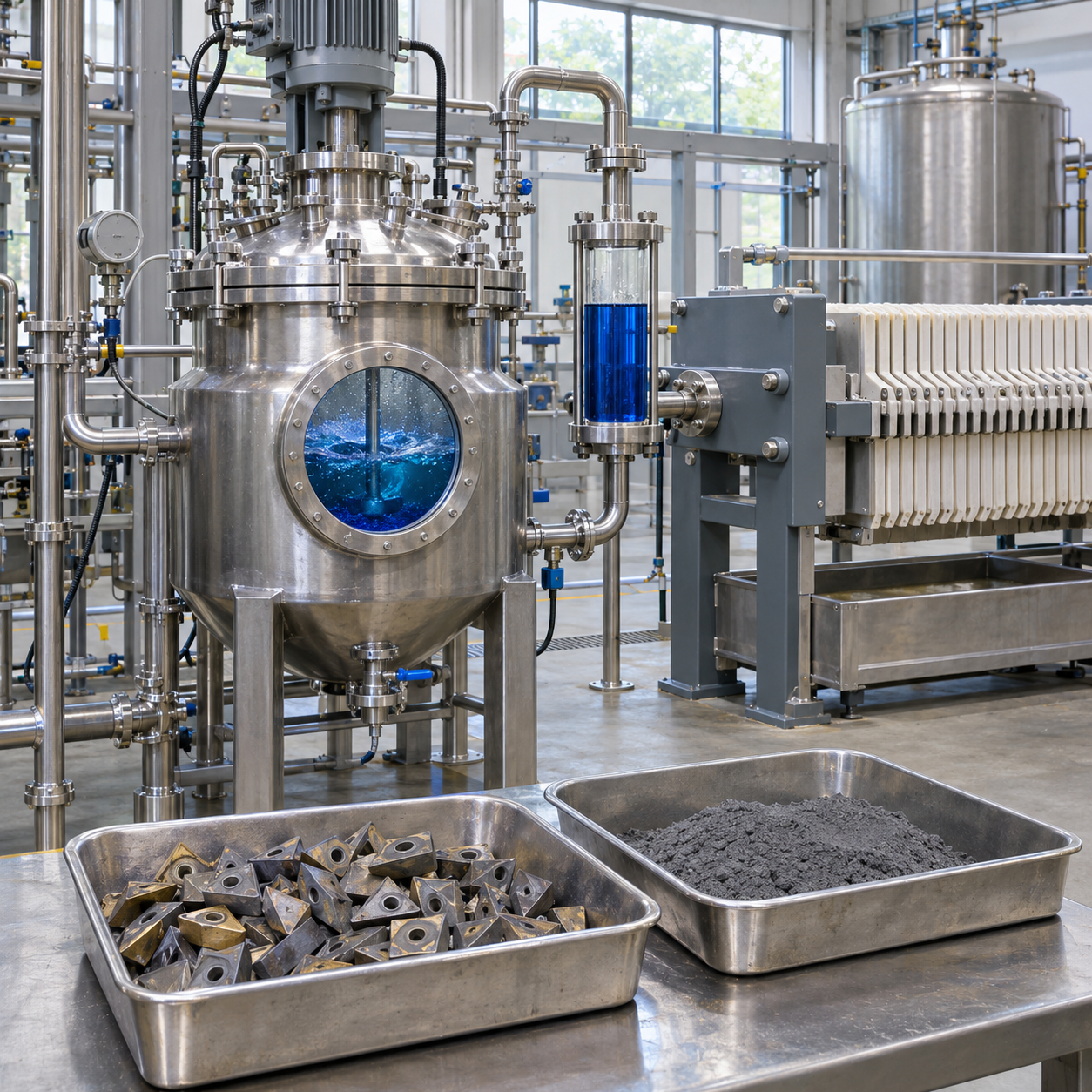
Cemented carbide tools combine hard tungsten carbide particles with a metallic binder, commonly cobalt. Selectively removing the binder can create a porous carbide skeleton or prepare material for further recovery, but the apparent simplicity of acid leaching hides substantial variability. Insert grade, cobalt content, grain size, coatings, brazing residue, geometry, wear contamination and prior cleaning all affect kinetics and downstream quality. Published research has examined formic acid with an oxidant for leaching cobalt from bulky cutting inserts. An industrial buyer should treat that evidence as a starting point for controlled development, not as a recipe. Formic acid concentration, oxidant addition, heat removal, gas management, materials compatibility and product washing must be engineered together.
Begin commercial qualification with written ownership for purchasing, quality, engineering, operations, laboratory, logistics and EHS. Approve identity, assay, impurity limits, test methods, sampling, storage, transfer, deviation response and release authority before the first production lot. Test multiple representative raw-material and process-feed lots under controlled conditions. Record mass balance, process performance, equipment observations, waste streams and final product or treatment results. This discipline separates formic acid variation from changes in water, feedstock, catalyst, equipment, operator or analytical method.
Review the complete delivery path from supplier release through container, carrier, receiving connection, storage and point of use. Contamination or dilution can occur after the supplier’s final analysis. Reconcile ordered, received, stored and consumed quantities and investigate unexplained differences. A supplier scorecard should cover COA accuracy, delivery condition, corrective-action quality and change notification as well as price. Qualify contingency supply with the same methods before a disruption. When buyer and supplier results differ, compare sample representativeness, temperature, standards, calibration, detection limits and uncertainty before disposition.
Formic acid is corrosive and can cause severe burns; concentrated vapor is hazardous. Use the current SDS, compatible closed equipment, ventilation, secondary containment, eyewash and shower access, trained response and jurisdiction-specific controls. The NIH PubChem formic acid record provides general identity and hazard context. It does not replace the supplier SDS, site risk assessment, transport rules or local law.
Use research as qualification evidence
A peer-reviewed International Journal of Refractory Metals and Hard Materials study reports monitored cobalt leaching from a WC-Co cutting insert using formic acid and hydrogen peroxide and examines kinetic dependencies: lixiviation kinetics of cobalt from cemented carbides. The authors also identify geometry, temperature and oxidant behavior as important experimental considerations.
Translate published conditions into a controlled trial
Record the exact feed, reagents, equipment, analytical methods and acceptance criteria used in each trial. Identify which variables are held constant, which are investigated and which stop conditions protect people, equipment and product. Scale only after replicated evidence, a reviewed hazard assessment and an approved disposition for every output stream support the decision.
Characterize hardmetal scrap before trials
Segregate inserts, drills, dies and mixed shop returns by supplier, declared grade, cobalt fraction, coating and contamination history. Determine moisture, oil, braze, steel attachments and tramp metals. A representative composite sample should reflect the feed envelope expected in routine operation rather than a visually clean laboratory subset.
Control geometry and exposed surface
Whole inserts, crushed pieces and grinding residues have very different surface area, mass transfer and handling risks. Document size distribution and pre-cleaning. If comminution is used, assess dust exposure, tool wear, cross-contamination and the possibility that fines change filtration and cobalt carryover.
Define the desired cobalt and carbide products
Set targets for residual cobalt in the carbide skeleton, tungsten loss, particle integrity, phase composition, moisture and contaminant carryover. Separately define the cobalt-bearing liquor or recovered cobalt product, including concentration, impurity limits and the intended refining route.
Close tungsten and cobalt balances
Measure cobalt, tungsten and key alloying metals in feed, solids, filtrate, washes and residues. A high cobalt extraction number is incomplete if tungsten dissolves, ultrafine carbide is lost through the filter or rinse water contains unreported metal inventory.
Qualify acid and oxidant as a matched system
Specify formic acid assay, water, metals, chloride, sulfate and nonvolatile residue according to the sensitivity of the leach and recovery train. Treat oxidant grade, stabilizers and dosing accuracy as separate critical inputs. Confirm that dilution water and cleaning chemicals do not add metals or halides.
Manage oxidant decomposition and heat
Hydrogen peroxide can decompose in contact with metals and catalytic surfaces. Use a formal reaction-hazard review, controlled addition, temperature monitoring, venting, pressure protection and validated stop conditions. Do not scale solely by keeping the same reagent ratio.
Validate separation and washing
Test filtration rate, cake permeability, cobalt displacement, wash demand, fines breakthrough and filter-media compatibility over multiple feed lots. Determine whether the carbide skeleton remains suitable for direct reuse, powder processing or another refining step after drying and classification.
Investigate incomplete binder removal
Residual cobalt may reflect coating barriers, inaccessible binder, oxidant loss, local depletion, temperature drift or short-circuit mixing. Use sectioning, microscopy and time-resolved solution analysis before increasing acid severity.
Build commercial supply and change control
Require batch COA, SDS, lot traceability, retained samples and advance notice of changes to acid feedstock, purification, site, analytical method, container or carrier. Link every acid lot to scrap genealogy, leach records and released products so a process shift can be traced without assumption.
Prepare a hardmetal-recycling inquiry
Provide the target formic acid concentration, impurity limits, pilot and annual volume, package or bulk mode, delivery location and documentation requirements. State that final suitability will be confirmed by the recycler under its own licensed process and hazard controls.
Request a specification-led quotation
Review the Hiacid formic acid product page, then contact the export team. Include end use, target concentration, analytical limits, annual and shipment volume, preferred package, destination, delivery profile and required documentation. Hiacid can respond against a defined commercial specification; the buyer remains responsible for process design, regulatory approval and final-use validation.
Related formic acid resources
- Formic Acid Pretreatment of Spent Automotive Catalysts
- Formic Acid for Spent Ni-Cd Battery Metal Recovery
- Formic Acid as a Hydrogen Donor for Waste Cooking Oil
Frequently asked questions
Can formic acid remove cobalt from intact WC-Co inserts?
Published work demonstrates cobalt leaching from bulky cutting inserts, but performance depends on grade, geometry, oxidant control and validated operating conditions.
Why is tungsten recovery measured during cobalt leaching?
It shows whether selectivity is preserved and whether fine carbide or dissolved tungsten is being lost from the intended product.
Is oxidant addition a simple scale-up variable?
No. Decomposition, heat release, catalytic surfaces, mixing and venting require independent engineering and hazard review.
What should a formic acid quotation include?
Include assay, impurity limits, package, forecast volume, destination and required COA, SDS and change-notification documents.