
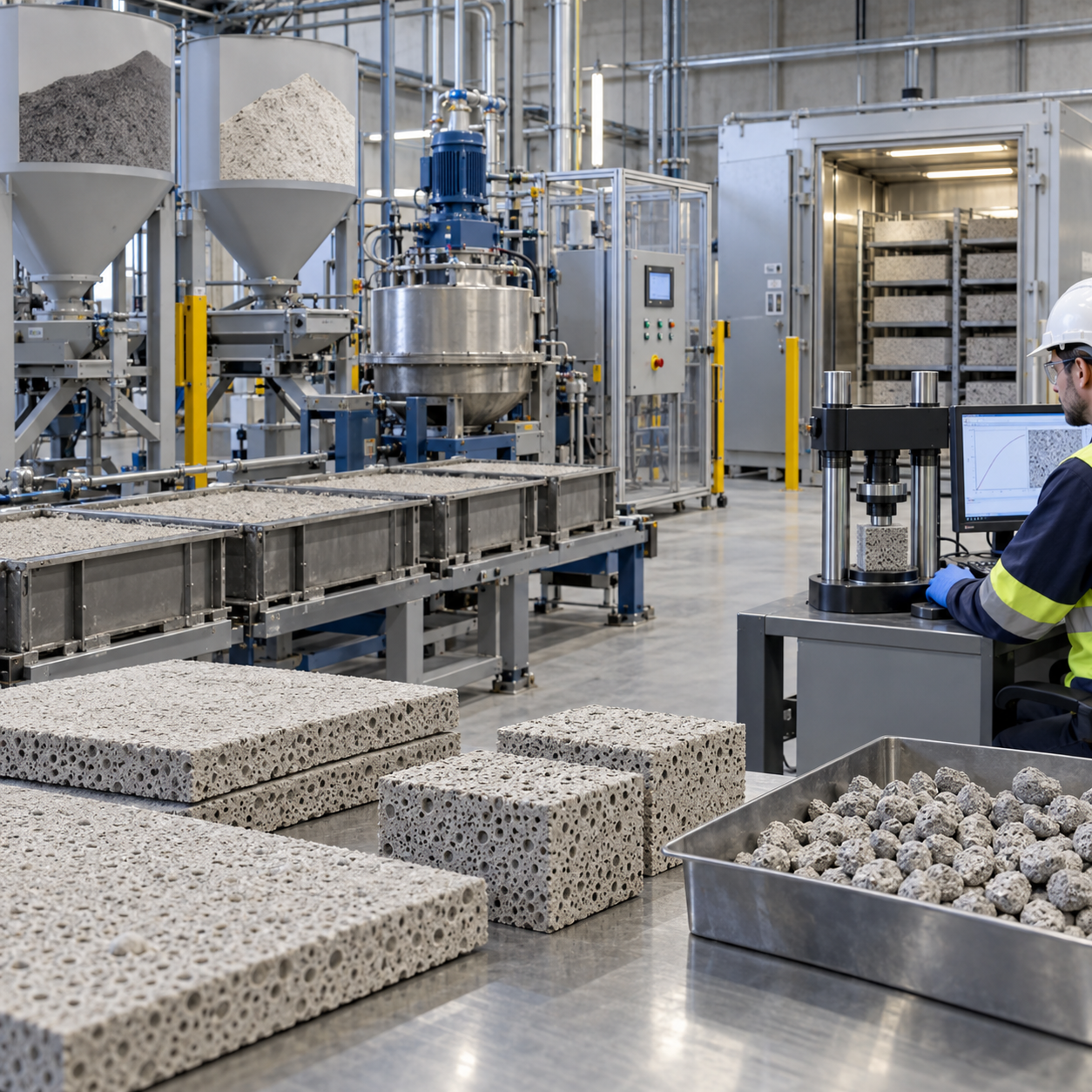
Hydrogen peroxide can generate oxygen within alkaline geopolymer mixes, creating pores that reduce density and thermal conductivity. The same decomposition that creates useful porosity can become too rapid or uneven, producing collapse, coarse voids, weak zones or inconsistent dimensions. Precursor chemistry, activator, temperature, mixing, surfactant, peroxide quality and curing all interact. A supplier qualification therefore has to connect reagent properties with pore structure and finished performance rather than concentration alone. This guide addresses controlled materials development, not a construction mix recipe.
A Minerals study on lightweight geopolymer panels examines how hydrogen peroxide content affects density, thermal and mechanical properties. Its raw materials and formulations are research-specific.
Industrial hydrogen peroxide qualification should assign purchasing, quality, engineering, operations, logistics and EHS ownership before the first delivery. Approve concentration, stabilizer package, analytical methods, sampling, storage, compatible transfer equipment, deviation response and release authority in writing. Compare representative lots under controlled conditions and record process performance, mass balance, gas evolution, waste, equipment observations and final product quality. This separates raw-material variation from changes in feedstock, water, equipment, operator or method. Review the chain from supplier release through carrier, package, receiving connection and day tank because contamination or decomposition can occur after final analysis. Reconcile ordered, received, stored and consumed quantities and investigate unexplained differences. Supplier scorecards should cover documentation accuracy, delivery condition, corrective-action quality and change notification as well as price. Qualify a contingency source using the same methods before a disruption. When buyer and supplier results differ, review sample representativeness, temperature, standards, calibration, detection limits and uncertainty before disposition. Confirm emergency contacts, unloading hours and stop-work authority for every shipment. Hydrogen peroxide is a strong oxidizer that can decompose exothermically and release oxygen; use the current SDS, dedicated compatible equipment, contamination control, ventilation, pressure relief, containment and an approved emergency plan. The NIOSH Pocket Guide entry and NIH PubChem record provide general hazard and identity context, while local law and site procedures remain controlling. Close qualification with an authorized report, approved-supplier status and a routine-monitoring plan.
Define the precursor and final product
Characterize fly ash, metakaolin, slag, fillers and aggregates for chemistry, fineness, moisture and lot variability. Set targets for dry density, pore distribution, dimensions, water absorption, thermal conductivity and strength.
Separate structural and insulation uses
Performance requirements differ for blocks, panels, lightweight aggregate and nonstructural insulation. Do not transfer a formulation or acceptance limit between products without validation.
Control foaming within the setting window
Map mixing, gas release, expansion, viscosity and set development using representative materials. If oxygen evolves before the matrix can retain it, foam escapes; if too late, large defects or internal stress can develop.
Measure pores as well as bulk density
Use imaging or validated pore analysis with density, compressive strength, thermal conductivity and water absorption. Two samples with the same density can have different pore sizes, connectivity and durability.
Specify peroxide for reproducible gas release
Define concentration, acidity, stabilizer system, trace metals, residue and methods. Metals and alkaline contamination can accelerate decomposition, while concentration error changes introduced water and oxygen potential.
Verify dosing and mixing equipment
Calibrate the metering system over the actual low-flow range and confirm dispersion before rapid decomposition. Prevent contamination or backflow into peroxide lines and use dedicated compatible connections.
Engineer alkaline-peroxide hazards
Strongly alkaline mixes can accelerate peroxide decomposition and oxygen release. Use guarded mixing, temperature monitoring, ventilation, controlled dosing and pressure-safe equipment under a formal hazard review.
Validate curing and durability
Record temperature and humidity history, shrinkage, cracking and dimensional stability. Test fire, freeze-thaw, moisture and reinforcement compatibility as required for the intended product and standard.
Qualify supplier lots against performance
Compare multiple peroxide lots with representative precursor lots and control material. Trend expansion, density, pores, strength and thermal results. Require COA, SDS, retained samples and change notification.
Prepare a geopolymer inquiry
Provide concentration, stabilizer and impurity limits, package, trial quantity, annual forecast and destination. Review the Hiacid hydrogen peroxide product page, then request a specification-led quotation.
Related hydrogen peroxide resources
- Hydrogen Peroxide for Peracetic Acid Manufacturing
- Hydrogen Peroxide for Chalcopyrite Copper Leaching Trials
- Hydrogen Peroxide for Liquid-Fuel Oxidative Desulfurization
Frequently asked questions
How does hydrogen peroxide create geopolymer pores?
It decomposes to release oxygen, which forms bubbles while the matrix is developing enough structure to retain them.
Does lower density always mean better insulation material?
No. Pore size, connectivity, strength, moisture behavior and durability must also meet the intended use.
Why can precursor lots change foaming?
Chemistry, fineness, metals, moisture and alkalinity can alter peroxide decomposition and setting.
Can this article be used as a mix design?
No. It is a B2B reagent-qualification framework and intentionally gives no formulation.