
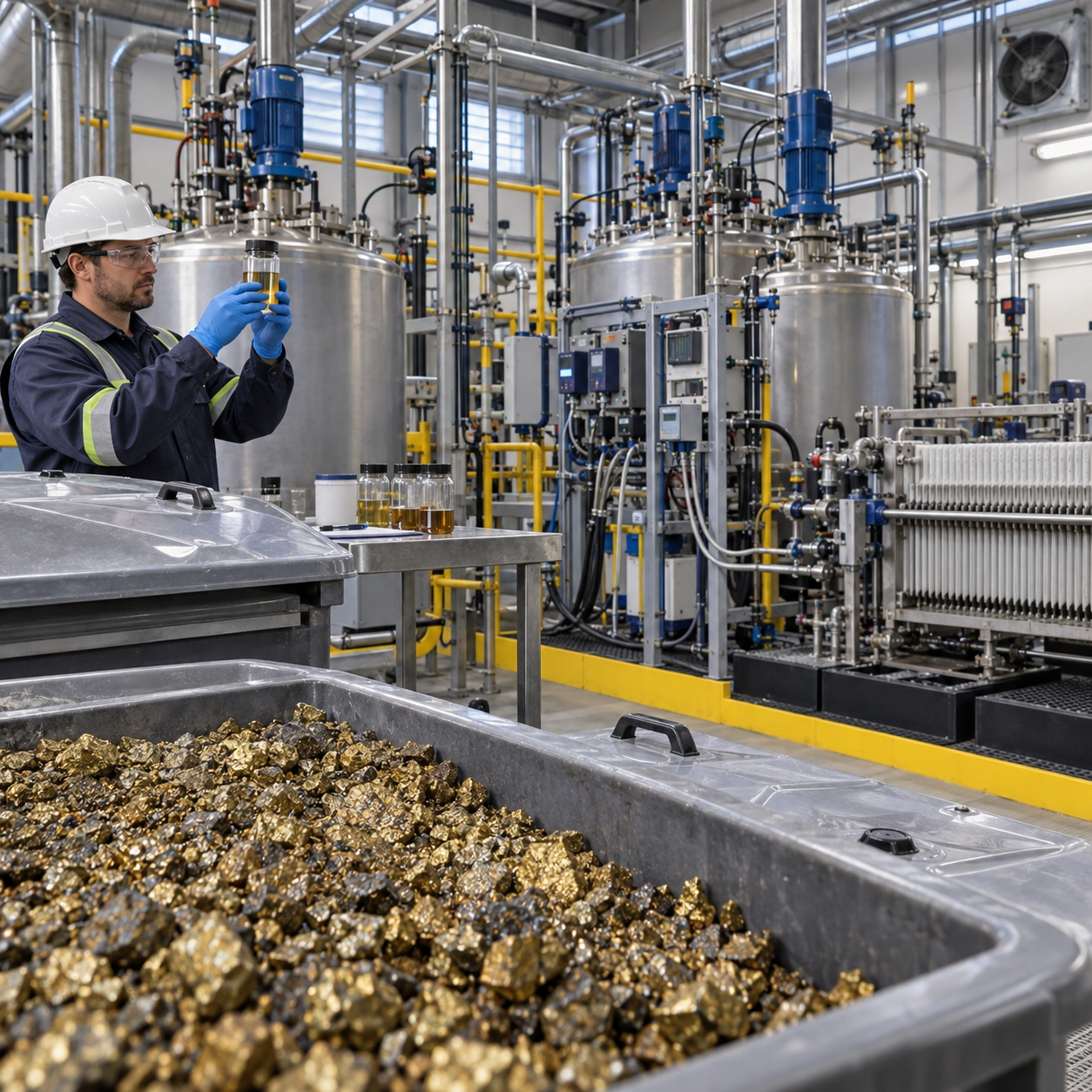
Chalcopyrite is an abundant copper sulfide mineral, but its hydrometallurgical dissolution can be limited by slow kinetics and passivating surface layers. Hydrogen peroxide has been studied as an oxidant in selected acidic leaching systems, yet it can also decompose rapidly in the presence of dissolved metals and mineral surfaces. Copper extraction alone does not establish a viable process: peroxide efficiency, iron behavior, sulfur products, heat, oxygen, filtration and downstream solvent extraction all matter. This article explains reagent qualification and pilot governance without offering operating conditions.
A 2025 Metals review evaluates hydrogen peroxide as an oxidizing agent in chalcopyrite leaching and discusses decomposition, passivation and process variables. Individual reported conditions require ore-specific validation.
Industrial hydrogen peroxide qualification should assign purchasing, quality, engineering, operations, logistics and EHS ownership before the first delivery. Approve concentration, stabilizer package, analytical methods, sampling, storage, compatible transfer equipment, deviation response and release authority in writing. Compare representative lots under controlled conditions and record process performance, mass balance, gas evolution, waste, equipment observations and final product quality. This separates raw-material variation from changes in feedstock, water, equipment, operator or method. Review the chain from supplier release through carrier, package, receiving connection and day tank because contamination or decomposition can occur after final analysis. Reconcile ordered, received, stored and consumed quantities and investigate unexplained differences. Supplier scorecards should cover documentation accuracy, delivery condition, corrective-action quality and change notification as well as price. Qualify a contingency source using the same methods before a disruption. When buyer and supplier results differ, review sample representativeness, temperature, standards, calibration, detection limits and uncertainty before disposition. Confirm emergency contacts, unloading hours and stop-work authority for every shipment. Hydrogen peroxide is a strong oxidizer that can decompose exothermically and release oxygen; use the current SDS, dedicated compatible equipment, contamination control, ventilation, pressure relief, containment and an approved emergency plan. The NIOSH Pocket Guide entry and NIH PubChem record provide general hazard and identity context, while local law and site procedures remain controlling. Close qualification with an authorized report, approved-supplier status and a routine-monitoring plan.
Characterize the concentrate and gangue
Measure chalcopyrite, pyrite, bornite and other sulfides, gangue mineralogy, particle size, surface area, moisture and copper, iron, sulfur and penalty elements. Representative sampling is essential because dense sulfide particles can segregate.
Define products and acceptable losses
Set targets for copper extraction, pregnant-solution quality, iron, solids, sulfur products and residue stability. Include the downstream copper-recovery route so the liquor is judged by more than copper concentration.
Treat peroxide efficiency as a key metric
Track peroxide delivered, residual, decomposed and productively consumed alongside oxidation-reduction potential, temperature and gas. A larger dose may increase early reaction but reduce reagent efficiency through catalytic decomposition.
Compare complete process alternatives
Benchmark peroxide-assisted routes against technically credible ferric, chloride, pressure or biological options using recovery, time, energy, chemical consumption, materials, emissions and waste on the same boundary.
Specify peroxide for metal-rich service
Define concentration, acidity, stabilizer system, iron, copper, nonvolatile residue and methods. Trace metals can change storage stability and experimental dosing efficiency. Verify representative lots and retain samples.
Link every run to full genealogy
Record ore composite, grinding, acid, peroxide, water, reactor, dosing history, analytical samples and residue. Use duplicates and reconciliation limits to distinguish process improvement from sampling variation.
Engineer exotherm and oxygen management
Minerals and dissolved metals can catalyze peroxide decomposition. Use compatible closed equipment, staged controlled dosing, cooling, ventilation, pressure protection, interlocks and emergency shutdown based on calorimetry and hazard review.
Close copper, iron and sulfur balances
Analyze feed, liquor, wash, residue, gas-control streams and recovered products. Verify solution volumes and sampling losses. Characterize residues rather than assuming sulfur remains in one form.
Scale supply only after reproducibility
Move from traceable trial containers to pilot or bulk delivery only after replicated metal balances, peroxide efficiency and safe equipment performance. Require COA, SDS, retained samples and advance change notice.
Prepare a chalcopyrite inquiry
Provide concentration, stabilizer and impurity limits, package, trial volume, schedule and destination. Review the Hiacid hydrogen peroxide page, then request a staged industrial supply proposal.
Related hydrogen peroxide resources
- Hydrogen Peroxide for Peracetic Acid Manufacturing
- Hydrogen Peroxide for Liquid-Fuel Oxidative Desulfurization
- Hydrogen Peroxide for Arsenite Oxidation in Groundwater Treatment
Frequently asked questions
Why can hydrogen peroxide consumption be high in chalcopyrite trials?
Mineral surfaces and dissolved transition metals can catalyze unproductive decomposition.
Is copper extraction the only success measure?
No. Peroxide efficiency, iron, sulfur, liquor quality, residue, safety and downstream recovery also matter.
Why test several concentrate composites?
Mineralogy, gangue and particle properties can change oxidation, passivation and reagent demand.
Does this article provide leaching conditions?
No. It is a B2B qualification framework for professionally engineered trials.