
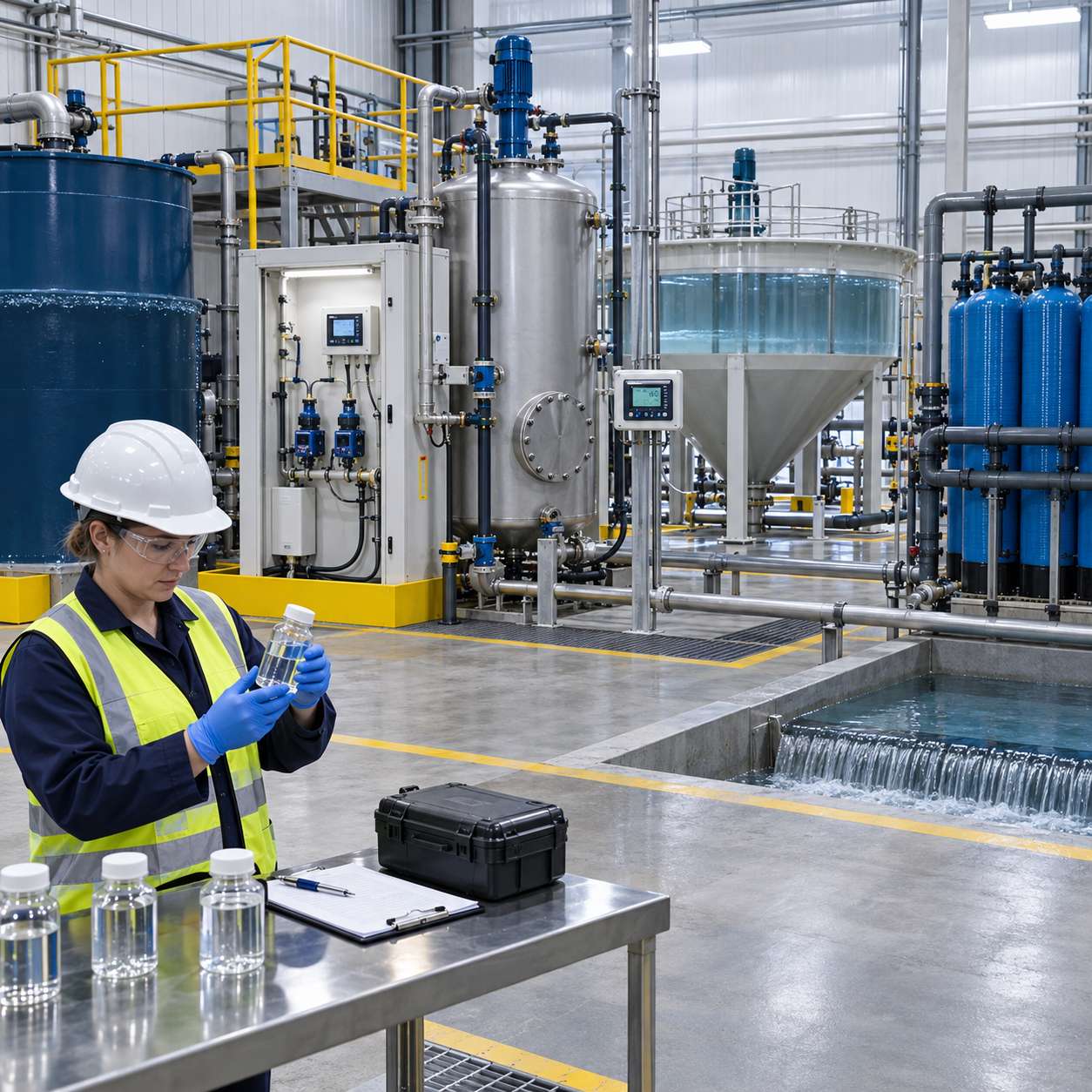
Arsenic removal often depends on oxidation state. Arsenite can be more difficult to remove by coagulation or adsorption than arsenate, so some treatment trains use hydrogen peroxide as a controlled oxidation step before iron coagulation, clarification or media filtration. Water chemistry, competing oxidant demand, peroxide decomposition and downstream solids handling determine performance. Oxidation does not destroy arsenic; it prepares it for capture. This article explains peroxide procurement and operating governance without specifying a universal dose.
A US EPA remediation-system evaluation documents hydrogen peroxide addition for arsenite-to-arsenate oxidation before coagulation and flotation at a groundwater treatment plant. Its setpoints and equipment are site-specific.
Industrial hydrogen peroxide qualification should assign purchasing, quality, engineering, operations, logistics and EHS ownership before the first delivery. Approve concentration, stabilizer package, analytical methods, sampling, storage, compatible transfer equipment, deviation response and release authority in writing. Compare representative lots under controlled conditions and record process performance, mass balance, gas evolution, waste, equipment observations and final product quality. This separates raw-material variation from changes in feedstock, water, equipment, operator or method. Review the chain from supplier release through carrier, package, receiving connection and day tank because contamination or decomposition can occur after final analysis. Reconcile ordered, received, stored and consumed quantities and investigate unexplained differences. Supplier scorecards should cover documentation accuracy, delivery condition, corrective-action quality and change notification as well as price. Qualify a contingency source using the same methods before a disruption. When buyer and supplier results differ, review sample representativeness, temperature, standards, calibration, detection limits and uncertainty before disposition. Confirm emergency contacts, unloading hours and stop-work authority for every shipment. Hydrogen peroxide is a strong oxidizer that can decompose exothermically and release oxygen; use the current SDS, dedicated compatible equipment, contamination control, ventilation, pressure relief, containment and an approved emergency plan. The NIOSH Pocket Guide entry and NIH PubChem record provide general hazard and identity context, while local law and site procedures remain controlling. Close qualification with an authorized report, approved-supplier status and a routine-monitoring plan.
Characterize arsenic and competing demand
Measure arsenic speciation, total arsenic, iron, manganese, sulfide, organic carbon, pH, alkalinity, turbidity and seasonal variability. Confirm the treatment target and analytical reporting limit.
Run representative pilot tests
Use actual water across expected conditions. Measure arsenite conversion, peroxide residual, iron dose, settling or flotation, filter performance and final dissolved arsenic. Include blanks and duplicate analyses.
Integrate oxidation with removal
Hydrogen peroxide changes oxidation state but does not remove arsenic mass. Coordinate the oxidation reactor with ferric coagulant, pH adjustment, flocculation, clarification, adsorption or filtration.
Control with more than one signal
ORP can support control but does not directly prove complete arsenite conversion in every matrix. Pair process signals with validated arsenic speciation and residual-peroxide measurements during commissioning and routine verification.
Specify hydrogen peroxide for water treatment
Define concentration, acidity, stabilizer package, trace metals, nonvolatile residue and methods. Confirm suitability for the water-use category and downstream media. Approve package size and metering range for the site demand.
Protect reagent stability at low feed rates
Small continuous doses can be affected by heat, contamination, dead legs and gas binding. Use dedicated compatible storage, clean lines, suitable pumps, pressure relief and flushing procedures approved by engineering.
Manage reaction and residuals safely
Use closed dosing, secondary containment, ventilation, backflow prevention, interlocks and emergency response. Monitor oxygen release and pump behavior rather than assuming low flow means low hazard.
Characterize arsenic-bearing solids
Track arsenic into sludge, spent media and backwash. Dewater, store and dispose or treat these materials under applicable rules. Oxidation is not complete risk control unless captured arsenic is managed.
Release the process with evidence
Verify final arsenic, speciation where needed, peroxide residual, turbidity, filter performance and sludge quality over representative operation. Define alarm, shutdown and corrective-action limits.
Prepare a groundwater-treatment inquiry
Provide concentration, stabilizer limits, package, daily demand, destination and quality documents. Review the Hiacid hydrogen peroxide page, then request a treatment-supply proposal.
Related hydrogen peroxide resources
- Hydrogen Peroxide for Peracetic Acid Manufacturing
- Hydrogen Peroxide for Chalcopyrite Copper Leaching Trials
- Hydrogen Peroxide for Liquid-Fuel Oxidative Desulfurization
Frequently asked questions
Does hydrogen peroxide remove arsenic by itself?
No. It can oxidize arsenite to arsenate, which must then be captured by coagulation, adsorption or filtration.
Is ORP alone enough to verify treatment?
No. ORP should be supported by validated arsenic speciation and final-water analysis.
Why can low-dose peroxide systems off-gas?
Contamination, metals, heat or stagnant sections can catalyze decomposition and release oxygen.
What happens to the captured arsenic?
It transfers to sludge, media or backwash that must be characterized and managed under applicable rules.