
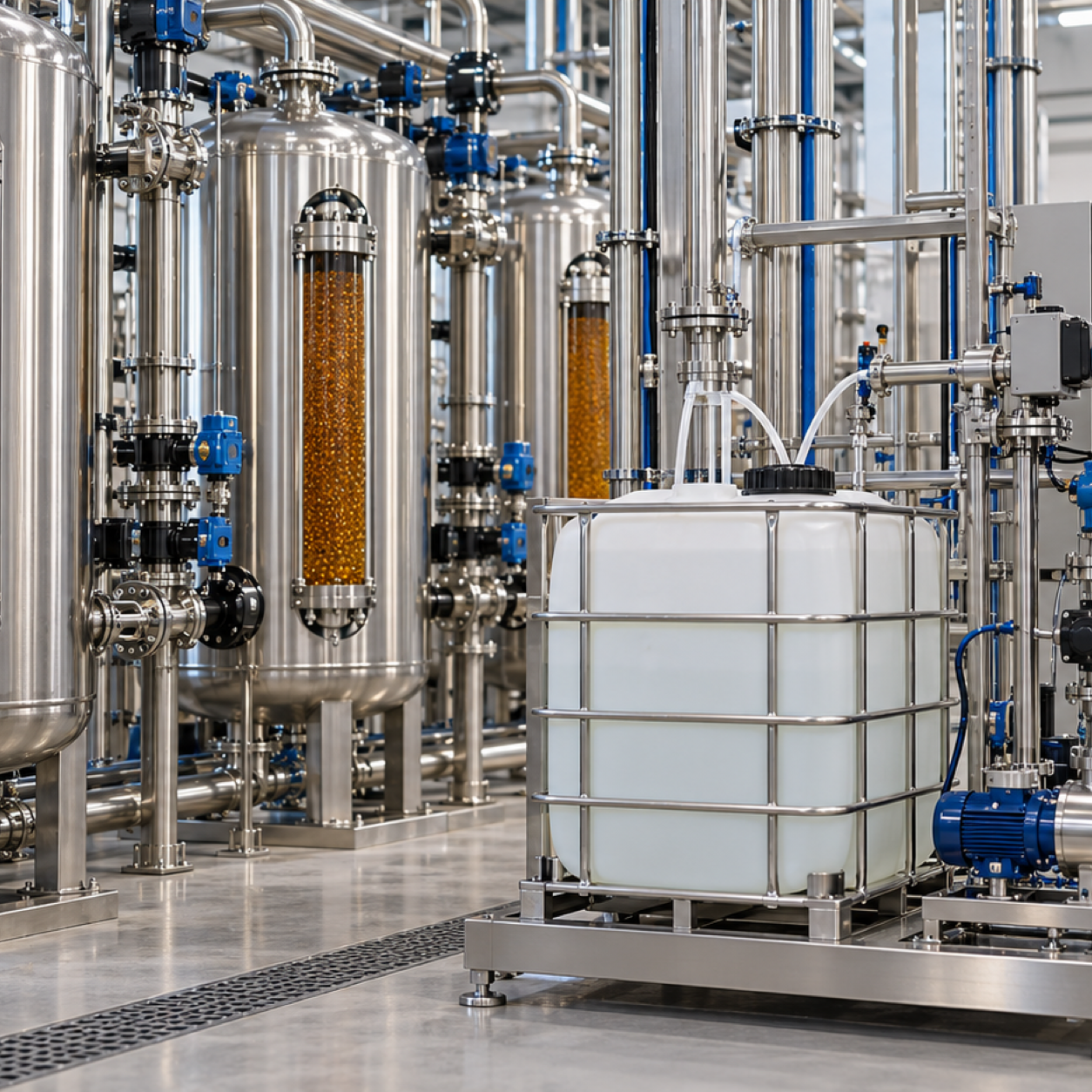
Ion exchange beds can support biological growth during warm standby, intermittent operation or treatment of nutrient-bearing water. Hydrogen peroxide may be used to sterilize compatible cation and anion resins, but the oxidant can also attack organic polymer structures if concentration, temperature, contact or contamination is not controlled. The correct program depends on resin chemistry, crosslinking, age, fouling history, vessel internals and the quality required from the treated water. Buyers should qualify the peroxide grade and the entire exposure-rinse sequence with the resin supplier rather than adopting a generic plant practice. This article gives a commercial and quality framework without replacing resin-specific operating instructions.
A DuPont ion exchange technical fact describes peroxide treatment for compatible cation and anion resins and stresses control of concentration, temperature, contact time and rinsing. Use the current resin-specific document for actual limits.
Industrial hydrogen peroxide qualification should assign purchasing, quality, engineering, operations, logistics and EHS ownership before the first delivery. Approve concentration, stabilizer package, analytical methods, sampling, storage, compatible transfer equipment, deviation response and release authority in writing. Compare representative lots under controlled conditions and record process performance, mass balance, gas evolution, waste, equipment observations and final product quality. This separates raw-material variation from changes in feedstock, water, equipment, operator or method. Review the chain from supplier release through carrier, package, receiving connection and day tank because contamination or decomposition can occur after final analysis. Reconcile ordered, received, stored and consumed quantities and investigate unexplained differences. Supplier scorecards should cover documentation accuracy, delivery condition, corrective-action quality and change notification as well as price. Qualify a contingency source using the same methods before a disruption. When buyer and supplier results differ, review sample representativeness, temperature, standards, calibration, detection limits and uncertainty before disposition. Confirm emergency contacts, unloading hours and stop-work authority for every shipment. Hydrogen peroxide is a strong oxidizer that can decompose exothermically and release oxygen; use the current SDS, dedicated compatible equipment, contamination control, ventilation, pressure relief, containment and an approved emergency plan. The NIOSH Pocket Guide entry and NIH PubChem record provide general hazard and identity context, while local law and site procedures remain controlling. Procurement documents should also define shelf life, minimum remaining life at delivery, storage-temperature expectations, seal condition and rejection criteria. Delivery planning should consider seasonal temperature, transit time, customs delay and unloading capacity. Train receiving personnel to compare the shipment, seal and documentation with the purchase order before connection. Close qualification with an authorized report, approved-supplier status and a routine-monitoring plan.
Define the microbiological objective
Identify the organism risk, treated-water specification, affected beds and trigger for intervention. Distinguish preventive hygiene from recovery of a heavily fouled or contaminated system.
Confirm resin and vessel compatibility
Record resin type, functional group, crosslinking, age and prior chemical exposure. Include distributors, collectors, sight glasses, gaskets, coatings and downstream equipment in the compatibility review.
Specify the peroxide feed
Agree assay, acidity, stabilizer identity, trace metals, nonvolatile residue and package cleanliness. High-purity applications may also require particle, ionic and total-organic-carbon limits.
Protect against catalytic decomposition
Keep peroxide away from rust, copper, incompatible metals, organics, reducing agents and contaminated transfer tools. Verify that regenerated beds and vessels are thoroughly cleared of incompatible chemicals.
Validate exposure and rinsing
Use the resin supplier’s approved sequence and measure microbiological reduction, peroxide residual, conductivity, pressure drop and treated-water quality. Confirm that rinsing reaches a justified release endpoint.
Check resin performance after treatment
Compare capacity, leakage, selectivity, color, swelling and pressure drop before and after repeated representative cycles. A visually clean bed may still have lost functional performance.
Control execution and return to service
Use dedicated dilution water, compatible metering, controlled flow and verified temperature. Document valves, isolation, venting and sampling so peroxide does not reach an unintended process.
Set a deviation response
Stop work for abnormal heat, gas evolution, pressure, discoloration or rapid assay loss. Quarantine the bed and peroxide lot until contamination, equipment and procedure have been reviewed.
Qualify supplier and delivery controls
Require COA, SDS, manufacturing traceability, retained samples and change notification. Audit receiving connections and unloading practices because post-release contamination can defeat a correct supplier analysis.
Prepare a resin sterilization inquiry
Provide peroxide grade, impurity and stabilizer limits, package, volume, destination and resin supplier constraints. Review the Hiacid hydrogen peroxide page, then request a specification-based quotation.
Related hydrogen peroxide resources
- Hydrogen Peroxide for RO Membrane Sanitization
- Hydrogen Peroxide for Biogas Hydrogen Sulfide Scrubbing
- Hydrogen Peroxide for Activated Sludge Bulking Control
Frequently asked questions
Can the same peroxide procedure be used for every resin?
No. Resin chemistry, age, fouling and manufacturer limits determine the acceptable procedure.
Why verify capacity after sterilization?
Oxidative exposure can damage the polymer or functional groups even if the resin still looks normal.
When is rinsing complete?
Use a validated endpoint based on peroxide residual and the required treated-water quality, not only elapsed time.
What supplier data should buyers request?
At minimum request assay, stabilizer information, key impurities, COA, SDS, traceability and change notification.