
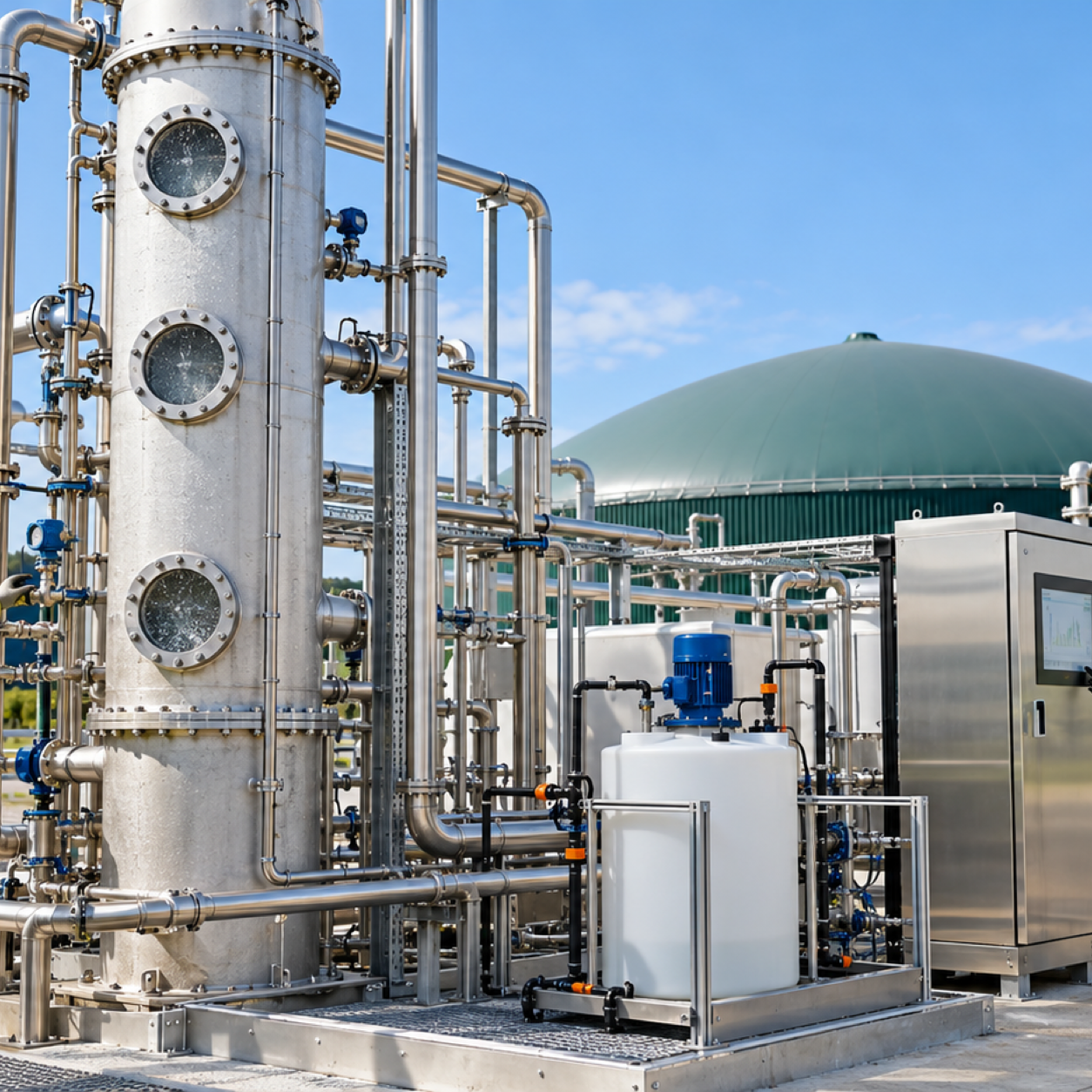
Hydrogen sulfide in raw biogas can corrode engines and piping, poison downstream catalysts, create sulfur emissions and prevent product gas from meeting a sales specification. An engineered alkaline oxidative scrubber may use hydrogen peroxide to oxidize absorbed sulfide while limiting avoidable carbon dioxide absorption. Performance depends on gas flow, sulfide loading, pH, redox potential, mass transfer, solution age and the chosen oxidation endpoint. Peroxide concentration alone cannot predict reagent efficiency or sulfur-product distribution. Buyers should connect raw-material qualification to stable removal performance, compatible equipment and controlled waste management. This guide addresses industrial procurement and governance, not scrubber sizing or a dosing recipe.
An EPA HERO record for a peer-reviewed pilot study reports alkaline oxidative scrubbing with hydrogen peroxide and identifies pH, redox potential and solution aging as important variables. Published pilot results do not replace site-specific process design.
Industrial hydrogen peroxide qualification should assign purchasing, quality, engineering, operations, logistics and EHS ownership before the first delivery. Approve concentration, stabilizer package, analytical methods, sampling, storage, compatible transfer equipment, deviation response and release authority in writing. Compare representative lots under controlled conditions and record process performance, mass balance, gas evolution, waste, equipment observations and final product quality. This separates raw-material variation from changes in feedstock, water, equipment, operator or method. Review the chain from supplier release through carrier, package, receiving connection and day tank because contamination or decomposition can occur after final analysis. Reconcile ordered, received, stored and consumed quantities and investigate unexplained differences. Supplier scorecards should cover documentation accuracy, delivery condition, corrective-action quality and change notification as well as price. Qualify a contingency source using the same methods before a disruption. When buyer and supplier results differ, review sample representativeness, temperature, standards, calibration, detection limits and uncertainty before disposition. Confirm emergency contacts, unloading hours and stop-work authority for every shipment. Hydrogen peroxide is a strong oxidizer that can decompose exothermically and release oxygen; use the current SDS, dedicated compatible equipment, contamination control, ventilation, pressure relief, containment and an approved emergency plan. The NIOSH Pocket Guide entry and NIH PubChem record provide general hazard and identity context, while local law and site procedures remain controlling. Procurement documents should also define shelf life, minimum remaining life at delivery, storage-temperature expectations, seal condition and rejection criteria. Delivery planning should consider seasonal temperature, transit time, customs delay and unloading capacity. Train receiving personnel to compare the shipment, seal and documentation with the purchase order before connection. Close qualification with an authorized report, approved-supplier status and a routine-monitoring plan.
Define the inlet and outlet gas basis
Characterize normal and peak biogas flow, hydrogen sulfide, carbon dioxide, methane, oxygen, moisture, temperature and trace contaminants. State the outlet H2S limit and its sampling basis.
Build a sulfur and oxidant balance
Reconcile sulfide entering with treated gas, scrubber liquid, elemental sulfur, thiosulfate, sulfate, purge and deposits. Trend peroxide consumption per unit of sulfur removed.
Qualify peroxide for the scrubber chemistry
Specify assay, acidity, stabilizers, trace metals and nonvolatile residue. Evaluate whether introduced water or stabilizers affect alkalinity, solids behavior or downstream liquid treatment.
Use representative load swings
Test approved peroxide lots across realistic gas-flow and sulfide changes. Record removal efficiency, carbon dioxide pickup, pH, redox response, pressure drop and purge quality.
Control mass transfer and oxidation
Maintain validated gas-liquid contact, circulation and analyzer response. Poor distribution or fouling can cause outlet breakthrough that extra chemical feed will not reliably correct.
Avoid control by ORP alone
Redox potential is useful but depends on electrodes, pH, temperature and solution composition. Verify it against direct gas and liquid analyses and maintain a calibrated backup strategy.
Engineer storage and reactive safety
Use compatible dedicated storage, metering, isolation, ventilation, pressure protection and backflow prevention. Prevent scrubber liquor, caustic, sulfide or dirty water from entering the peroxide system.
Plan for off-normal conditions
Define safe actions for high H2S, feed interruption, analyzer failure, pump loss, blocked packing, excess heat, rapid gas evolution and power recovery. Restart only after authorized inspection.
Manage logistics and supplier changes
Require COA, SDS, lot genealogy, retained samples and advance notice of concentration, stabilizer, site, method, package or carrier changes. Review delivery frequency against storage residence time.
Prepare a biogas scrubbing inquiry
Provide concentration and impurity limits, daily and peak demand, package, destination and delivery schedule. Review the Hiacid hydrogen peroxide page, then request a technical quotation.
Related hydrogen peroxide resources
- Hydrogen Peroxide for RO Membrane Sanitization
- Hydrogen Peroxide for Ion Exchange Resin Sterilization
- Hydrogen Peroxide for Activated Sludge Bulking Control
Frequently asked questions
Why does inlet H2S variability matter?
Peak loading can exceed mass-transfer or reagent capacity even when the daily average appears acceptable.
Can ORP alone control peroxide feed?
No. ORP should be supported by calibrated gas and liquid measurements and a validated control strategy.
Why is backflow prevention critical?
Sulfide-bearing alkaline liquor can contaminate peroxide equipment and create rapid decomposition.
What should a supplier trial measure?
Measure outlet gas, peroxide efficiency, pH, redox response, pressure drop, purge quality and material observations.