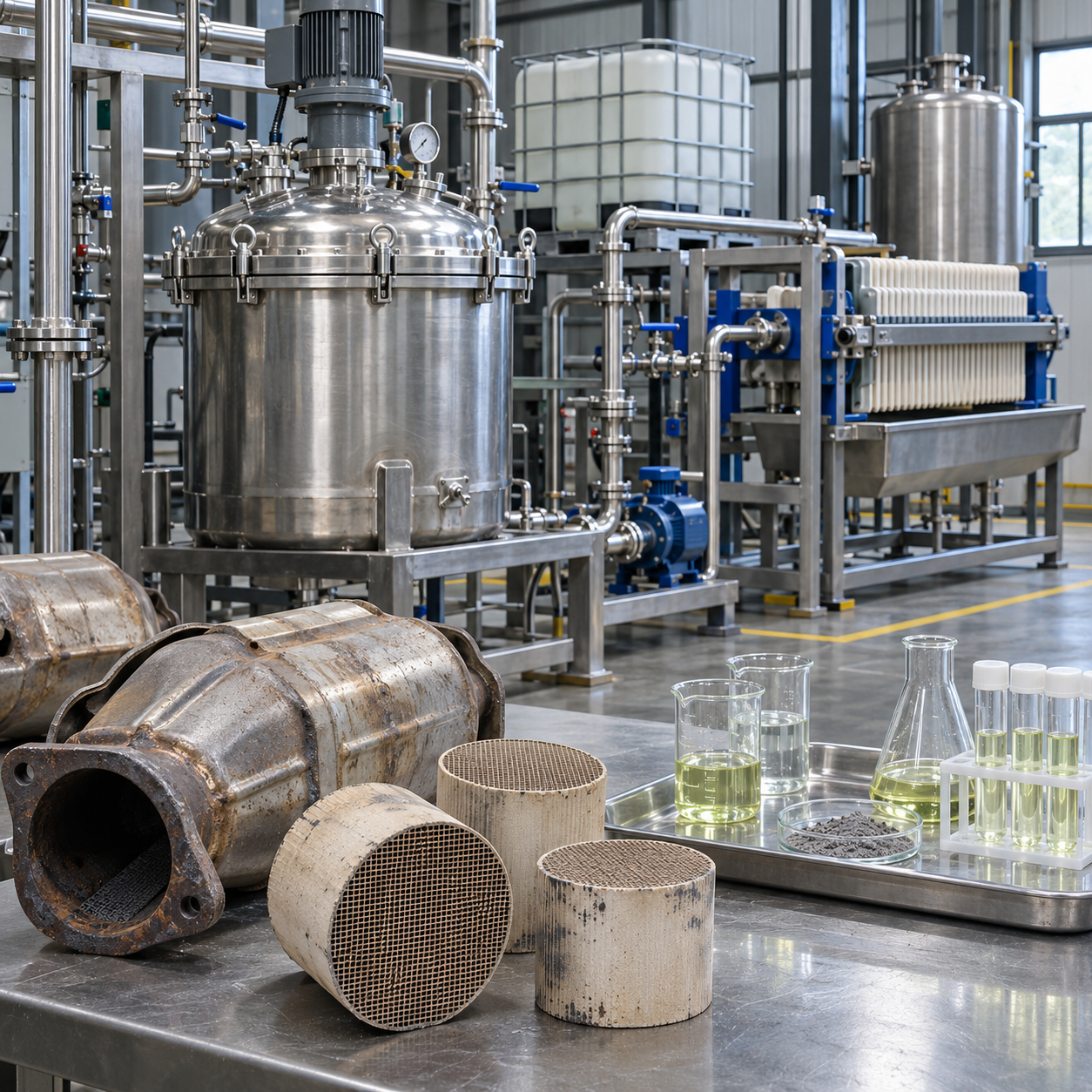
Spent automotive catalysts contain a ceramic or metallic substrate, washcoat, platinum-group metals and numerous non-precious elements. Their composition changes with vehicle type, service history, catalyst generation, contamination and dismantling practice. Organic-acid pretreatment can be evaluated to remove selected base metals before the main precious-metal recovery stage. Recent research compared formic and oxalic acids for leaching non-precious metals from spent automotive catalysts and modeled the influence of process variables. For a recycler, the commercial question is not simply whether a metal dissolves. The pretreatment must preserve platinum, palladium and rhodium value, create a manageable solution, improve the next unit operation and remain safe and economical across heterogeneous lots.
Begin commercial qualification with written ownership for purchasing, quality, engineering, operations, laboratory, logistics and EHS. Approve identity, assay, impurity limits, test methods, sampling, storage, transfer, deviation response and release authority before the first production lot. Test multiple representative raw-material and process-feed lots under controlled conditions. Record mass balance, process performance, equipment observations, waste streams and final product or treatment results. This discipline separates formic acid variation from changes in water, feedstock, catalyst, equipment, operator or analytical method.
Review the complete delivery path from supplier release through container, carrier, receiving connection, storage and point of use. Contamination or dilution can occur after the supplier’s final analysis. Reconcile ordered, received, stored and consumed quantities and investigate unexplained differences. A supplier scorecard should cover COA accuracy, delivery condition, corrective-action quality and change notification as well as price. Qualify contingency supply with the same methods before a disruption. When buyer and supplier results differ, compare sample representativeness, temperature, standards, calibration, detection limits and uncertainty before disposition.
Formic acid is corrosive and can cause severe burns; concentrated vapor is hazardous. Use the current SDS, compatible closed equipment, ventilation, secondary containment, eyewash and shower access, trained response and jurisdiction-specific controls. The NIH PubChem formic acid record provides general identity and hazard context. It does not replace the supplier SDS, site risk assessment, transport rules or local law.
Use research as qualification evidence
A 2025 research article in Sustainable Materials and Technologies evaluates formic or oxalic acid as a pretreatment for non-precious-metal removal from spent automotive catalysts and reports that temperature and acid identity significantly influence leaching behavior: spent automotive catalyst organic-acid pretreatment study. Its optimized laboratory conditions should be independently validated against the recycler’s own feed and downstream flowsheet.
Translate published conditions into a controlled trial
Record the exact feed, reagents, equipment, analytical methods and acceptance criteria used in each trial. Identify which variables are held constant, which are investigated and which stop conditions protect people, equipment and product. Scale only after replicated evidence, a reviewed hazard assessment and an approved disposition for every output stream support the decision.
Build a representative catalyst feed model
Record substrate type, catalyst family, vehicle class, service age, decanning method and visible contamination. Determine moisture, carbon, oil, particle size, loss on ignition and elemental composition. Composite sampling and certified reference checks are essential because PGM distribution can be highly heterogeneous.
Separate monolith preparation from chemistry
Decanning, dust collection, crushing, milling, screening and thermal treatment can change exposure and assay. Freeze the preparation method during comparisons so apparent formic acid effects are not actually changes in particle size or carbon removal.
Define what pretreatment must accomplish
Identify the non-precious metals that interfere with the selected PGM route, the acceptable removal range and the maximum allowable PGM loss. Specify residue composition, filtration behavior, wash demand and the chemical conditions required by the next leach, smelter or refining step.
Use a complete precious-metal balance
Assay feed, pretreated solid, filtrate, washes, filter media and retained residues for platinum, palladium and rhodium. Very small percentage losses can be commercially important, so reporting only base-metal extraction can misrepresent value recovery.
Qualify formic acid and process water
Set limits for assay, water, chloride, sulfate, metals and nonvolatile residue. Confirm process-water ions and recycled-liquor composition because they can alter dissolution, precipitation and analytical recovery. Use matched acid lots in side-by-side trials.
Control evolving liquor chemistry
Trend pH, free acidity, dissolved metals, redox indicators, temperature, density and solids loading over time. Precipitation during cooling or neutralization can transfer valuable fines or metals into an unexpected phase.
Validate solid-liquid separation
Measure settling, filtration rate, cake permeability, fines breakthrough and washing efficiency for representative feeds. Select filter media after compatibility and retention testing. Characterize the leachate before choosing recovery, recycle, neutralization or disposal routes.
Connect pretreatment to final PGM recovery
Run the full downstream sequence with and without pretreatment. Compare PGM extraction, reagent demand, impurity loading, residue quality, cycle time and waste generation. A higher pretreatment extraction is not beneficial if the next stage becomes less selective.
Govern hazardous feed and supplier changes
Spent catalysts can contain toxic dust and variable contaminants. Use enclosed preparation, ventilation, exposure monitoring, containment and documented waste classification. Require the acid supplier to provide current SDS, COA, traceability, transport-cleanliness evidence and advance change notification.
Prepare a catalyst-recycling inquiry
Provide target assay and impurities, expected consumption, package, delivery frequency and destination. Share only the process information needed to confirm material grade and logistics while the recycler retains responsibility for flowsheet design and regulatory compliance.
Request a specification-led quotation
Review the Hiacid formic acid product page, then contact the export team. Include end use, target concentration, analytical limits, annual and shipment volume, preferred package, destination, delivery profile and required documentation. Hiacid can respond against a defined commercial specification; the buyer remains responsible for process design, regulatory approval and final-use validation.
Related formic acid resources
- Formic Acid for Cobalt Removal from WC-Co Hardmetal Scrap
- Formic Acid for Spent Ni-Cd Battery Metal Recovery
- Formic Acid as a Hydrogen Donor for Waste Cooking Oil
Frequently asked questions
Does formic acid recover platinum-group metals directly?
This article focuses on pretreatment to remove selected non-precious metals before a separately validated PGM recovery stage.
Why must PGM losses be measured during pretreatment?
Even a small fractional loss of platinum, palladium or rhodium can materially change the economics of the operation.
Can one catalyst sample represent commercial feed?
Usually not. Vehicle origin, catalyst design, contamination and preparation create substantial lot variability.
What supply documents should accompany formic acid?
A current SDS, batch COA, lot traceability, packaging details and documented change notification should be agreed.