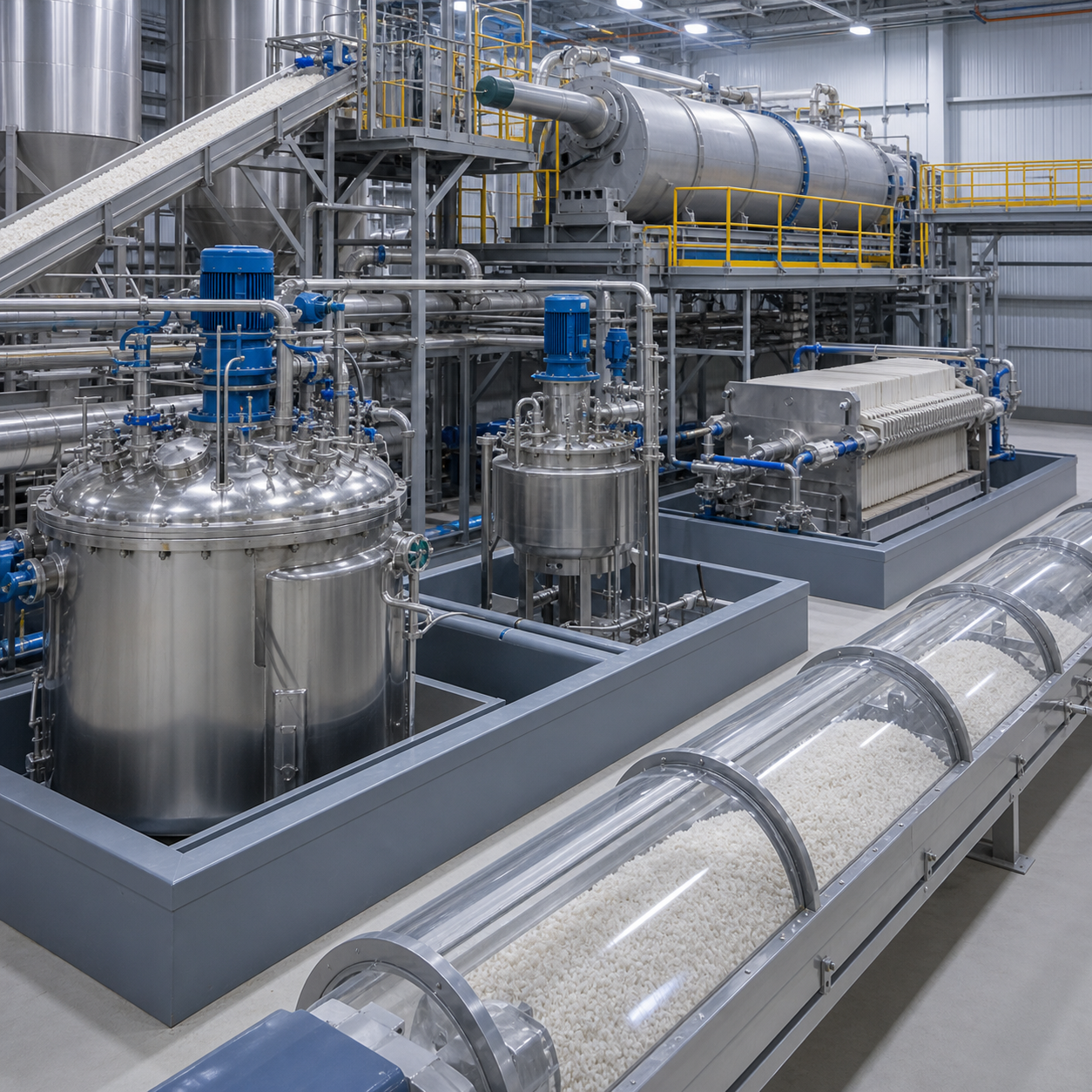
Oxalic acid can be evaluated for removing selected iron-bearing surface impurities from silica sand. The treatment relies on acid dissolution and oxalate complexation, but performance depends on where the iron occurs. Surface coatings and liberated iron minerals may respond, while iron locked inside quartz or refractory inclusions may remain. Feed mineralogy, particle size, attrition, acid concentration, temperature, residence time, solids loading and oxygen conditions all affect removal. A laboratory result cannot be scaled by multiplying reagent dose alone. Producers must integrate leaching with classification, washing, filtration, water balance and effluent treatment. Procurement supports this flowsheet by supplying consistent oxalic acid form, assay and low insoluble matter, but the process owner must validate the complete mineral-specific program and final silica specification.
For B2B implementation, assign purchasing, production, quality, engineering and EHS ownership before the first delivery. Approve receiving tests, sampling tools, storage, dosing basis, deviation response and retained-sample period in writing. This control plan helps separate raw-material variation from equipment or operating changes and provides objective evidence for buyer-supplier investigations. During qualification, compare at least several representative acid lots under the same operating conditions and record mass balance, product quality, waste load and equipment observations. Establish who can approve a temporary deviation and what evidence is required before material is released. Review transportation, package integrity and unloading alongside laboratory results, because contamination or moisture can enter after the supplier’s final test. Close every trial with a written conclusion, updated specification and defined requalification triggers.
Characterize the silica feed before leaching
Measure total and surface iron, aluminum, titanium, clay, heavy minerals and particle-size distribution across representative mine lots. Use microscopy or mineralogical analysis to distinguish removable coatings from lattice-bound impurities. Sorting, scrubbing, magnetic separation or attrition may remove more iron economically before chemical treatment.
Set a product-specific purification target
Define silica grade, iron limit, whiteness, particle size and downstream use. Glass, foundry, filler and high-purity applications have different requirements. A treatment that improves color may still leave unacceptable trace metals, while an aggressive route can reduce yield without creating additional customer value.
Design controlled leaching trials
Vary acid concentration, temperature, residence time, agitation and solids loading systematically. Analyze dissolved iron and remaining solids, not just liquor color. Include normal and worst-case feed. Confirm whether iron reprecipitates during cooling, neutralization or washing.
Evaluate ultrasound or attrition carefully
Research has reported ultrasound-assisted oxalic-acid leaching of silica sand, but industrial energy, erosion and equipment scale matter. Compare mechanical activation and conventional mixing on removal, fines generation, filtration and total cost before selecting a design.
Control washing and acid recovery
Establish counter-current washing or another validated scheme that meets residual oxalate and dissolved-metal limits. Track water use, cake moisture and silica losses. If acid or liquor is recycled, define purge based on iron and impurity accumulation rather than a fixed calendar interval.
Prevent contamination after purification
Use compatible conveyors, filters, dryers and storage that do not reintroduce iron. Rusting carbon steel downstream can erase a successful leach. Inspect contact materials and keep purified product separated from untreated sand and dirty water circuits.
Specify incoming oxalic acid
State dihydrate or approved form, assay, insoluble matter, iron, color and relevant anions with agreed methods. Dissolution behavior and caking can affect solution preparation. Review several supplier lots and retain samples linked to production campaigns.
Use published evidence as context
A peer-reviewed silica-sand study indexed by PubMed evaluated oxalic acid with and without ultrasound. Its reported conditions belong to that ore and apparatus; commercial users must run their own mineralogical and scale-up trials.
Plan safety and waste treatment
Oxalic acid dust and solutions require enclosed charging, ventilation, compatible PPE and emergency facilities. NIOSH provides exposure and hazard information. Spent liquor, wash water and iron-rich residues require site-specific treatment and compliant disposal or recovery.
Prepare a silica-processing RFQ
Provide hydrate form, assay, iron and insoluble limits, methods, monthly volume, package, destination, COA, SDS and change notification. Review the Hiacid oxalic acid supply page and product record, then request a documented quotation.
Related oxalic acid resources
- Oxalic Acid for Ceramic Clay Iron Removal and Whitening
- Oxalic Acid for Controlled Industrial System Decontamination
- Oxalic Acid for Spent Vanadium Catalyst Recovery
Frequently asked questions
Can oxalic acid remove iron locked inside quartz?
Not necessarily. It is more effective for responsive surface coatings or liberated iron phases than refractory lattice-bound impurities.
Why test several mine lots?
Mineralogy and surface iron can vary enough to change acid demand and achievable purity.
Can leach liquor be recycled indefinitely?
No. Iron and other impurities can accumulate, so recycle and purge must be controlled by analysis.
Which supplier documents should be requested?
Request a current SDS, lot-specific COA, traceability, agreed methods and change notification.