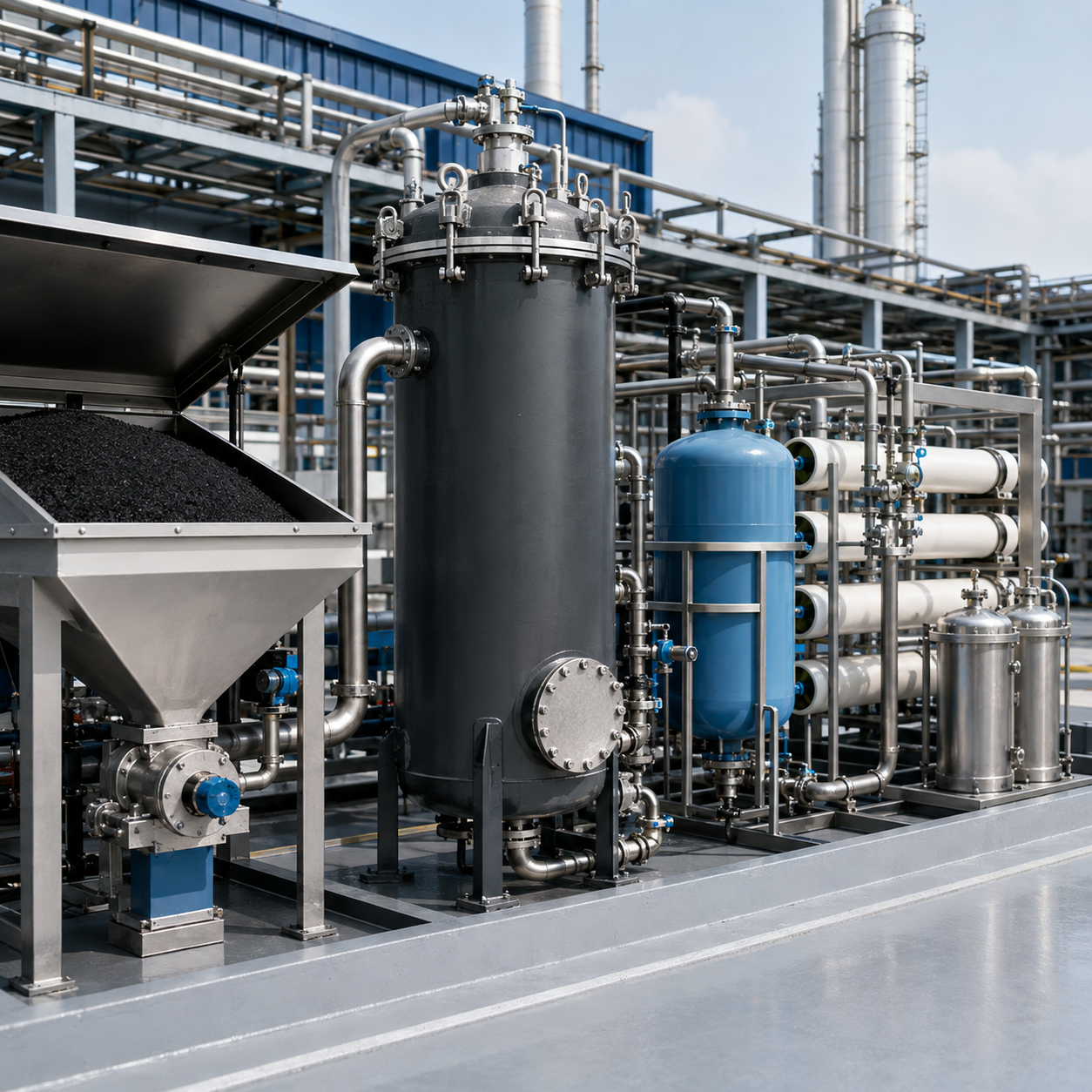
Hydrochloric acid can be used in selected activated-carbon processing and regeneration routes to remove acid-soluble mineral matter such as carbonates and some metal-containing deposits. The effect depends on carbon source, ash chemistry, particle size, pore structure, previous service and the intended adsorption duty. Aggressive treatment can increase fines, leave residual chloride or create a difficult metal-bearing wash stream. Processors must therefore qualify acid washing with adsorption tests, mechanical-quality measurements, rinse endpoints and a complete waste plan. This article addresses industrial procurement and control, not a treatment recipe. Carbon suppliers and plant engineers must establish application-specific conditions.
For B2B implementation, assign purchasing, production, quality, engineering and EHS ownership before the first delivery. Approve receiving tests, sampling tools, storage, transfer, deviation response and retained-sample period in writing. During qualification, compare several representative acid lots under the same conditions and record mass balance, product quality, waste load and equipment observations. This control plan helps separate raw-material variation from operating or analytical changes and provides objective evidence for buyer-supplier investigations. Review transport, package integrity and unloading because contamination can enter after the supplier’s final test. Define who can approve a deviation, which evidence is required before release and which changes trigger requalification. Review complaint response, shelf-life evidence, emergency contacts and delivery scheduling during approval. Purchasers should reconcile ordered, received, stored and consumed quantities; trend concentration and critical impurities by lot; audit transfer connections and sampling cleanliness; and review deviations jointly with operations before changing a specification. Supplier scorecards should include document accuracy, delivery condition, responsiveness and corrective-action quality, not price alone. A controlled alternate source should be qualified before a supply interruption. Training records, instrument calibration and laboratory uncertainty should be reviewed whenever buyer and supplier results disagree. Close each trial with an authorized report, updated specification, assigned actions and clear routine-monitoring decision.
Characterize carbon and deposited minerals
Measure ash, calcium, iron, aluminum, silica, sulfur, particle size, moisture and service contaminants. Compare virgin, spent and regenerated carbon separately. Mineralogy determines what HCl can dissolve and what will remain.
Define performance after washing
Set targets for ash, pH, chloride, hardness, adsorption capacity, iodine number or application-specific uptake. Also measure abrasion and fines. Cleaner chemistry is not valuable if carbon loss or mechanical damage is unacceptable.
Develop controlled washing trials
Vary approved acid strength, contact, temperature and liquid-to-carbon ratio systematically. Analyze the solid and liquor and close a mass balance. Use representative scale equipment to understand mixing, gas release and filtration.
Establish rinse endpoints
Track pH, conductivity, chloride and dissolved metals during washing. Demonstrate that the carbon meets downstream requirements without unnecessary water. Counter-current or recycle concepts require impurity-accumulation limits.
Protect pores and physical integrity
Avoid excessive agitation and transfer that create fines. Compare particle-size distribution, apparent density, pressure drop and adsorption performance before and after treatment. Drying or thermal reactivation can introduce additional changes.
Use EPA evidence as context
An EPA mineral-processing background document describes acid washing of activated carbon to remove carbonate impurities and metal complexes in a specific gold-recovery context. Other duties require independent trials and approvals.
Specify incoming hydrochloric acid
State concentration, iron, residue and carbon-sensitive impurities with methods. Validate several acid lots through the full wash, rinse and performance test. Use dedicated transfer and sampling to avoid oils or incompatible chemicals.
Manage corrosion and contamination
Review reactors, pumps, filters, dryers and storage for chloride-acid exposure. Corrosion products can add iron back to cleaned carbon. Inspect linings, seals and downstream equipment throughout qualification.
Plan spent wash treatment
Characterize acidity, chloride, dissolved metals, organics and suspended carbon. Recover valuable material where relevant and follow the permitted waste route. Control dust during dry-carbon handling and vapor during acid use.
Prepare an activated-carbon RFQ
Provide concentration, impurity limits, methods, trial and monthly quantity, package, destination, COA, SDS and change control. Review the Hiacid hydrochloric acid product page and supply overview, then request documents and pricing.
Related hydrochloric acid resources
- Hydrochloric Acid for Ion-Exchange Resin Regeneration
- Hydrochloric Acid Supply for Oilfield Matrix Acidizing
- Food-Grade Hydrochloric Acid for Gelatin Processing
Frequently asked questions
Will HCl remove all activated-carbon ash?
No. It mainly removes acid-soluble components; silica and other refractory material may remain.
Why test adsorption after acid washing?
Chemical cleaning can change pore access, surface chemistry, fines and application performance.
Which rinse indicators are useful?
Validated pH, conductivity, chloride and dissolved-metal endpoints are commonly considered.
Can spent wash be neutralized and discharged automatically?
No. It must be characterized and managed under the facility permit and local regulations.