
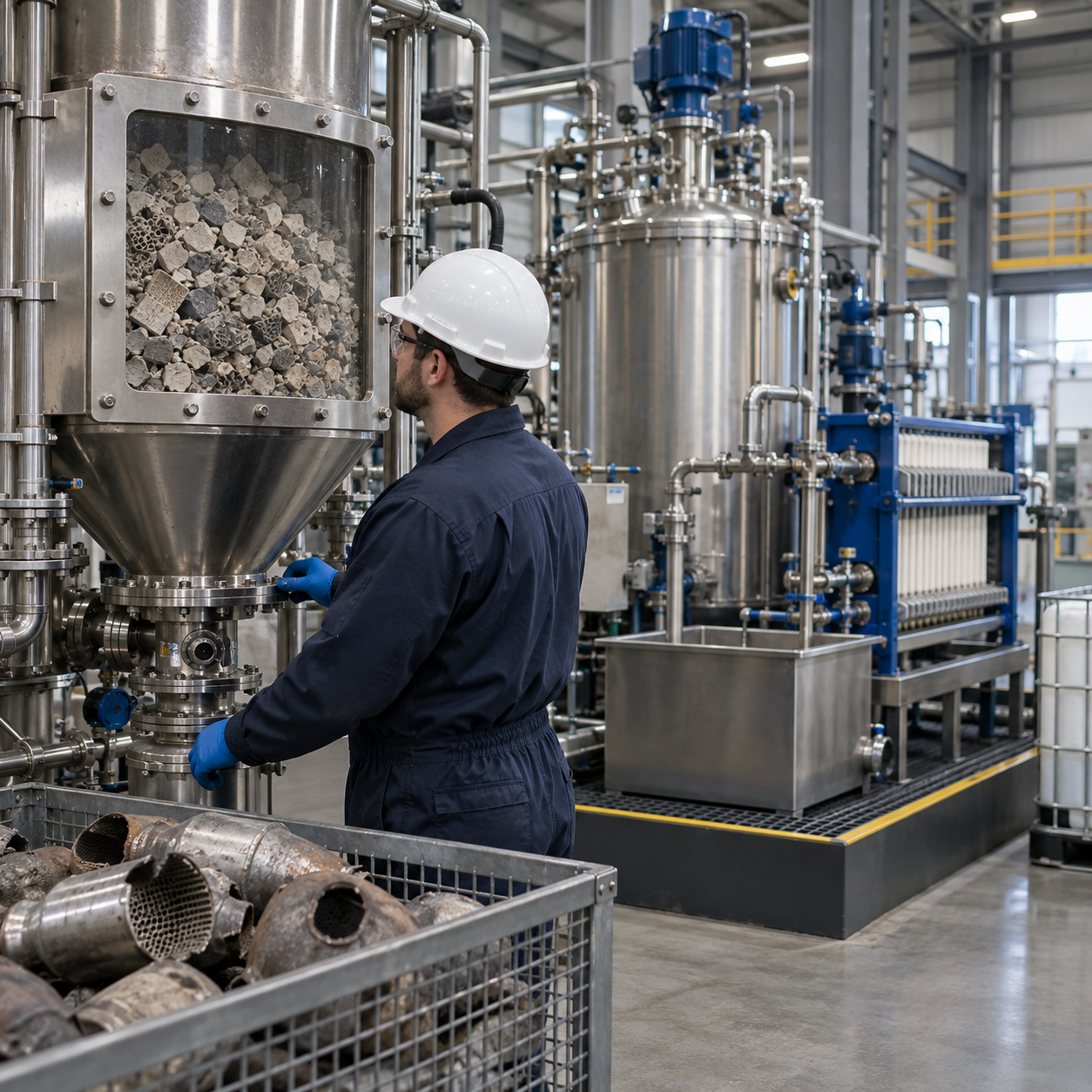
Spent automotive catalysts contain platinum-group metals on complex ceramic or metallic substrates together with alumina, ceria, base metals, soot and service-derived contamination. Organic-acid pretreatment may remove selected base metals or condition the feed before a separate PGM recovery stage. Oxalic acid is not a universal direct PGM leachant, and one catalyst population cannot represent the global scrap stream. Recyclers should evaluate it within a complete sampling, mass-balance, residue and downstream-refining program. This article covers B2B reagent qualification and pilot planning, not a leaching recipe.
For industrial qualification, assign purchasing, quality, engineering, operations, logistics and EHS ownership before the first delivery. Approve the specification, analytical methods, sampling point, retained-sample period, storage conditions, transfer equipment, deviation response and release authority in writing. Compare representative lots under controlled conditions and record process performance, mass balance, waste, equipment observations and final quality. This separates raw-material variation from water, equipment, operator or analytical changes. Review the chain from supplier release through carrier, package, receiving connection and day tank because contamination or misidentification can occur after final analysis. Reconcile ordered, received, stored and consumed quantities and investigate unexplained differences. Supplier scorecards should cover documentation accuracy, delivery condition, corrective-action quality and change notification as well as price. Qualify an alternate source before a disruption using the same methods and process criteria. When buyer and supplier results differ, review sample representativeness, temperature, calibration, detection limits and uncertainty before deciding disposition. Confirm emergency contacts, unloading hours and stop-work authority for every shipment. Include maintenance and warehouse teams in post-trial review because they often identify seal, vent, hose or handling issues not visible in a certificate of analysis. Close qualification with an authorized report, approved supplier status and a defined routine-monitoring plan. The current safety data sheet, local law and site procedures control storage, handling, exposure control and emergency response.
Build a representative catalyst feed
Separate or document catalyst type, substrate, vehicle class, service history and decanning method. Crush and blend under controlled conditions while managing dust. Use statistically defensible sampling because PGM and base-metal distribution can be highly heterogeneous.
Interpret published pretreatment evidence carefully
A 2025 study of organic-acid pretreatment for spent automotive catalysts offers recent technical context. Its feed, preparation and conditions do not automatically predict commercial scrap behavior or authorize scale-up without independent validation.
Define what pretreatment must accomplish
Set targets for selected base-metal removal, PGM retention, reagent consumption, filtration, wash demand and residue suitability for the next recovery stage. A pretreatment is valuable only when it improves the total flowsheet, refining yield, environmental performance or cost.
Protect PGM accountability
Measure platinum, palladium and rhodium in feed, liquor, washes, residues and analytical duplicates. Include sampling and assay uncertainty. Investigate any apparent PGM loss before proceeding, even when base-metal removal looks favorable.
Specify reagent quality for the trial
Control oxalic acid assay, hydration state, water, insolubles and impurities that could interfere with analysis, filtration or downstream refining. Link each experiment to supplier lot and COA. Retain reagent and feed samples for dispute or anomaly review.
Evaluate lot and supplier robustness
Repeat critical tests with multiple acid lots and, where feasible, a second qualified source. A process that performs only with one laboratory bottle is not ready for reliable industrial campaigns.
Engineer solids, liquor and waste handling
Characterize filtration rate, cake washing, dissolved metals, suspended solids and liquor stability. Plan treatment or recovery of the spent solution and compliant residue disposition. Include recycle tests because accumulated metals and organics can change performance.
Scale under process-safety governance
Assess dust, corrosive exposure, mixing, heat effects, off-gas, plugging and incompatible chemicals. Use closed equipment and engineering controls selected by the operator. Complete hazard review, materials testing and environmental authorization before pilot scale.
Connect procurement to campaign evidence
Order traceable laboratory quantities first, then tie pilot volume to the verified feed mass and reagent balance. Define acceptance tests, packaging, delivery sequence and change control. Avoid bulk purchase before the downstream refiner accepts the pretreated material.
Prepare a recycling inquiry
Provide required specification, test quantity, package, destination, campaign timing and documentation needs. Review the Hiacid oxalic acid product page, then request a documented pilot-supply proposal.
Related oxalic acid resources
- Oxalic Acid Supply for Registered Varroa Treatments
- High-Purity Oxalic Acid for Semiconductor Wafer Cleaning
- Oxalic Acid for Historic Masonry Iron-Stain Treatment
Frequently asked questions
Does oxalic acid directly recover all PGMs?
No. It may be evaluated as a pretreatment; the complete recovery flowsheet requires separate validation.
Why is representative sampling critical?
Catalyst scrap is heterogeneous, and poor sampling can distort both PGM recovery and base-metal-removal results.
What should a pilot mass balance include?
Account for feed, liquor, washes, residue, samples and PGM plus key base metals with stated uncertainty.
When is larger-scale supply appropriate?
Only after repeatable tests, downstream acceptance, hazard review, waste planning and a defined pilot campaign.