
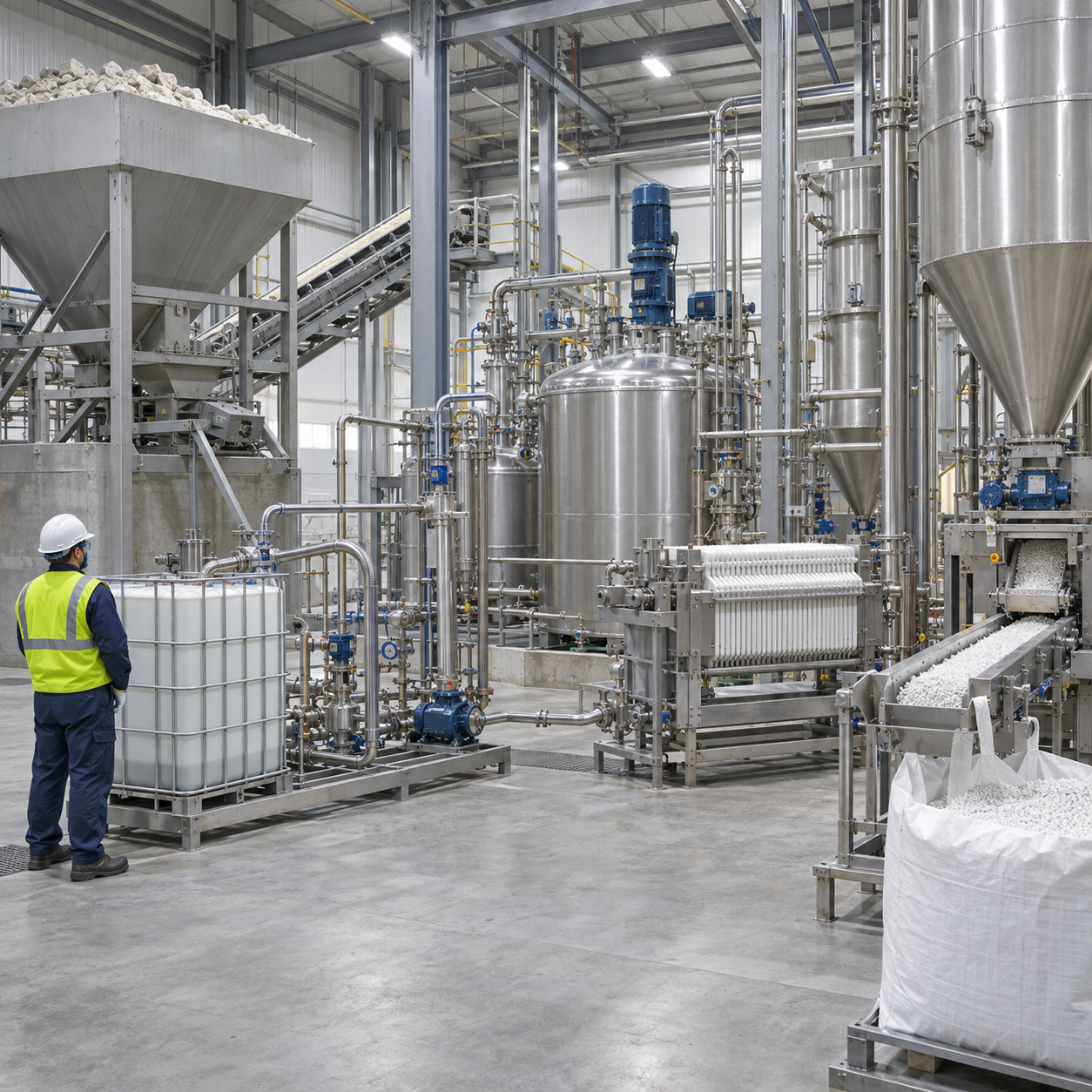
Calcium magnesium acetate, commonly abbreviated CMA, is an acetate-based deicing material produced by reacting acetic acid with calcium- and magnesium-bearing feedstocks. The Federal Highway Administration technical guidance describes commercial CMA production from acetic acid and dolomitic limestone and discusses its use as a deicer. For a manufacturer, however, the raw-material decision is not simply acid plus stone. Acid assay and water affect stoichiometry and evaporation load, while limestone chemistry, particle size, filtration, pellet strength and storage behavior shape finished-product quality. This article provides a B2B qualification framework rather than an operating formula. Process conditions must be established by qualified engineers and validated for the selected mineral source and product form.
For industrial qualification, assign purchasing, quality, engineering, operations, logistics and EHS responsibilities before the first commercial delivery. Approve the specification, analytical methods, sampling point, retained-sample period, storage conditions, transfer equipment, deviation response and release authority in writing. Compare several representative lots under controlled conditions and record process performance, mass balance, waste, equipment observations and final quality. This helps separate raw-material variation from water, equipment, operator or analytical changes. Review the chain from supplier release through carrier, package, receiving connection and day tank because contamination or misidentification can occur after final analysis. Reconcile ordered, received, stored and consumed quantities and investigate unexplained differences. Supplier scorecards should cover documentation accuracy, delivery condition, corrective-action quality and change notification as well as price. Qualify an alternate source before a disruption using the same methods and process criteria. When buyer and supplier results differ, review sample representativeness, temperature, calibration, detection limits and uncertainty before deciding disposition. Confirm emergency contacts, unloading hours and stop-work authority for every shipment. Glacial acetic acid can crystallize near common cool-weather temperatures, so winter logistics, controlled warming, homogenization and representative sampling must be approved in advance. Include maintenance and warehouse teams in the post-trial review because they often identify seal, vent, hose or handling issues not visible in a certificate of analysis. Close qualification with an authorized report, approved supplier status and a defined routine-monitoring plan.
Define the finished deicer specification
Set targets for calcium-to-magnesium ratio, acetate content, moisture, insolubles, particle-size distribution, bulk density, flowability and storage stability. Include the form sold to customers, such as granules, pellets or solution. These requirements determine the acceptable mineral feed and acid balance.
Use representative mineral campaigns
Dolomite and limestone vary by quarry and seam. Analyze calcium, magnesium, carbonate, silica, iron, moisture and other relevant components for each campaign. Pilot representative material rather than qualifying a carefully selected laboratory sample that does not reflect commercial supply.
Specify acid for mass-balance control
Define glacial acetic acid assay, water, color, residue and process-sensitive impurities with agreed methods. Require a lot-specific COA and an incoming identity or assay check. Compare purchase offers on active acid, not only delivered solution mass.
Account for delivered water
Water enters with both acid and mineral feed and later affects concentration, filtration, drying and energy use. Reconcile water and acetate through the process. A change in acid concentration should trigger engineering review before purchasing treats it as an interchangeable grade.
Control neutralization and solids separation
Use closed compatible feed, measured mineral addition and approved temperature and gas-management controls. Carbon dioxide generation and foaming must be considered in reactor volume, venting and filtration design. Record actual feed quantities and endpoint evidence for every batch.
Manage insolubles and recycle
Track filter-cake mass, mineral utilization, mother-liquor composition and recycle accumulation. Silica, fines and trace metals can build up and influence color, filtration and product stability. Establish purge or cleanup rules from data rather than reacting only after a quality failure.
Connect drying to winter performance
Monitor particle formation, moisture removal, attrition and dust. Evaluate storage under humidity and freeze-thaw conditions relevant to customers. A chemically compliant acetate can still perform poorly if it cakes, fragments or cannot be distributed uniformly.
Validate application evidence responsibly
Field performance depends on pavement temperature, application timing, precipitation, traffic and equipment. Coordinate product claims with validated test programs and applicable procurement specifications. Avoid extending results from one road condition to all winter-service scenarios.
Build resilient seasonal supply
Forecast acid demand from normal, severe-weather and inventory-recovery scenarios. Approve packaging or bulk delivery, unloading connections, winter heating controls and an alternate source before the season. Do not exceed validated storage residence time simply to build inventory.
Issue a production-specific RFQ
Provide required assay, water and impurity limits, monthly and peak volume, shipment mode, destination and documents. Review the Hiacid glacial acetic acid page, then request current COA, SDS and a specification-based quotation.
Related glacial acetic acid resources
- Glacial Acetic Acid for Sodium Diacetate Production
- Glacial Acetic Acid for Chitosan Film Manufacturing
- Glacial Acetic Acid for Limescale Remover Formulation
Frequently asked questions
What is the main raw-material role of acetic acid in CMA?
It supplies acetate while reacting with calcium- and magnesium-bearing feed, but the exact mass balance is feed-specific.
Why analyze every mineral campaign?
Quarry variation changes calcium, magnesium, insolubles, reaction demand, filtration and finished-product consistency.
Should buyers compare acid by solution price?
Compare delivered active acid together with water, freight, storage, handling and process energy.
Which CMA properties should be trended?
Track composition, moisture, particle size, bulk density, attrition, caking and relevant field-performance data.