
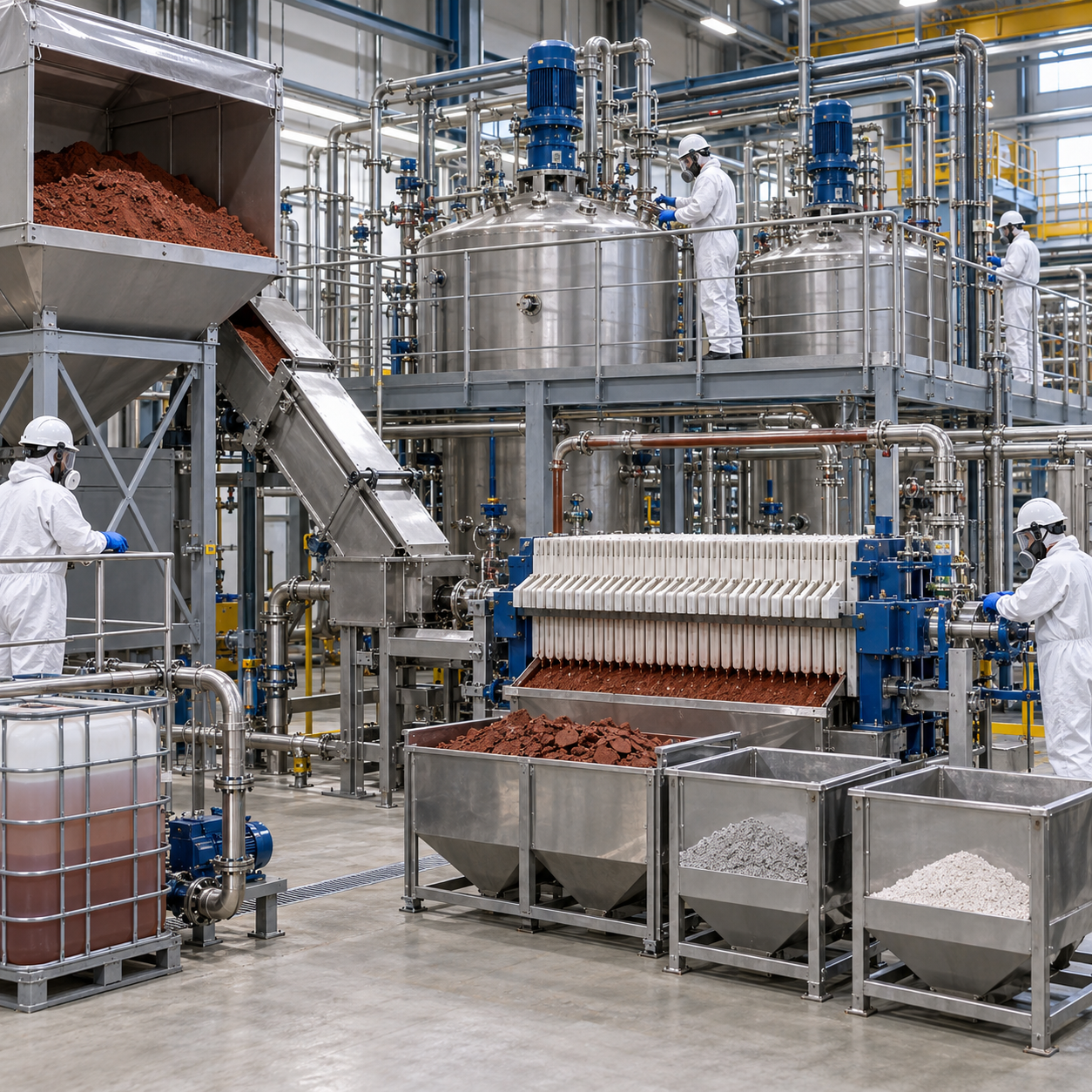
Bauxite residue, commonly called red mud, is an alkaline, iron-rich by-product of alumina refining. Its mineralogy and trace-metal content vary by ore, Bayer process and storage history. Research has examined oxalic acid within multi-stage flowsheets that recover iron-bearing products and move scandium or gallium into solution. These concepts are promising research routes, not proof of commercial viability. High solids, alkalinity, silica, titanium minerals and radioactive or trace constituents can change reagent demand and residue classification. This article describes how a project can qualify oxalic acid feed and evidence for pilot scale.
For industrial qualification, assign purchasing, quality, engineering, operations, logistics and EHS ownership before the first commercial delivery. Approve the oxalic acid hydration state, assay basis, analytical methods, sample point, retained-sample period, storage conditions, transfer method, deviation response and release authority in writing. Compare representative lots under controlled conditions and record process performance, mass balance, waste, equipment observations and final product quality. This separates raw-material variation from changes in water, feedstock, equipment, operator or analytical method. Review the chain from supplier release through carrier, package, warehouse and point of addition because contamination, moisture uptake or misidentification can occur after final analysis. Reconcile ordered, received, stored and consumed quantities and investigate unexplained differences. Supplier scorecards should cover documentation accuracy, delivery condition, corrective-action quality and change notification as well as price. Qualify a contingency source before a disruption using the same methods and process criteria. When buyer and supplier results differ, review sample representativeness, hydration state, drying basis, calibration, detection limits and uncertainty before deciding disposition. Confirm emergency contacts, unloading hours and stop-work authority for every shipment. Include maintenance and warehouse teams in post-trial review because they often identify dust, seal, liner or handling issues not visible on a certificate of analysis. Close qualification with an authorized report, approved-supplier status and a defined routine-monitoring plan. The NIH PubChem record for oxalic acid provides broad identity and use context; the current SDS, local law and site procedures remain controlling.
Characterize representative red mud
Measure moisture, alkalinity, particle size, mineral phases and concentrations of iron, aluminum, silicon, titanium, sodium, scandium, gallium and regulated trace elements. Use a sampling plan that covers depth, storage area and production period.
Define a product-led flowsheet objective
State which products are intended: ferrous oxalate, iron oxide, alumina, silica, titanium-rich residue or a scandium-gallium stream. Set purity, recovery and residue criteria for the entire flowsheet before selecting acid demand.
Treat published flowsheets as development evidence
A Minerals Engineering study investigated a flowsheet using oxalic acid leaching within broader recovery of iron, aluminum, titanium, scandium and gallium from red mud. The reported feed and sequence are not universal.
Screen selectivity rather than extraction alone
Measure dissolution of target and gangue elements, acid consumption, filtration and downstream separations. A high scandium or iron extraction may be unattractive if aluminum, silica or sodium loads overwhelm purification.
Qualify oxalic acid and process water
Specify hydration state, assay, insolubles, residue and metals that could distort mass balances or product purity. Characterize water and recycled liquors because alkalinity and dissolved ions affect reagent demand.
Use multi-lot pilot evidence
Test several red mud and oxalic acid lots. Track mineralogy, reagent consumption, recovery, filterability and final products. Statistical variability is necessary for a credible commercial design basis.
Design containment and residue management
Red mud dust, alkaline carryover and acidic liquors require engineered containment, ventilation and compatible equipment. Review reaction heat, gas potential, slurry transport, erosion, filtration and emergency response.
Plan oxalate fate and water reuse
Quantify oxalate in products, raffinate, wash water and residue. Evaluate recovery or destruction routes, impurity buildup and discharge requirements. Do not label a flowsheet circular without a closed mass balance.
Stage supply with project maturity
Use small documented packages for screening, campaign-aligned quantities for pilot work and bulk only after stable balances and permits. Require change notification and retained samples throughout development.
Prepare a red-mud inquiry
Provide hydration state, impurity limits, trial volume, package, destination, COA and scale-up schedule. Review the Hiacid oxalic acid product page, then request a documented pilot-supply proposal.
Related oxalic acid resources
- Oxalic Acid for Leather Waste Dechroming and Collagen Recovery
- Oxalic Acid for Iron Recovery from Wet-Process Phosphoric Acid
- Oxalic Acid Recovery from High-Iron Process Liquors
Frequently asked questions
Is all red mud chemically similar?
No. Ore mineralogy, refinery conditions and storage history cause major differences in alkalinity and metal behavior.
Does high iron extraction prove commercial viability?
No. Product purity, acid consumption, filtration, critical-metal recovery, residue and water treatment also determine viability.
Why analyze process water and recycle liquor?
Dissolved ions and accumulated impurities affect reagent demand, selectivity and product quality.
When should bulk oxalic acid be considered?
Only after reproducible pilot campaigns, a closed mass balance, approved safety controls and required permits.