
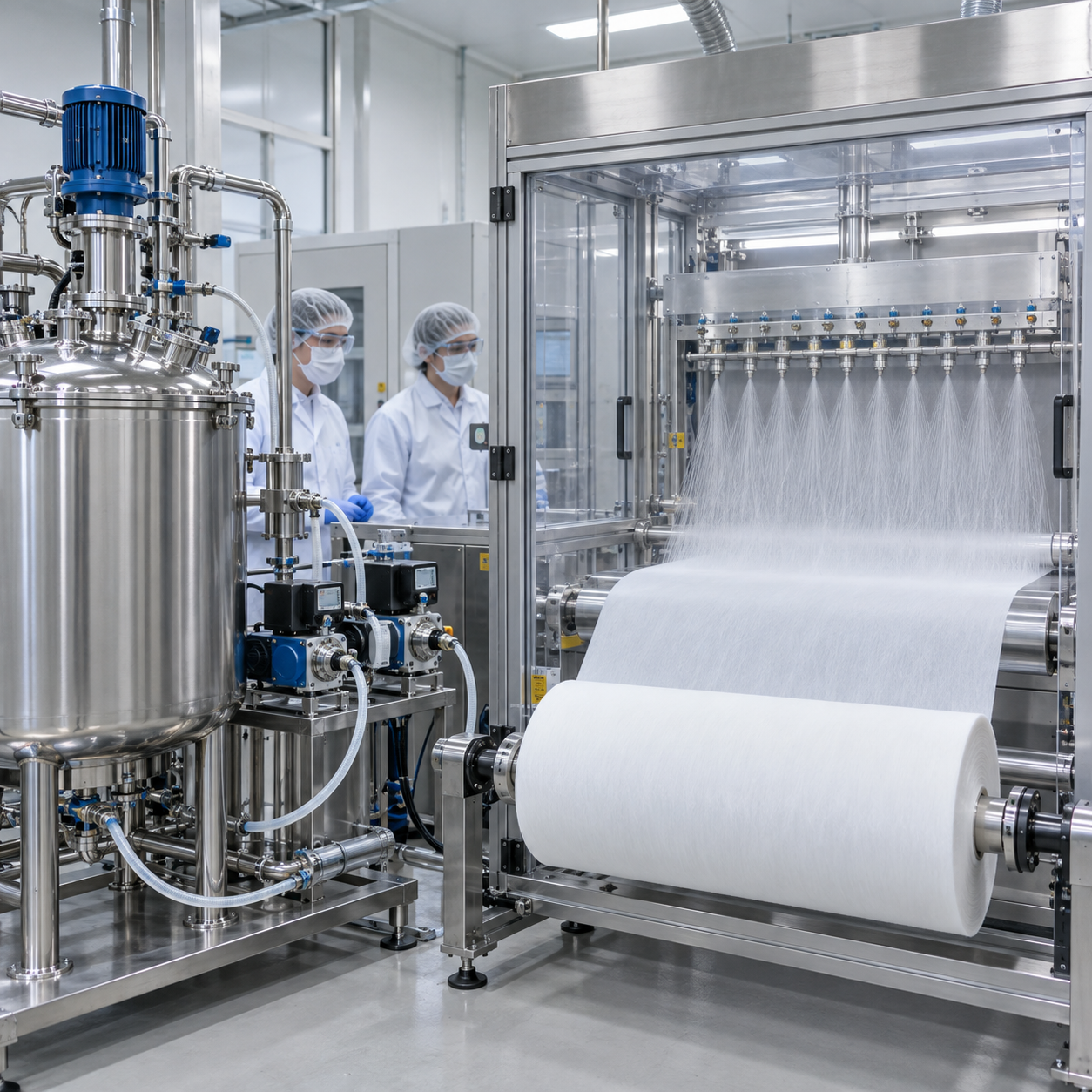
Polyamide electrospinning is used to develop high-surface-area fiber mats for filtration, separators, protective textiles and composite reinforcement. Formic acid is a common solvent for PA6 and PA66 systems, either alone or in blends, because it can support polymer dissolution and electrical conductivity. Fiber quality remains sensitive to polymer molecular properties, concentration, solvent water, temperature, humidity, residence time and equipment geometry. A successful bench syringe does not automatically translate to a stable multi-needle or needleless line. Solvent procurement, process control and recovery therefore need to be qualified as one system.
Industrial buyers should establish written ownership across purchasing, quality, engineering, operations, logistics and EHS before a commercial trial. Approve the formic acid specification, analytical methods, sample point, retained-sample period, storage conditions, transfer equipment, release authority and deviation response. Compare more than one representative lot under controlled conditions and record material balance, process performance, equipment observations, waste and final product quality. This makes it possible to distinguish acid variation from changes in water, feedstock, equipment, operator or test method. Review the entire chain from supplier release through package or carrier, receiving connection and day tank because contamination or misidentification can occur after manufacture. Reconcile ordered, received, stored and consumed quantities and investigate unexplained differences. Supplier scorecards should include document accuracy, delivery condition, corrective-action quality and change notification as well as price. Qualify a contingency source before a disruption using the same tests and process criteria. If buyer and supplier results differ, review sampling, temperature, calibration, detection limits and uncertainty before disposition. Confirm emergency contacts, unloading hours and stop-work authority for every shipment. Include warehouse and maintenance teams in post-trial review because they often identify seal, vent, hose or handling issues not visible on a certificate. Close qualification with an authorized report, approved-supplier status and routine monitoring. The NIH PubChem record for formic acid provides identity and broad hazard context; the current SDS, local law and site procedures remain controlling.
Match the solvent system to the polyamide
Identify polymer family, grade, molecular mass distribution, additives, moisture and thermal history. Establish dissolution and aging behavior for the exact resin because PA6, PA66 and long-chain polyamides do not share one universal solvent window.
Use literature to define measurable questions
A review and comparative study of polyamide electrospinning identifies formic acid as a widely used solvent and discusses polymer- and process-dependent morphology. Use that evidence to plan trials, not as a fixed production formula.
Control solution preparation and hold time
Specify charge order, agitation, temperature monitoring, closed transfer, filtration and maximum hold time through qualified procedures. Measure solution concentration, viscosity, conductivity and appearance using consistent temperature and sampling conditions.
Treat water as a process variable
Water can enter with acid, polymer, air or cleaning. Define limits through fiber data, confirm the acid method, and protect opened packages or day tanks from uncontrolled moisture exchange.
Link spinning conditions with fiber morphology
Record voltage, flow, distance, collector speed, temperature, humidity and solution age. Evaluate diameter distribution, beads, fused regions, basis weight, pore structure, tensile behavior and residual solvent.
Scale with guarded equipment and ventilation
Larger emitter arrays change airflow, evaporation, electrical fields and deposition uniformity. Validate enclosure, interlocks, grounding, exhaust and solvent monitoring before production trials.
Plan solvent capture and quality control
Quantify acid charged, retained in product, captured, condensed, purged and lost. Test recovered solvent for water, dissolved polymer, color and performance before recycle. Do not infer purity only from density.
Protect finished-mat consistency
Link each roll to polymer and acid lots, solution batch, equipment settings and fiber tests. Retain representative samples so a morphology shift can be investigated across material and process history.
Qualify the supplier for advanced materials work
Approve assay, water, residue, color, metals and selected organic impurities based on trials. Require lot-specific COA data, packaging identity, retained samples and advance change notice.
Prepare an electrospinning inquiry
Provide concentration, water and impurity limits, package, trial volume, delivery site and scale-up forecast. Review the Hiacid formic acid page, then request a documented solvent quotation.
Related formic acid resources
- Formic Acid for Fish Silage Production
- Formic Acid for Swine Feed Acidification
- Formic Acid for Nanocellulose Isolation
Frequently asked questions
Can one formic acid specification cover every polyamide?
No. Polymer family, molecular properties, additives and moisture can change dissolution and fiber formation.
Why is acid water content important?
It can affect solution properties, evaporation and fiber morphology, so limits should be tied to trial data.
Which fiber tests support qualification?
Diameter distribution, defects, basis weight, pore structure, mechanical properties and residual solvent are common candidates.
Can recovered formic acid be reused automatically?
No. Its water, dissolved polymer, color and process performance must be measured and controlled.