
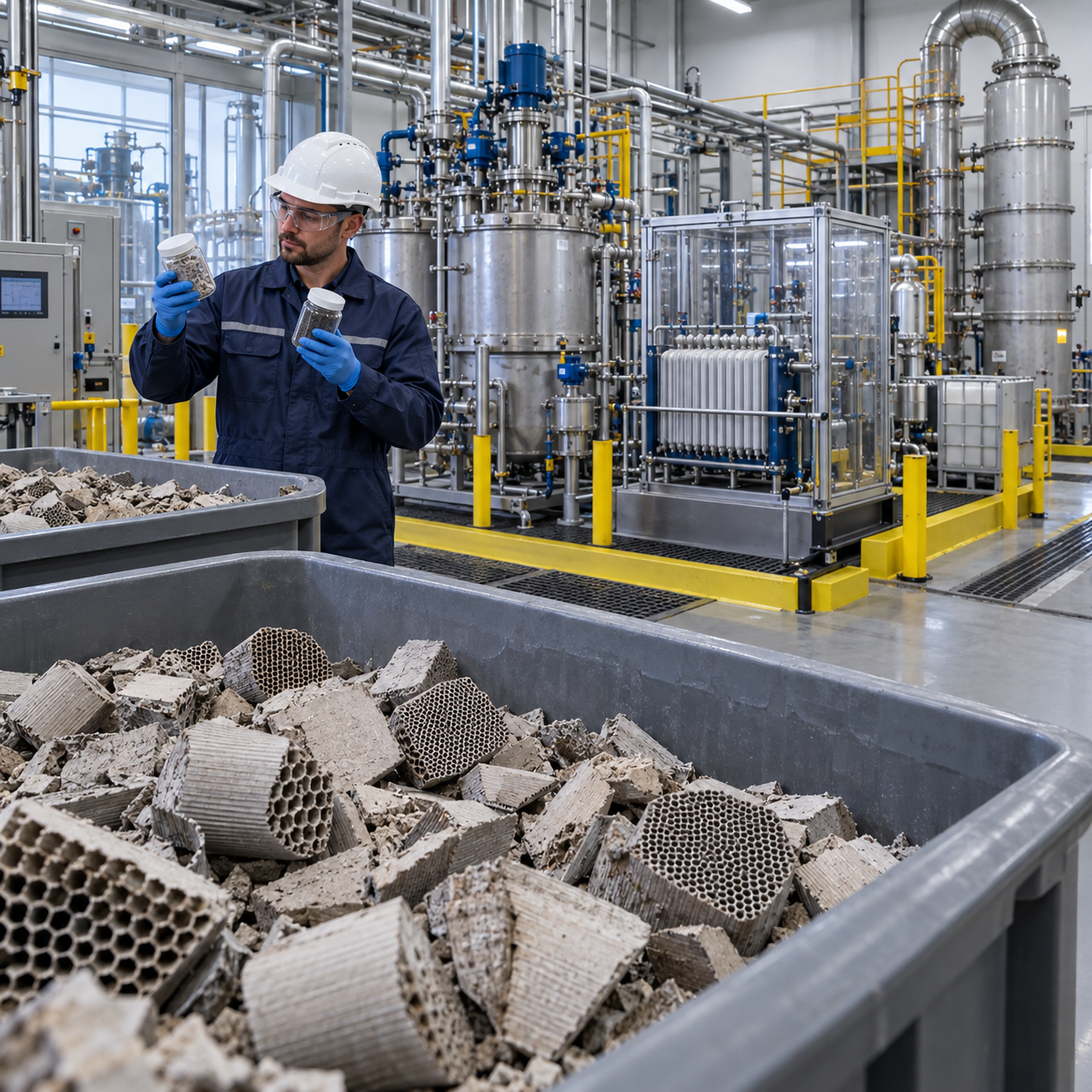
Spent automotive catalysts contain platinum, palladium and rhodium dispersed at low concentrations on a ceramic or metallic support, together with base metals, soot and road contamination. Hydrochloric acid can form chloride complexes used in selected hydrometallurgical recovery routes, usually with a separately controlled oxidizing system. Feed variability, difficult rhodium dissolution, chloride corrosion and multi-stage separation make simple extraction percentages inadequate. This guide helps recyclers and chemical buyers qualify hydrochloric acid and commercial evidence without providing operational leaching conditions.
An ACS Sustainable Chemistry & Engineering study evaluated hydrochloric-acid leaching and supported ionic-liquid separation for a characterized spent automotive catalyst. Its material, oxidant and laboratory conditions are research-specific.
Industrial hydrochloric acid qualification should assign purchasing, quality, engineering, operations, logistics and EHS ownership before the first delivery. Approve concentration, analytical methods, sampling, storage, compatible transfer equipment, deviation response and release authority in writing. Compare representative lots under controlled conditions and record process performance, mass balance, emissions-control operation, waste, equipment observations and final product quality. This separates raw-material variation from changes in feedstock, water, equipment, operator or analytical method. Review the chain from supplier release through carrier, package, receiving connection and day tank because contamination or dilution can occur after final analysis. Reconcile ordered, received, stored and consumed quantities and investigate unexplained differences. Supplier scorecards should cover documentation accuracy, delivery condition, corrective-action quality and change notification as well as price. Qualify a contingency source with the same methods before a disruption. When buyer and supplier results differ, review sample representativeness, temperature, standards, calibration, detection limits and measurement uncertainty before disposition. Confirm emergency contacts, unloading hours and stop-work authority for every shipment. Hydrochloric acid is corrosive and can release irritating hydrogen chloride vapor; use the current SDS, compatible segregation, ventilation, containment and an approved emergency plan. The NIOSH Pocket Guide entry and NIH PubChem record provide general hazard and identity context, while local law and site procedures remain controlling. Close qualification with an authorized report, approved-supplier status and a routine-monitoring plan.
Assay and homogenize the catalyst feed
Separate ceramic monolith, metallic substrate, washcoat concentrate and mixed fines where practical. Record vehicle or catalyst source, preprocessing, moisture, carbon, particle size, platinum, palladium, rhodium and major base metals.
Validate sampling at low PGM levels
Use representative crushing, splitting, certified reference materials and reconciliation. Precious-metal value can be distorted by segregation or a small analytical bias, so sample preparation and retained feed matter as much as the leaching test.
Compare complete recovery flowsheets
Evaluate extraction, selectivity, solid-liquid separation, chloride complex stability, capture, stripping, precipitation, refining and reagent recycle together. A high palladium result does not prove that platinum and rhodium or final product purity are acceptable.
Separate acid and oxidant decisions
Hydrochloric acid supplies chloride and acidity, while oxidation state may be controlled by another reagent or electrochemical step. Qualify each independently and assess compatibility, gas generation and redox control under the approved process design.
Specify hydrochloric acid for precious metals work
Define concentration, iron, copper, lead, sulfate, nonvolatile residue and analytical methods. Incoming metals can burden downstream separation or contaminate the recovered product. Agree lot sampling, retest and release rules with the supplier.
Link every result to lot genealogy
Record catalyst lot, acid lot, oxidant lot, equipment, filtration, separation media and all samples. Retain feed, liquor, residue and product so an apparent metal loss can be reconstructed.
Engineer corrosion, gas and powder controls
Use compatible closed reactors, metered addition, heat removal, ventilation, scrubbing, containment and emergency shutdown. Control ceramic dust during preprocessing and assess any chlorine-containing or other gases that the selected oxidizing system could produce.
Close chloride and metal balances
Account for PGM and base metals in feed, liquor, scrubber, wash, residue, separation media and products. Track chloride in raffinate and recycle. Include treatment and corrosion costs in the scale-up decision.
Stage supply around campaign evidence
Begin with traceable trial packages, then scale only after replicated recovery, product-quality and waste data. Require COA, SDS, retained samples, delivery qualification, deviation support and advance change notification.
Prepare a PGM-recovery inquiry
Provide concentration, impurity limits, package, trial or annual volume, schedule and destination. Review the Hiacid hydrochloric acid product page, then request a specification-led supply proposal.
Related hydrochloric acid resources
- Hydrochloric Acid for High-Purity Quartz Purification
- Hydrochloric Acid for Scandium Recovery from Bauxite Residue
- Hydrochloric Acid for RO Membrane Carbonate Scale Cleaning
Frequently asked questions
Can one process treat every automotive catalyst?
No. Substrate, washcoat, PGM loading, age and contamination require representative feed testing.
Why separate acid and oxidant qualification?
They perform different chemical functions and may introduce different impurities, hazards and costs.
What should a PGM mass balance include?
Feed, liquor, wash, scrubber, residue, separation media, intermediate and final product should be reconciled.
Does this article provide a precious-metal recovery recipe?
No. It presents procurement and qualification controls for professional recycling projects.