
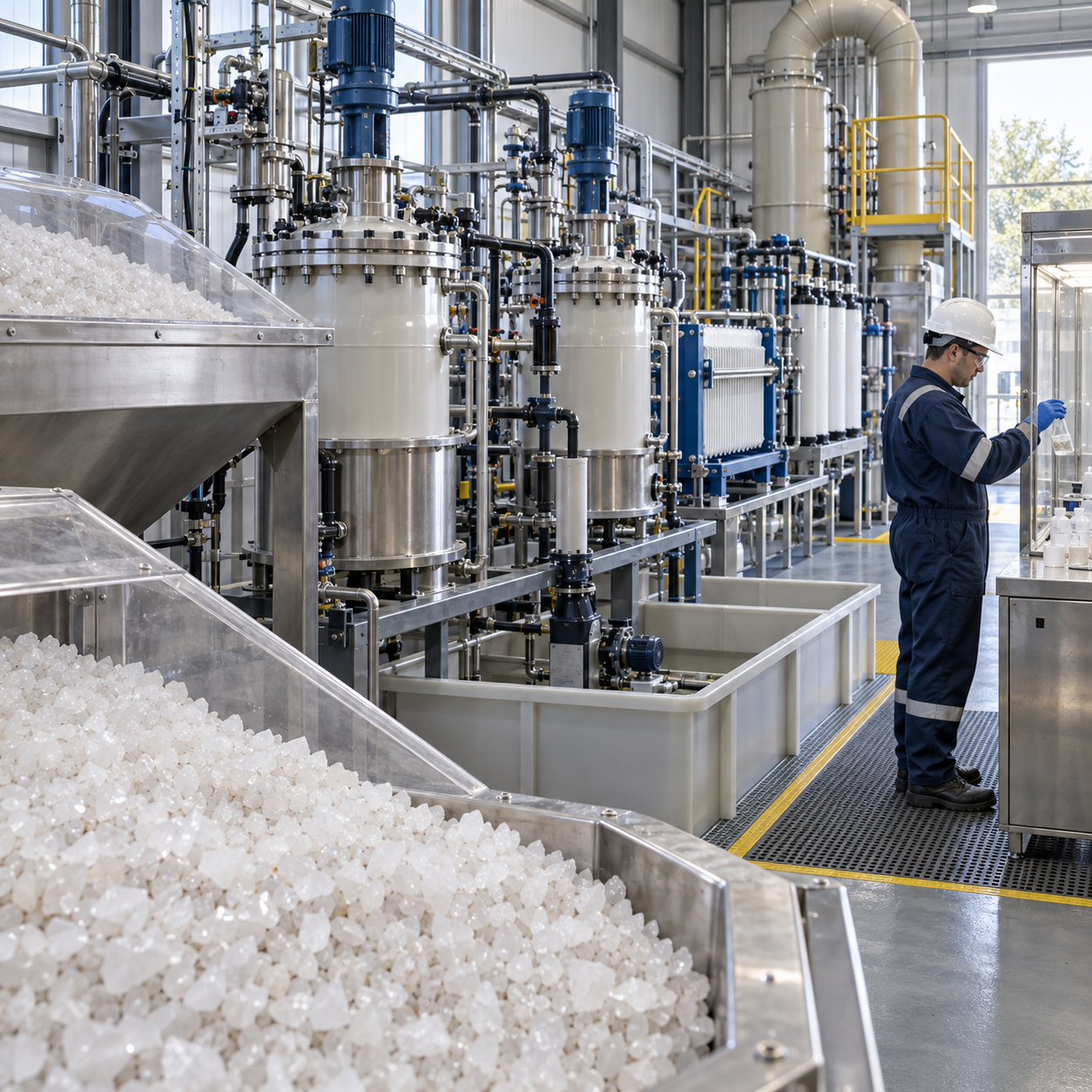
High-purity quartz is used in demanding applications where iron, aluminum, calcium, titanium, alkali metals and other trace contaminants can limit performance. Hydrochloric acid may be incorporated into selected purification flowsheets to dissolve accessible metal-bearing impurities after physical beneficiation or thermal treatment. Its effectiveness depends on mineralogy, inclusion type, particle size and pretreatment; a low bulk impurity result does not prove that every contaminant has been removed or that yield is acceptable. This guide explains how mineral processors and silica buyers can qualify hydrochloric acid supply without prescribing a leach recipe.
A Minerals case study on vein-quartz purification describes acid leaching as one part of a wider beneficiation route and emphasizes analysis of trace impurities before and after treatment. Published feed and conditions are not universal plant instructions.
Industrial hydrochloric acid qualification should assign purchasing, quality, engineering, operations, logistics and EHS ownership before the first delivery. Approve concentration, analytical methods, sampling, storage, compatible transfer equipment, deviation response and release authority in writing. Compare representative lots under controlled conditions and record process performance, mass balance, emissions-control operation, waste, equipment observations and final product quality. This separates raw-material variation from changes in feedstock, water, equipment, operator or analytical method. Review the chain from supplier release through carrier, package, receiving connection and day tank because contamination or dilution can occur after final analysis. Reconcile ordered, received, stored and consumed quantities and investigate unexplained differences. Supplier scorecards should cover documentation accuracy, delivery condition, corrective-action quality and change notification as well as price. Qualify a contingency source with the same methods before a disruption. When buyer and supplier results differ, review sample representativeness, temperature, standards, calibration, detection limits and measurement uncertainty before disposition. Confirm emergency contacts, unloading hours and stop-work authority for every shipment. Hydrochloric acid is corrosive and can release irritating hydrogen chloride vapor; use the current SDS, compatible segregation, ventilation, containment and an approved emergency plan. The NIOSH Pocket Guide entry and NIH PubChem record provide general hazard and identity context, while local law and site procedures remain controlling. Close qualification with an authorized report, approved-supplier status and a routine-monitoring plan.
Characterize the quartz before choosing chemistry
Measure mineral phases, inclusion types, particle-size distribution, surface coatings and trace elements using methods appropriate to the final market. Distinguish impurities on particle surfaces or fractures from those trapped within the quartz lattice. Acid cannot compensate for inadequate liberation or remove every structural inclusion.
Create an application-based impurity map
Rank iron, aluminum, calcium, sodium, potassium, lithium, titanium, boron and other elements against the customer specification. Define sampling and detection limits that can distinguish real improvement from analytical variability.
Design a complete purification sequence
Coordinate crushing, scrubbing, magnetic separation, flotation, thermal steps, acid treatment, washing and drying. A strong result in one stage can be lost through contaminated water, steel contact, filter media or handling after purification.
Track recovery as well as purity
Record mass yield, fines generation, filter loss, acid consumption, water use and final particle distribution. A process that reaches a trace-element target with excessive quartz loss may not be technically or commercially viable.
Specify hydrochloric acid around critical metals
Define concentration, iron, aluminum, calcium, nonvolatile residue, sulfate, color and validated methods. Supplier and buyer should agree sampling, units, temperature correction, detection limits and retest rules before trial material is accepted.
Qualify water and contact materials
Use water that meets the project blank targets and confirm compatibility of reactors, transfer lines, filters, dryers and storage. Include equipment blanks in pilot campaigns to distinguish mineral impurities from process contamination.
Control washing and chloride carryover
Set wash endpoints using justified measures such as chloride, conductivity, acidity and trace-metal results. Confirm that the washing sequence reaches specifications across representative particle sizes without losing fine product.
Close liquid and solid balances
Account for chloride, dissolved metals, wash water, filter cake and off-spec quartz. Evaluate acid recovery or water reuse only after checking accumulation of metals and salts over repeated cycles.
Stage supply with project maturity
Begin with traceable trial packages and move to bulk delivery only after reproducible product, yield, corrosion and waste-treatment results. Require COA, SDS, retained samples, deviation support and advance notification of manufacturing or logistics changes.
Prepare a quartz-purification inquiry
Provide concentration, critical impurity limits, package, trial volume, annual forecast, destination and required documents. Review the Hiacid hydrochloric acid product page, then request a specification-based supply proposal.
Related hydrochloric acid resources
- Hydrochloric Acid for Scandium Recovery from Bauxite Residue
- Hydrochloric Acid for PGM Recovery from Automotive Catalysts
- Hydrochloric Acid for RO Membrane Carbonate Scale Cleaning
Frequently asked questions
Can hydrochloric acid remove every quartz impurity?
No. Mineralogy and impurity location determine accessibility; physical beneficiation and other validated stages may be necessary.
Why monitor quartz yield?
Purity gains can be commercially unattractive if fines, dissolution or filtration losses reduce saleable product.
Which acid impurities may be important?
Iron, aluminum, calcium, sulfate and nonvolatile residue should be assessed against the final quartz specification.
Does this article provide a quartz leaching recipe?
No. It is a procurement and qualification framework for professionally engineered trials.