
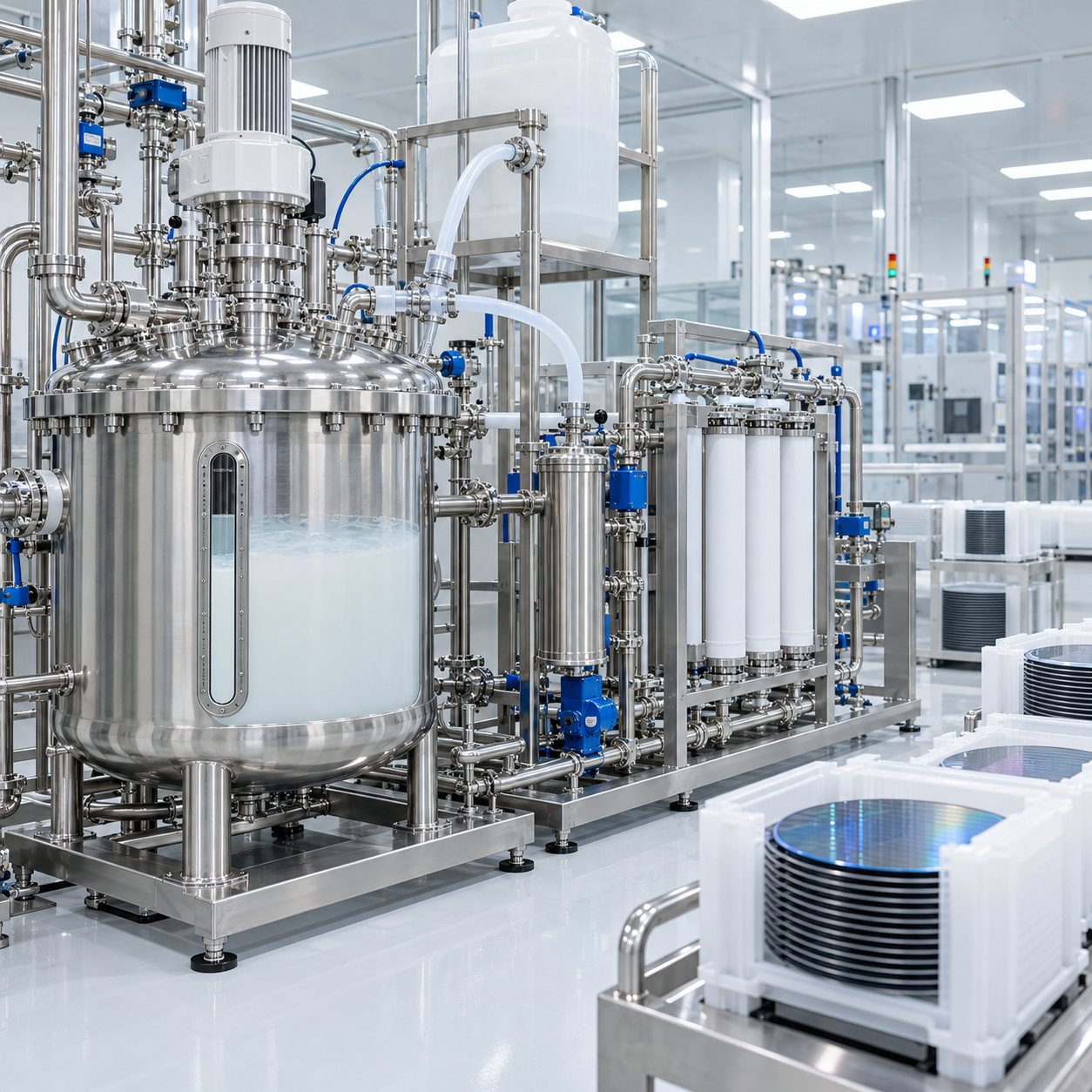
Tungsten chemical mechanical planarization uses a slurry that combines chemical oxidation with controlled mechanical removal. Hydrogen peroxide can serve as the oxidizer, but slurry behavior also depends on catalyst, abrasive, pH, inhibitors, dissolved metals, particles and time after blending. Decomposition changes oxidizer availability and can create gas, while trace contamination can affect wafer defects and removal uniformity. A nominal industrial peroxide grade is not automatically suitable for semiconductor slurry manufacture. Buyers must qualify purity, stabilizer chemistry, packaging, blending sequence and performance on representative wafers. This guide explains supply governance without disclosing a slurry formulation.
A peer-reviewed study of tungsten CMP slurry compares hydrogen peroxide and other oxidizers and relates oxidizer choice and pH to tungsten polishing behavior. Its test slurry is not a universal production formula.
Industrial hydrogen peroxide qualification should assign purchasing, quality, engineering, operations, logistics and EHS ownership before the first delivery. Approve concentration, stabilizer package, analytical methods, sampling, storage, compatible transfer equipment, deviation response and release authority in writing. Compare representative lots under controlled conditions and record process performance, mass balance, gas evolution, waste, equipment observations and final product quality. This separates raw-material variation from changes in feedstock, water, equipment, operator or method. Review the chain from supplier release through carrier, package, receiving connection and day tank because contamination or decomposition can occur after final analysis. Reconcile ordered, received, stored and consumed quantities and investigate unexplained differences. Supplier scorecards should cover documentation accuracy, delivery condition, corrective-action quality and change notification as well as price. Qualify a contingency source using the same methods before a disruption. When buyer and supplier results differ, review sample representativeness, temperature, standards, calibration, detection limits and uncertainty before disposition. Confirm emergency contacts, unloading hours and stop-work authority for every shipment. Hydrogen peroxide is a strong oxidizer that can decompose exothermically and release oxygen; use the current SDS, dedicated compatible equipment, contamination control, ventilation, pressure relief, containment and an approved emergency plan. The NIOSH Pocket Guide entry and NIH PubChem record provide general hazard and identity context, while local law and site procedures remain controlling. Close qualification with an authorized report, approved-supplier status and a routine-monitoring plan.
Define wafer and integration requirements
Specify tungsten stack, barrier materials, pattern density, target removal rate, selectivity, within-wafer uniformity, dishing, erosion, roughness and defect limits. Include post-CMP cleaning and downstream yield.
Use blanket and patterned wafer evidence
Blanket data supports screening, but patterned wafers reveal feature-dependent defects and planarization. Approve the peroxide-slurry system only after representative tool and wafer testing.
Specify peroxide for high-purity service
Define concentration, acidity, stabilizer identity, trace metals, anions, total organic carbon, particles and nonvolatile residue at justified limits. Agree analytical methods, detection limits and sampling containers.
Evaluate stabilizer compatibility explicitly
A stabilizer that improves peroxide storage may interact with catalyst, abrasive, wafer surface or post-CMP cleaning. Test the actual approved package instead of assuming all peroxide at one concentration is equivalent.
Control blending and useful life
Map peroxide assay, dissolved oxygen, pH, particles and polishing response from blend through point of use. Define mix order, hold time, temperature and recirculation under the qualified process.
Investigate decomposition signals
Unexpected heat, bubbles, pressure, assay loss or removal-rate drift should trigger containment and root-cause review. Examine metals, filter materials, tanks, pumps and cleaning residues.
Protect particles and contamination performance
Use high-purity compatible packages, dedicated connections, filtered transfer and controlled cleanroom handling. Trend incoming and blended-particle distributions rather than relying only on bulk chemical assay.
Close the slurry performance matrix
Compare removal rate, selectivity, defects, roughness, dishing, erosion and cleaning results across peroxide lots, slurry age, tool conditions and wafer designs. Use statistical limits appropriate to production risk.
Govern supplier and packaging changes
Require COA, SDS, lot genealogy, retained samples and advance notice of manufacturing site, purification, stabilizer, container, analytical method or logistics changes. Requalify critical changes on wafers.
Prepare a tungsten CMP inquiry
Provide concentration, stabilizer, trace-metal and particle limits, package, cleanroom expectations, volume and destination. Review the Hiacid hydrogen peroxide product page, then request a high-purity supply discussion.
Related hydrogen peroxide resources
- Hydrogen Peroxide for Chlorine Dioxide Generation
- Hydrogen Peroxide for Thiourea Dioxide Manufacturing
- Hydrogen Peroxide for Cyclohexanone Ammoximation
Frequently asked questions
Why is peroxide assay alone insufficient for tungsten CMP?
Stabilizers, metals, particles, residue and decomposition can affect removal, selectivity and wafer defects.
Why test patterned wafers?
They reveal dishing, erosion, feature-density effects and defects that blanket wafers cannot fully represent.
What can cause peroxide loss in slurry?
Catalytic metals, temperature, incompatible surfaces, contamination and extended hold time can accelerate decomposition.
Does this guide provide a tungsten slurry formula?
No. It provides a supplier-qualification framework and intentionally omits composition and operating conditions.