
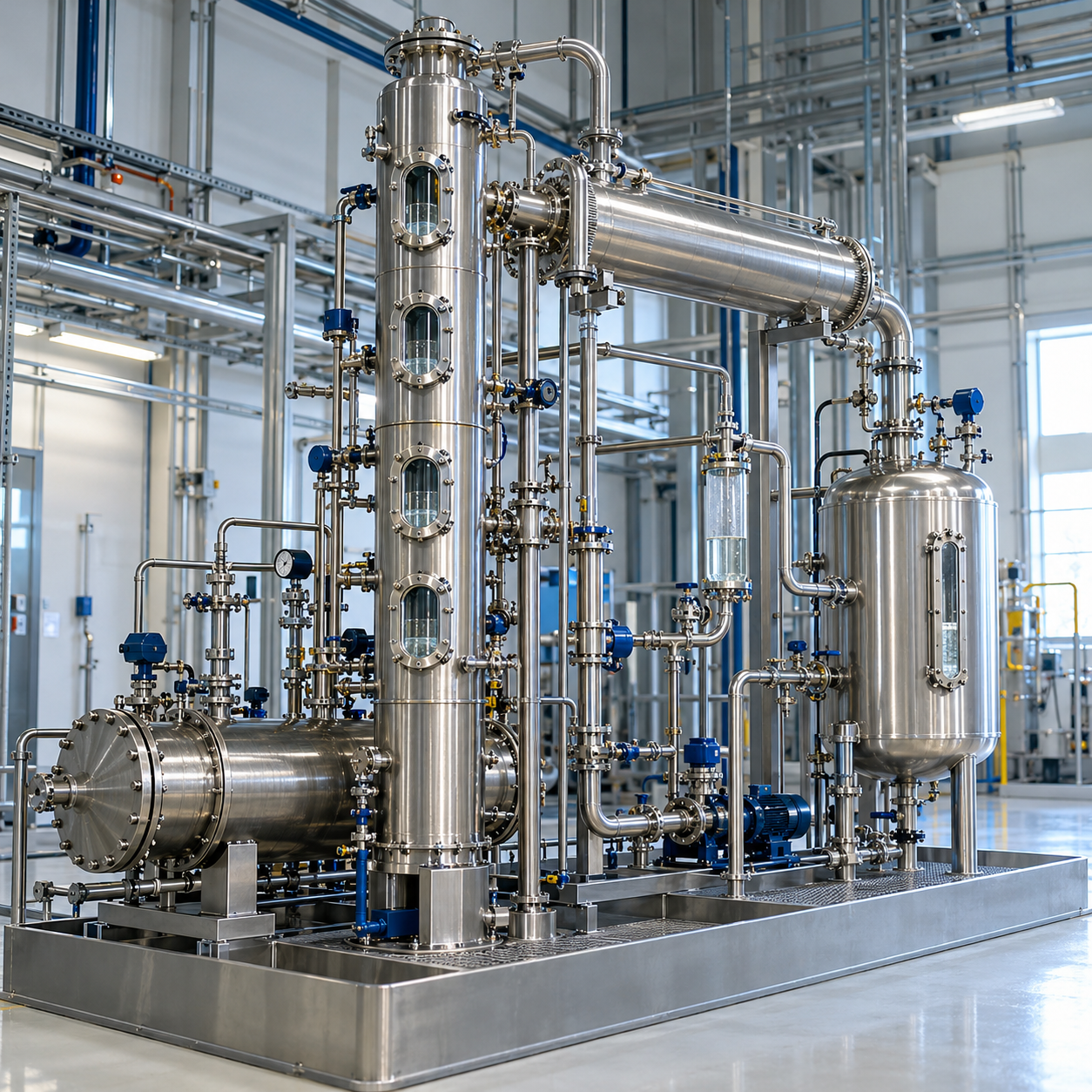
Recovering formic acid can reduce raw-material loss and wastewater loading, but the separation is rarely a simple boiler-and-condenser problem. Water and formic acid show non-ideal vapor-liquid behavior, while real process streams may also contain acetic acid, methanol, methyl formate, salts, metals, suspended solids and high-boiling organics. Concentration changes can alter corrosion, vapor composition and product suitability. A sound project begins with representative feed data and phase-equilibrium review, then integrates separation method, materials, control, energy and end-use quality. This guide helps industrial teams frame a pilot and procurement program; detailed design belongs to qualified process-safety and separation specialists.
A published process study describes the maximum-boiling behavior of the formic-acid/water system and compares separation approaches. Research on reactive, extractive and pressure-swing configurations shows why feed composition and recovery target must be defined before equipment selection.
Industrial qualification should have named ownership across purchasing, quality, engineering, operations, logistics and EHS. Approve the formic acid specification, test methods, sample points, retained-sample period, package or carrier, unloading connection, storage limits, release authority and deviation response before the first commercial lot. Compare representative lots under controlled conditions and record material balance, process performance, equipment observations, waste and final-product quality. This helps separate acid variation from changes in water, feedstock, equipment, operator or test method. Review the entire chain from supplier release through transport, receiving and point of use because contamination or misidentification can occur after manufacture. Reconcile ordered, received, stored and consumed quantities and investigate unexplained differences. Supplier scorecards should include document accuracy, delivery condition, corrective-action quality and change notification as well as price. Qualify contingency supply before a disruption using the same tests and process criteria. Where buyer and supplier results differ, review sampling, temperature, calibration, detection limits, units and measurement uncertainty before disposition. Confirm emergency contacts, unloading hours and stop-work authority for every shipment. Include warehouse and maintenance personnel in the trial review because they often identify seal, vent, hose or handling issues not visible on a certificate. Close qualification with an authorized report, approved-supplier status, routine monitoring and requalification triggers. Formic acid is corrosive and concentrated grades may introduce additional transport and fire considerations. The NIH PubChem record for formic acid provides identity and broad hazard context; the current SDS, local law, permit conditions and site procedures remain controlling. Buyers should not infer regulatory approval or guaranteed process performance from a product description or published study.
Characterize every recovery feed
Sample across normal production, grade changes, startup, shutdown, cleaning and upset periods. Measure formic acid, water, other acids, alcohols, esters, salts, suspended solids, metals, color and nonvolatile residue. Record temperature, flow and campaign timing with each sample.
Set separate product and waste targets
Define recovered-acid concentration, impurity limits, color, intended reuse and allowable accumulation. Also define bottoms, aqueous purge and vent criteria. A high recovery percentage is not useful when the recovered stream cannot return safely to its intended process.
Select separation from thermodynamics
Build or validate vapor-liquid and liquid-liquid data for the actual mixture. Review pressure effects, azeotropes, decomposition, association and potential phase splits. Use simulation as a decision tool supported by experiments rather than as proof that an unmeasured stream will behave ideally.
Compare complete process routes
Evaluate pressure-swing, extraction plus distillation, reactive separation, membrane or hybrid options where appropriate. Include solvent or entrainer recovery, water removal, purge, startup inventory and off-spec handling. Compare complexity and controllability as well as energy.
Design corrosion and containment controls
Map concentration and temperature at reboilers, columns, condensers, receivers, pumps, vents and dead legs. Qualify metals, welds, linings, gaskets and seals for both liquid and vapor conditions. Include impurities that may dominate localized corrosion.
Review reactive and pressure hazards
Assess heat input, vacuum or pressure, blocked outlets, loss of cooling, contamination, air ingress and incompatible cleaning chemicals. Confirm relief disposition, ventilation, detection, isolation and emergency shutdown through a formal hazard review.
Prove product quality at pilot scale
Operate through representative feed changes and sample column profiles, condensate, product and residue. Track acid assay, water, trace organics, metals, color and residue alongside pressure, temperature and energy. Reconcile a total material balance before claiming recovery.
Test the recovered acid in its destination
Run controlled application trials against approved virgin acid. Verify process performance, final-product quality and impurity buildup over repeated recycle. Define a maximum recycle fraction or purge logic where full closed-loop use is not demonstrated.
Build an operating and economic case
Include utilities, cooling, vacuum, cleaning, analytical load, maintenance, corrosion allowance, downtime, solvent makeup, waste and quality losses. Test economics against realistic feed variability rather than a single design composition.
Prepare a recovery-project inquiry
Provide feed analysis, flow profile, recovery objective, target concentration, impurity limits and integration constraints. Review the Hiacid formic acid product page, then contact the Hiacid team about makeup acid and qualification supply.
Related formic acid resources
- Formic Acid for Multilayer Film Delamination Recycling
- Formic Acid for Wet Flue Gas Desulfurization Trials
- Formic Acid Shipping Classification and Documentation Checklist
Frequently asked questions
Can aqueous formic acid always be concentrated by simple distillation?
No. Non-ideal phase behavior and the actual impurity matrix may require another separation strategy.
Why analyze minor organic compounds?
They can change vapor-liquid behavior, accumulate in recycle or make recovered acid unsuitable for reuse.
Does high recovery prove the project is successful?
No. Product quality, safe operability, energy, corrosion, waste and repeated-recycle performance also matter.
Should recovered acid use the same specification as purchased acid?
It needs an approved fit-for-use specification connected to the destination process and final product.