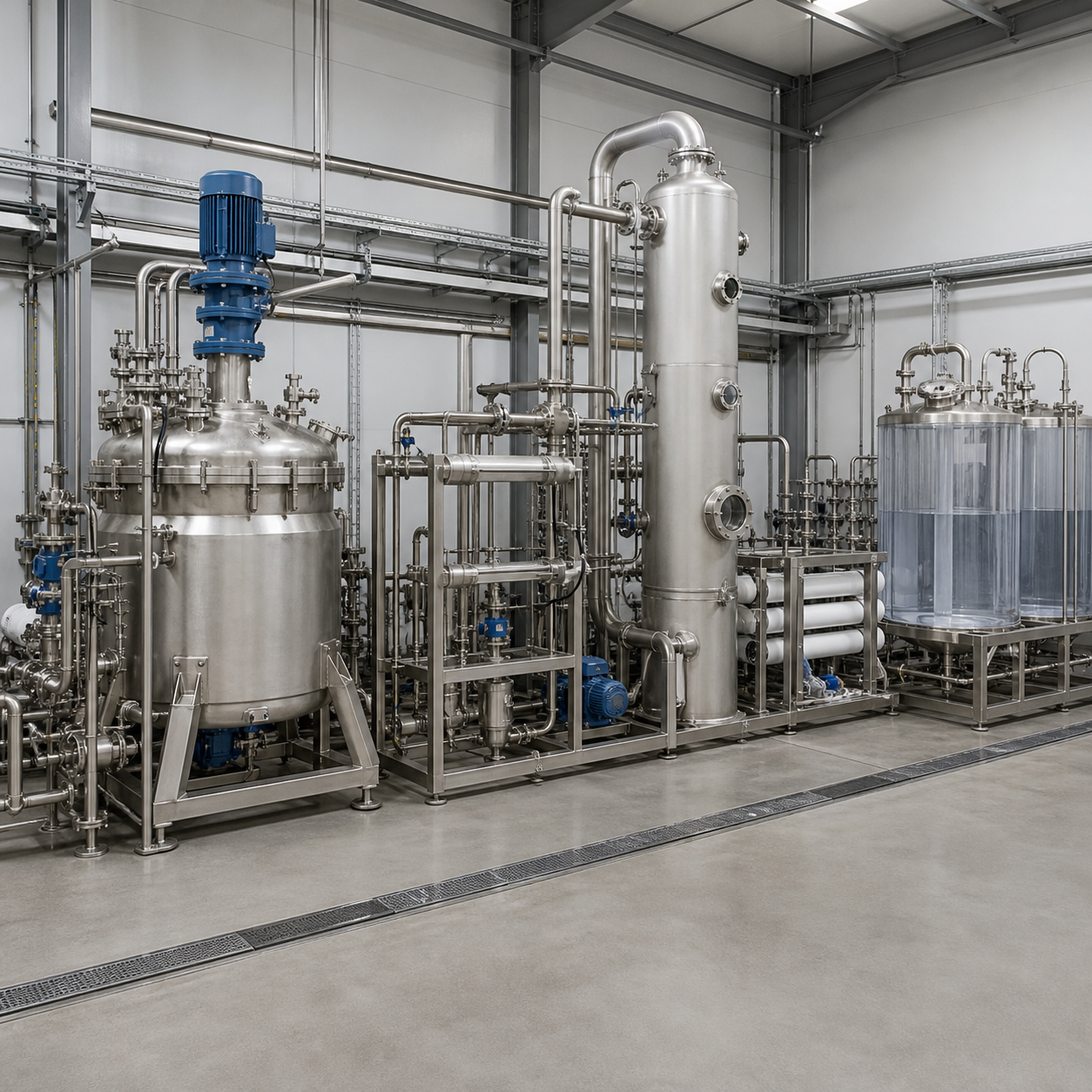
Industrial metal nitrate production may use nitric acid with a metal, oxide, hydroxide or carbonate feed under a validated process. The exact chemistry, heat release, gas generation and impurity profile depend on the selected raw material and oxidation state. A route suitable for one nitrate cannot be transferred automatically to another. Producers should complete reaction calorimetry, materials review, ventilation and off-gas engineering before scale-up. Purchasing nitric acid then becomes part of the product-purity strategy: chloride, sulfate, iron, trace metals, nitrous species and residue can affect color, stability, crystallization or downstream customer performance. Concentration also changes water balance and reaction control. The approved specification should come from a full mass balance and final-product limits, not a generic reagent label. Supplier qualification must connect acid lots to finished nitrate results across several campaigns. Process teams should document charge verification, controlled feed, temperature and pressure response, endpoint analysis, filtration, evaporation or crystallization, mother-liquor handling and off-spec disposition.
For B2B implementation of Nitric Acid for Industrial Metal Nitrate Production, assign ownership across purchasing, quality, production, engineering, logistics and EHS before the first delivery. Approve the receiving test, compatible handling system, deviation response, retained-sample period and supplier-change process in writing. This shared control plan helps separate raw-material variation from equipment or operating changes and provides objective evidence for investigations.
Define the nitrate product and feed route
Specify target metal, oxidation state, solution or crystal form, assay, water, insoluble matter and trace-ion limits. Select the metal-bearing feed based on purity, reactivity, availability and waste profile. Different feeds can produce different gases, residues and thermal behavior even when the final nitrate formula is the same.
Build the stoichiometric and water balance
Calculate theoretical demand, then establish practical operating limits through controlled development. Include water entering with nitric acid and other feeds, water formed or consumed, wash streams and recycle. Confirm what basis is used when converting commercial acid mass to pure HNO3 equivalent.
Engineer a controlled closed reaction
Use compatible closed equipment, metered feed, agitation, cooling, temperature monitoring and emergency isolation designed by qualified engineers. Define the safe sequence and permissible accumulation from hazard analysis. Do not scale by vessel volume alone; heat removal and gas handling may become limiting.
Treat off-gas as a process stream
Some nitrate routes can generate nitrogen oxides. Connect the reactor to a validated condenser, absorber or scrubber system and monitor its performance. Include startup, shutdown and upset cases in the design. Visible plume absence alone does not prove emissions control.
Link acid impurities to finished product
Develop an impurity transfer study for chloride, sulfate, iron and application-sensitive metals. Some impurities remain in solution while others concentrate during evaporation or recycle. Set nitric acid limits only where data show risk, then verify final nitrate across several acid and metal-feed lots.
Control sampling and endpoint analysis
Representative sampling is difficult in reactive, hot or slurry systems. Define a safe location, sample conditioning and analytical timing. Use validated endpoint measures rather than operator appearance alone. Retain feed and finished-product samples for investigations.
Plan purification and crystallization
Filtration, clarification, evaporation, cooling and crystallization can change impurity distribution and particle behavior. Establish mother-liquor recycle limits so contaminants do not accumulate. Connect crystal size, filtration time, wash demand and drying performance to upstream chemistry.
Use production references responsibly
The EPA AP-42 nitric acid production chapter describes nitric acid manufacturing and emission sources. It provides industrial context, but a metal-nitrate producer needs a dedicated reaction and emissions assessment for its own feed and equipment.
Qualify raw material and continuity
Review acid concentration, nitrous species, relevant anions and metals, packaging, lot traceability and change notification. Confirm that tankers and transfer lines are dedicated and compatible. Audit alternate sources before emergency use rather than changing acid during a supply interruption without trial data.
Prepare a nitrate-production RFQ
State product application, acid assay range, impurity limits and methods, consumption profile, package, destination, COA and delivery schedule. Review the Hiacid nitric acid product and supply page and procurement guide, then request samples and pricing.
Related nitric acid resources
- 68% Nitric Acid Buying Specification for Industrial Supply
- Nitric Acid for Stainless Steel Passivation and Validation
- High-Purity Nitric Acid for Electronics Cleaning Supply
Frequently asked questions
Can the same process make every metal nitrate?
No. Feed chemistry, oxidation state, heat release, gas generation and purification needs vary by product.
Why does nitric acid concentration matter?
It changes both pure-acid input and water balance, which can affect control and downstream concentration.
Which acid impurities should be limited?
Select chloride, sulfate, metals or other limits from impurity-transfer and final-product evidence.
Why evaluate mother-liquor recycle?
Recycle can reduce loss but may accumulate contaminants and change crystallization or product purity.