
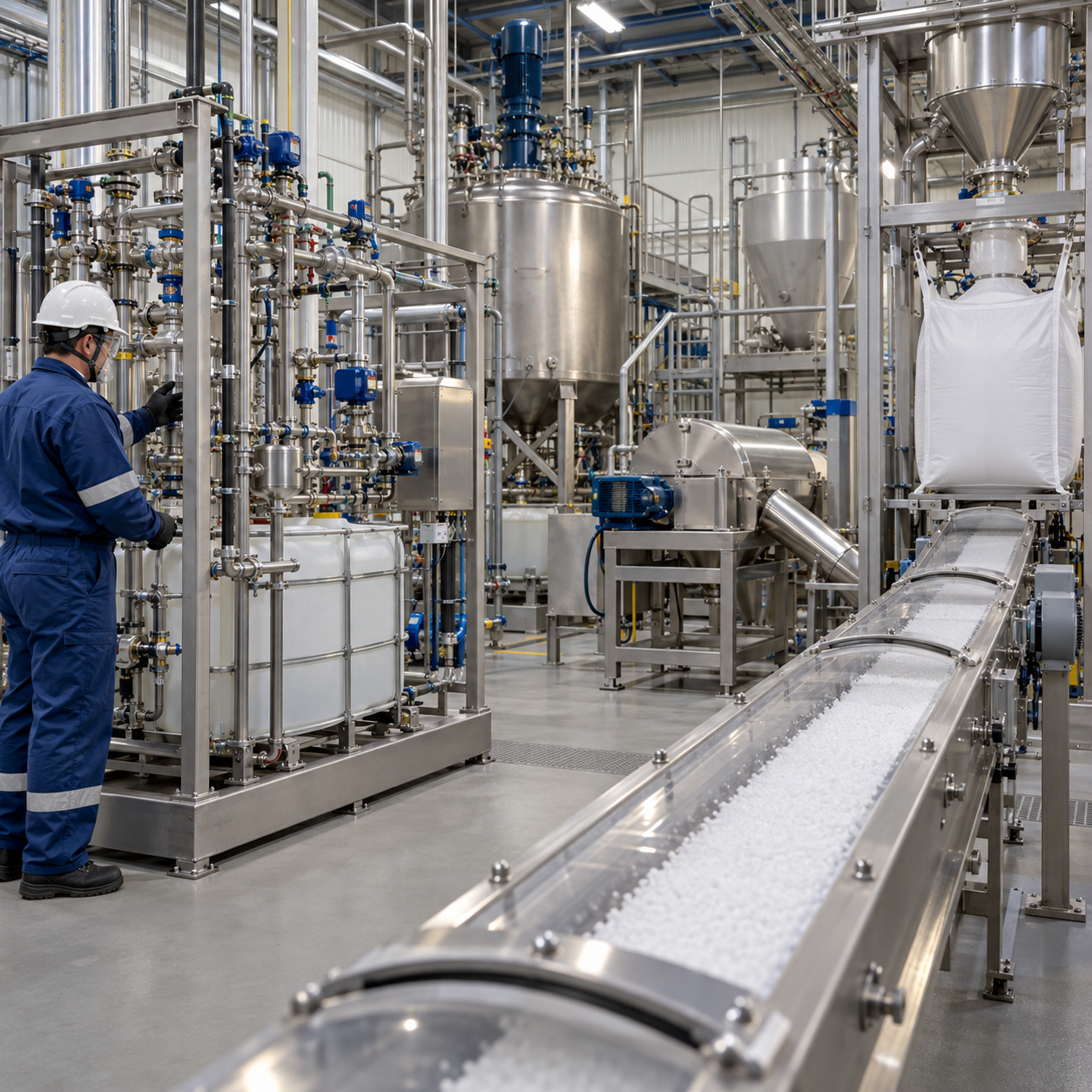
Sodium formate is used in some airport and industrial deicing products, where performance must be considered together with corrosion, environmental profile, storage and application equipment. Producers may manufacture sodium formate by controlled neutralization and further processing, but raw-material concentration and impurities influence mass balance, color, solids handling and final quality. A commercial deicer also has to meet customer or industry specifications; chemical identity alone is insufficient. This guide focuses on qualifying formic acid feed and the supplier relationship. Process design, operating conditions and reaction safeguards belong to the manufacturer’s engineering and process-safety systems.
For industrial qualification, assign purchasing, quality, engineering, operations, logistics and EHS ownership before the first commercial delivery. Approve the formic acid concentration, analytical methods, sample point, retained-sample period, storage conditions, transfer equipment, deviation response and release authority in writing. Compare representative lots under controlled conditions and record process performance, mass balance, waste, equipment observations and final product quality. This separates raw-material variation from changes in water, feedstock, equipment, operator or analytical method. Review the chain from supplier release through carrier, package, receiving connection and day tank because contamination or misidentification can occur after final analysis. Reconcile ordered, received, stored and consumed quantities and investigate unexplained differences. Supplier scorecards should cover documentation accuracy, delivery condition, corrective-action quality and change notification as well as price. Qualify a contingency source before a disruption using the same methods and process criteria. When buyer and supplier results differ, review sample representativeness, temperature, calibration, detection limits and uncertainty before deciding disposition. Confirm emergency contacts, unloading hours and stop-work authority for every shipment. Include maintenance and warehouse teams in the post-trial review because they often identify seal, vent, hose or handling issues not visible on a certificate of analysis. Close qualification with an authorized report, approved-supplier status and a defined routine-monitoring plan. The NIH PubChem record for formic acid provides broad identity and hazard context; the current SDS, local law and site procedures remain controlling.
Start with the final deicer specification
Define sodium formate content, water, insolubles, color, pH, particle or solution properties, corrosion limits and packaging requirements. Include the applicable airport, customer or national test protocol.
Connect performance with environmental review
The US EPA airport deicing assessment discusses sodium formate among airfield deicing chemicals and compares environmental considerations. Local approval, runoff controls and airport specifications remain decisive for each market.
Build a complete reaction mass balance
Use verified formic acid assay and water values when calculating raw-material demand, expected salt production and concentration steps. Track sodium source purity, utilities, wash streams, mother liquor and product losses.
Treat concentration variation as an operating input
A small assay or water shift can affect heat release, endpoint control, evaporation duty and throughput. Define receiving limits and an approved adjustment strategy rather than correcting informally during production.
Map impurities into product quality
Evaluate metals, halides, sulfate, nonvolatile residue and organic color bodies for their effect on corrosion, crystallization, appearance and customer tests. Set feed limits from data and include the sodium source and process water in the same impurity balance.
Validate across representative lots
Run controlled pilot or plant trials with multiple formic acid lots. Compare yield, filtration, crystal behavior, energy use, color, corrosion testing and finished-product stability before commercial approval.
Engineer reaction and materials safeguards
Neutralization is exothermic and requires designed feed control, agitation, heat removal, instrumentation and emergency response. Confirm compatibility of storage, pumps, seals, reactor, evaporator and dryer systems.
Control dust, moisture and storage
Solid sodium formate handling introduces its own occupational and product-quality considerations. Design ventilation and housekeeping, protect the material from moisture pickup, and verify that packaging preserves the required physical properties.
Qualify dependable industrial supply
Approve concentration, analytical methods, package, tanker or IBC cleanliness, retained samples, deviation response and change notification. Forecast demand from campaign plans and keep a qualified contingency source.
Prepare a deicer-production inquiry
Provide concentration, impurity limits, package, annual volume, delivery schedule, destination and COA requirements. Review the Hiacid formic acid product page, then request a feedstock supply proposal.
Related formic acid resources
- Food-Grade Formic Acid Supply and Compliance
- Formic Acid for Wood Adhesive Resin pH Control
- Formic Acid for Transparent Wood Film Manufacturing
Frequently asked questions
Is sodium formate automatically approved for every airport?
No. Airport, customer, national and environmental requirements must be confirmed for the destination market.
Why does formic acid water content matter?
It affects reaction mass balance, concentration duty, throughput and final product consistency.
Which impurities should manufacturers assess?
Metals, halides, sulfate, residue and color bodies should be linked to product and corrosion requirements.
Can a laboratory trial replace plant validation?
No. Representative pilot and plant trials are needed to confirm heat transfer, solids handling, quality and safety.