
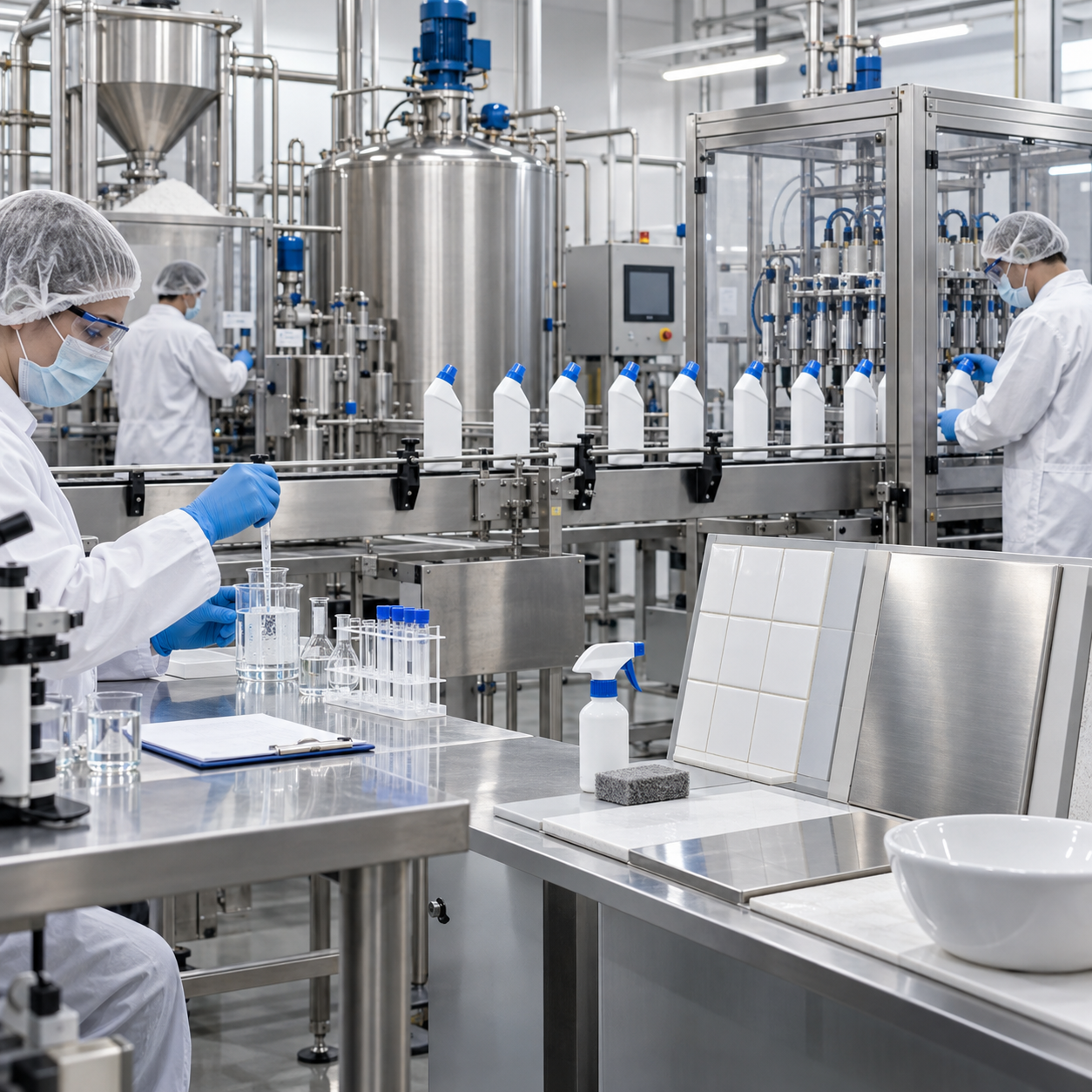
Oxalic acid is used in some commercial cleaning products because oxalate chemistry can help address iron-containing stains and mineral soils. A raw-material function does not establish that a finished cleaner is safe for every surface or allowed to make disinfectant claims. Formulators must qualify performance, compatibility, exposure, packaging and the regulatory category of the finished product in each market. This article addresses B2B raw-material sourcing for professional manufacturers. It does not provide a consumer recipe, recommend direct use of concentrated acid or authorize antimicrobial claims.
For industrial qualification, assign purchasing, quality, engineering, operations, logistics and EHS ownership before the first commercial delivery. Approve the oxalic acid hydration state, assay basis, analytical methods, sample point, retained-sample period, storage conditions, transfer method, deviation response and release authority in writing. Compare representative lots under controlled conditions and record process performance, mass balance, waste, equipment observations and final product quality. This separates raw-material variation from changes in water, feedstock, equipment, operator or analytical method. Review the chain from supplier release through carrier, package, warehouse and point of addition because contamination, moisture uptake or misidentification can occur after final analysis. Reconcile ordered, received, stored and consumed quantities and investigate unexplained differences. Supplier scorecards should cover documentation accuracy, delivery condition, corrective-action quality and change notification as well as price. Qualify a contingency source before a disruption using the same methods and process criteria. When buyer and supplier results differ, review sample representativeness, hydration state, drying basis, calibration, detection limits and uncertainty before deciding disposition. Confirm emergency contacts, unloading hours and stop-work authority for every shipment. Include maintenance and warehouse teams in post-trial review because they often identify dust, seal, liner or handling issues not visible on a certificate of analysis. Close qualification with an authorized report, approved-supplier status and a defined routine-monitoring plan. The NIH PubChem record for oxalic acid provides broad identity and use context; the current SDS, local law and site procedures remain controlling.
Define the finished-product claim and market
Separate ordinary cleaning, rust-stain removal, descaling and antimicrobial claims. The destination country, use site, label wording and customer type determine regulatory obligations.
Do not infer disinfectant status from the ingredient
The US EPA oxalic acid reregistration fact sheet describes historical registered bathroom uses and emphasizes product labeling and exposure concerns. Registration belongs to a specific finished product, not to commodity oxalic acid.
Build performance tests around actual soils
Use representative iron stains, hard-water deposits, soap soil and substrates. Define cleaning, contact time, rinseability and redeposition endpoints before screening. Compare complete formulations rather than assuming more acid produces better results.
Test material compatibility broadly
Evaluate ceramic, grout, stone, stainless steel, plated metal, coatings, sealants and fixtures under intended and misuse conditions. Oxalic acid can damage or discolor unsuitable surfaces, especially where calcium or reactive finishes are present.
Translate formulation risk into a specification
Set hydration state, assay, insoluble matter, residue, metals and color limits supported by test methods. The EPA ChemExpo record provides product-use context, while the manufacturer remains responsible for formulation and label compliance.
Qualify more than one lot
Manufacture pilot batches from representative oxalic acid lots and evaluate dissolution, stability, package compatibility and cleaning performance. Retain raw material and finished product for investigation.
Engineer dust-controlled manufacturing
Use enclosed powder charging or other assessed controls, local exhaust ventilation, housekeeping and suitable PPE. Review incompatible materials and emergency response using the current SDS and the OSHA oxalic acid sampling method as industrial hygiene context.
Validate packaging and consumer safeguards
Select a package that resists the full formulation, limits moisture entry and supports compliant directions and warnings. Conduct transport, leakage, child-safety or other testing required for the market.
Govern claims and supplier changes
Maintain evidence for every cleaning or antimicrobial claim. Require advance notice of manufacturing site, route, purification, particle form, method or package changes that could alter dissolution or impurities.
Prepare a cleaner-manufacturing inquiry
Provide hydration state, specification, package, annual demand, destination and required documents. Review the Hiacid oxalic acid product page, then request a B2B raw-material quotation.
Related oxalic acid resources
- Oxalic Acid for Leather Waste Dechroming and Collagen Recovery
- Oxalic Acid for Iron Recovery from Wet-Process Phosphoric Acid
- Oxalic Acid for Bauxite Residue and Red Mud Valorization
Frequently asked questions
Does oxalic acid make a cleaner a disinfectant?
No. Antimicrobial claims require product-specific authorization and supporting data in the destination market.
Can one compatibility test cover every bathroom surface?
No. Stone, grout, metals, coatings and fixtures respond differently and need representative testing.
Why control particle form and insolubles?
They can affect dust, dissolution, product appearance, filling equipment and finished-product stability.
Is this article a formula for household use?
No. It is a B2B qualification guide for professional manufacturers and provides no mixing recipe.