
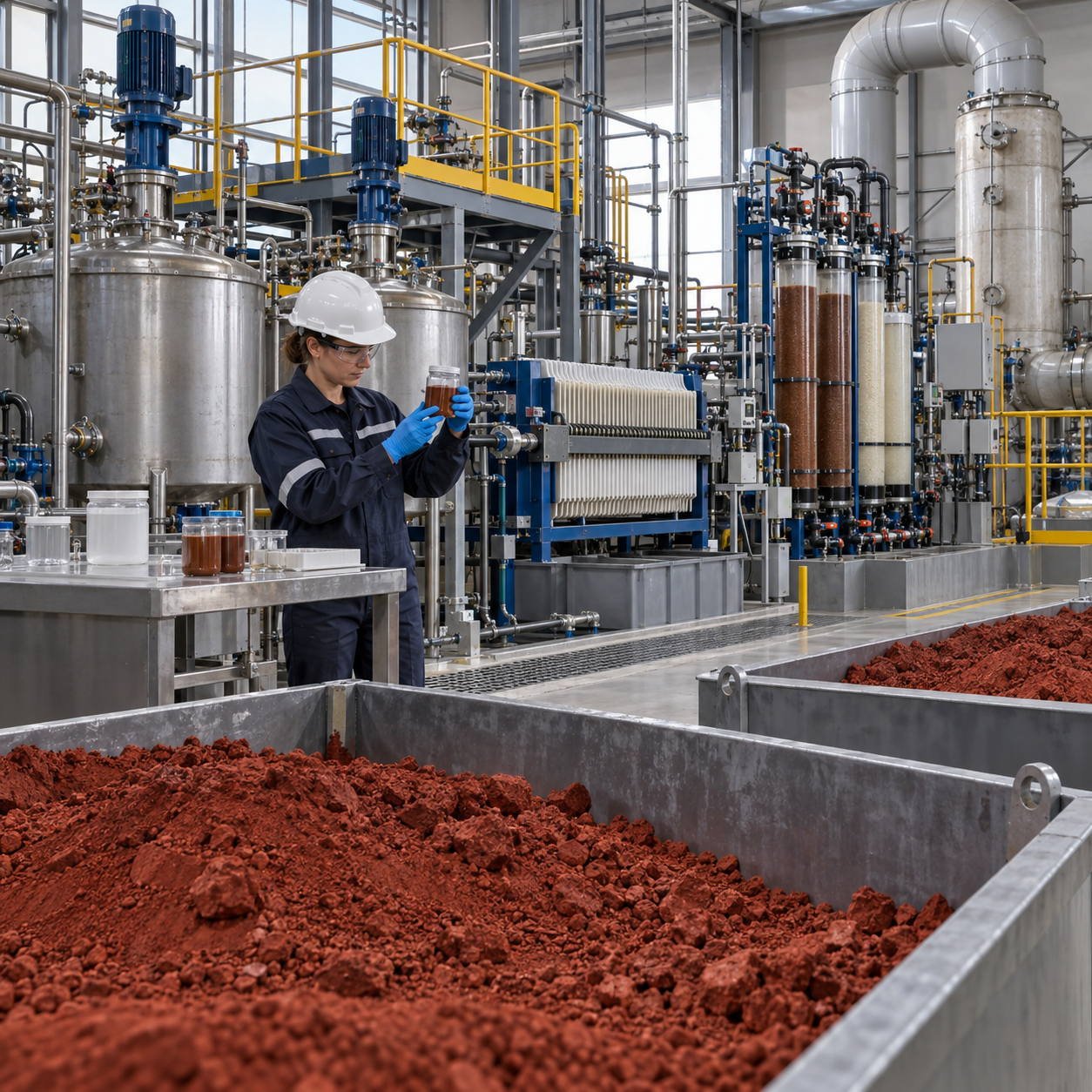
Bauxite residue, often called red mud, contains iron, aluminum, titanium, calcium, sodium and trace strategic elements including scandium. Hydrochloric acid has been studied as a leachant, but the residue is strongly alkaline and target scandium concentrations are low relative to major metals. High extraction can therefore coincide with heavy acid consumption and a complex pregnant solution. A credible project must evaluate selectivity, downstream concentration, chloride management and residue disposition together. This article provides B2B reagent-qualification guidance without supplying operating conditions.
A Materials review of scandium recovery methods summarizes hydrochloric-acid leaching studies for bauxite residue and highlights the importance of acid demand and co-dissolved elements. Individual published results require validation on the actual residue.
Industrial hydrochloric acid qualification should assign purchasing, quality, engineering, operations, logistics and EHS ownership before the first delivery. Approve concentration, analytical methods, sampling, storage, compatible transfer equipment, deviation response and release authority in writing. Compare representative lots under controlled conditions and record process performance, mass balance, emissions-control operation, waste, equipment observations and final product quality. This separates raw-material variation from changes in feedstock, water, equipment, operator or analytical method. Review the chain from supplier release through carrier, package, receiving connection and day tank because contamination or dilution can occur after final analysis. Reconcile ordered, received, stored and consumed quantities and investigate unexplained differences. Supplier scorecards should cover documentation accuracy, delivery condition, corrective-action quality and change notification as well as price. Qualify a contingency source with the same methods before a disruption. When buyer and supplier results differ, review sample representativeness, temperature, standards, calibration, detection limits and measurement uncertainty before disposition. Confirm emergency contacts, unloading hours and stop-work authority for every shipment. Hydrochloric acid is corrosive and can release irritating hydrogen chloride vapor; use the current SDS, compatible segregation, ventilation, containment and an approved emergency plan. The NIOSH Pocket Guide entry and NIH PubChem record provide general hazard and identity context, while local law and site procedures remain controlling. Close qualification with an authorized report, approved-supplier status and a routine-monitoring plan.
Build a representative residue specification
Document refinery source, bauxite origin, storage history, moisture, alkalinity, particle size, mineral phases and major-element composition. Measure scandium and relevant rare earths with validated digestion and reference materials because target concentrations may be close to sampling and analytical uncertainty.
Define product and residue endpoints
Specify the intended scandium concentrate or oxide purity, recovery and impurity limits. Also define neutralized residue, wastewater and any iron-, aluminum- or titanium-rich by-products so the project does not merely move material into a more difficult form.
Evaluate selectivity across the whole flowsheet
Measure scandium extraction alongside iron, aluminum, calcium, titanium, sodium and silica. High scandium release may be uneconomic if the liquor requires excessive neutralization or purification.
Integrate concentration and purification early
Test ion exchange, solvent extraction, precipitation or other validated separation steps on real leach liquor rather than ideal model solutions. Track organic loss, resin capacity, fouling, chloride loading and product quality over repeated cycles.
Qualify hydrochloric acid and process water
Specify concentration, iron, aluminum, other metals, sulfate, nonvolatile residue and methods. Verify each development lot and retain samples. Water composition can affect precipitation, resin loading and chloride balance, so it belongs in the qualification plan.
Close acid and metal balances
Reconcile acid charged, neutralized, recovered and discharged with metals in feed, liquor, raffinate, product, wash and residue. Establish mass-balance acceptance limits before deciding which trial performed best.
Engineer alkaline-feed and chloride hazards
Adding acid to alkaline residue can generate heat and gas. Use compatible closed equipment, controlled feed, cooling, ventilation, containment, interlocks and pressure protection under a formal hazard review.
Plan chloride and residue management
Evaluate acid regeneration, water reuse and purges without concentrating troublesome metals. Characterize every final solid and liquid according to local rules and proposed commercial use rather than relying on the original residue classification.
Scale deliveries only after reproducibility
Align package and delivery size with campaign demand, approved storage and actual consumption. Require COA, SDS, lot genealogy, retained samples, corrective-action support and advance change notification.
Prepare a scandium-recovery inquiry
Provide concentration, impurity limits, package, trial schedule, annual estimate and destination. Review the Hiacid hydrochloric acid page, then request a documented pilot or commercial quotation.
Related hydrochloric acid resources
- Hydrochloric Acid for High-Purity Quartz Purification
- Hydrochloric Acid for PGM Recovery from Automotive Catalysts
- Hydrochloric Acid for RO Membrane Carbonate Scale Cleaning
Frequently asked questions
Why is bauxite residue difficult to leach selectively?
Scandium is dilute while abundant iron, aluminum, calcium and sodium can consume acid or enter the liquor.
Is high scandium extraction enough?
No. Selectivity, downstream concentration, acid use, residue quality and total process economics also matter.
Why test separation with real leach liquor?
Major metals, silica and chloride can change resin, solvent or precipitation performance compared with model solutions.
Does this article specify leaching conditions?
No. It is a supplier-qualification and project-governance guide.