
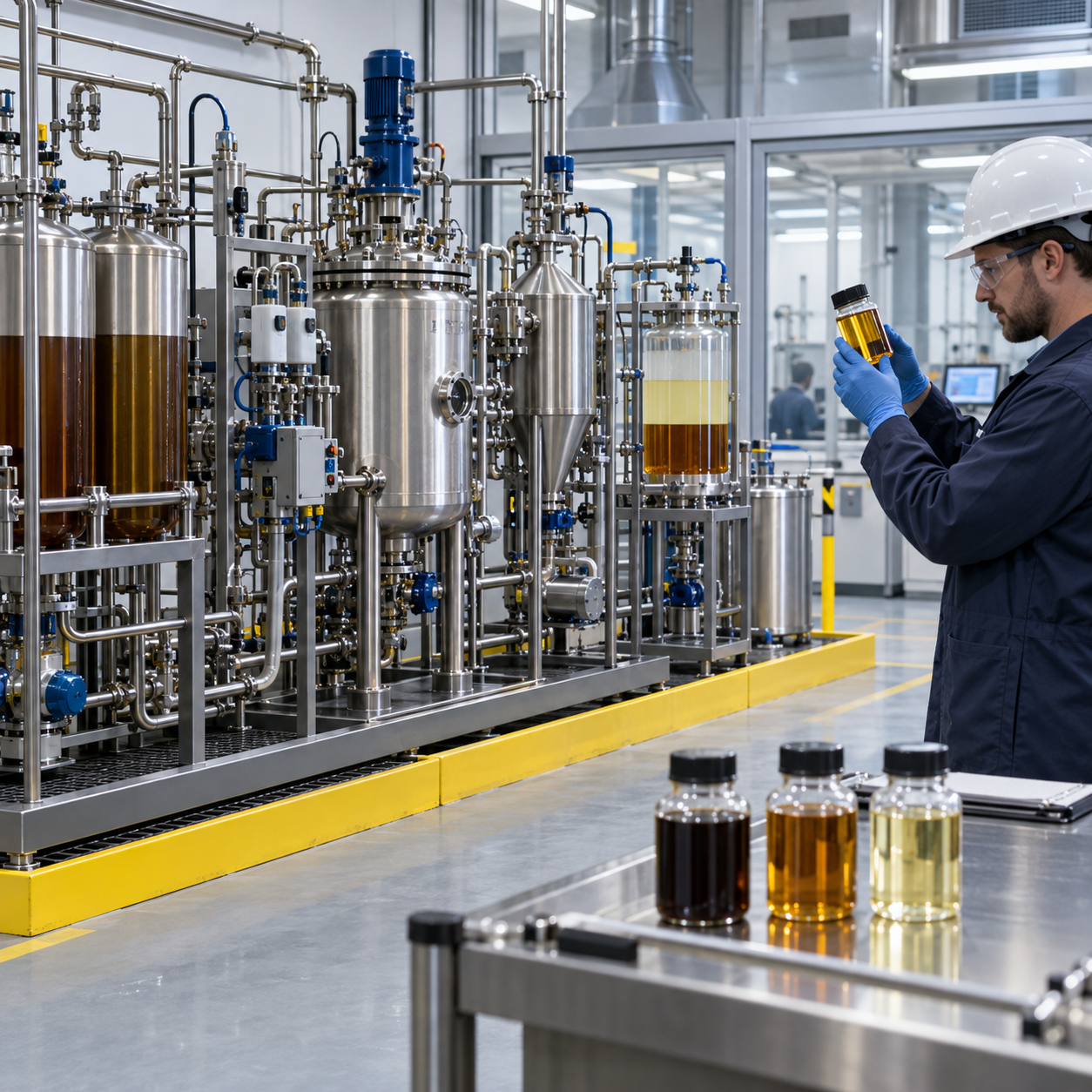
Oxidative desulfurization converts sulfur compounds in liquid fuels into more polar oxidation products that can be separated by extraction, adsorption or another downstream step. Hydrogen peroxide is widely investigated as the oxidant, often with catalysts or peracid chemistry. Performance depends on fuel composition, sulfur species, phase transfer, water, catalyst, oxidant efficiency and separation. A low measured sulfur result is not enough if fuel yield, stability, catalyst recovery or solvent use is unacceptable. This guide covers B2B peroxide qualification without providing a fuel-processing recipe.
An Energy & Fuels critical review examines catalysts, oxidants, solvents, fuel types and operating factors that govern oxidative desulfurization. Published systems require validation on the actual refinery stream.
Industrial hydrogen peroxide qualification should assign purchasing, quality, engineering, operations, logistics and EHS ownership before the first delivery. Approve concentration, stabilizer package, analytical methods, sampling, storage, compatible transfer equipment, deviation response and release authority in writing. Compare representative lots under controlled conditions and record process performance, mass balance, gas evolution, waste, equipment observations and final product quality. This separates raw-material variation from changes in feedstock, water, equipment, operator or method. Review the chain from supplier release through carrier, package, receiving connection and day tank because contamination or decomposition can occur after final analysis. Reconcile ordered, received, stored and consumed quantities and investigate unexplained differences. Supplier scorecards should cover documentation accuracy, delivery condition, corrective-action quality and change notification as well as price. Qualify a contingency source using the same methods before a disruption. When buyer and supplier results differ, review sample representativeness, temperature, standards, calibration, detection limits and uncertainty before disposition. Confirm emergency contacts, unloading hours and stop-work authority for every shipment. Hydrogen peroxide is a strong oxidizer that can decompose exothermically and release oxygen; use the current SDS, dedicated compatible equipment, contamination control, ventilation, pressure relief, containment and an approved emergency plan. The NIOSH Pocket Guide entry and NIH PubChem record provide general hazard and identity context, while local law and site procedures remain controlling. Close qualification with an authorized report, approved-supplier status and a routine-monitoring plan.
Define the fuel and sulfur target
Document boiling range, density, aromatics, olefins, nitrogen compounds, water, metals and individual sulfur species where possible. Set the product sulfur limit, yield, color, oxidation stability and other fuel-quality constraints.
Use representative refinery streams
Model sulfur compounds help compare mechanisms, but commercial decisions require real feeds from different campaigns. Include matrix effects and analytical recovery at the required reporting limit.
Separate oxidation from product removal
Measure conversion of sulfur species and actual removal from the fuel. Oxidized sulfur remaining in the hydrocarbon phase can appear as incomplete treatment, while extraction losses can falsely improve sulfur concentration through reduced product yield.
Close oxidant and solvent balances
Track peroxide charged and residual, water introduced, catalyst, extraction solvent, adsorbent, product fuel, raffinate and waste. Include regeneration and purge needs in economics and lifecycle review.
Specify peroxide around catalyst sensitivity
Define concentration, acidity, stabilizer system, metals and nonvolatile residue. Catalyst poisons or trace metals can alter decomposition and selectivity. Confirm that the approved stabilizer package is compatible with the chosen chemistry.
Validate analytical methods
Use validated sulfur speciation or total-sulfur methods, peroxide residual assays and fuel-property testing. Check blanks, standards, matrix effects and sampling of multiphase systems.
Engineer multiphase oxidation safely
Assess peroxide contact with fuel, catalyst and organic acids using calorimetry and reaction-hazard testing. Use compatible closed reactors, controlled addition, mixing, cooling, ventilation, pressure protection and emergency shutdown.
Protect final fuel quality
Verify flash point, acidity, water, color, oxidation stability, distillation behavior and other applicable specifications after separation. Residual oxidant or solvent must meet the approved product standard.
Qualify supply from laboratory to demonstration
Start with documented trial lots and scale only after replicated sulfur removal, fuel yield, oxidant efficiency and safe operation. Require COA, SDS, retained samples, deviation support and change notification.
Prepare an ODS inquiry
Provide concentration, stabilizer and impurity limits, package, pilot or annual volume and destination. Review the Hiacid hydrogen peroxide product page, then request a documented supply quotation.
Related hydrogen peroxide resources
- Hydrogen Peroxide for Peracetic Acid Manufacturing
- Hydrogen Peroxide for Chalcopyrite Copper Leaching Trials
- Hydrogen Peroxide for Arsenite Oxidation in Groundwater Treatment
Frequently asked questions
Does oxidation alone remove sulfur from fuel?
No. Oxidized sulfur species normally require a validated separation step such as extraction or adsorption.
Why test real fuel instead of model sulfur compounds?
Aromatics, olefins, nitrogen compounds, water and sulfur distribution can change oxidation and separation.
Which peroxide properties may affect ODS?
Concentration, acidity, stabilizers, metals and residue may influence catalyst behavior, decomposition and fuel quality.
Can this guide replace reaction-hazard testing?
No. Peroxide-organic systems require professional calorimetry, engineering and site-specific safety review.