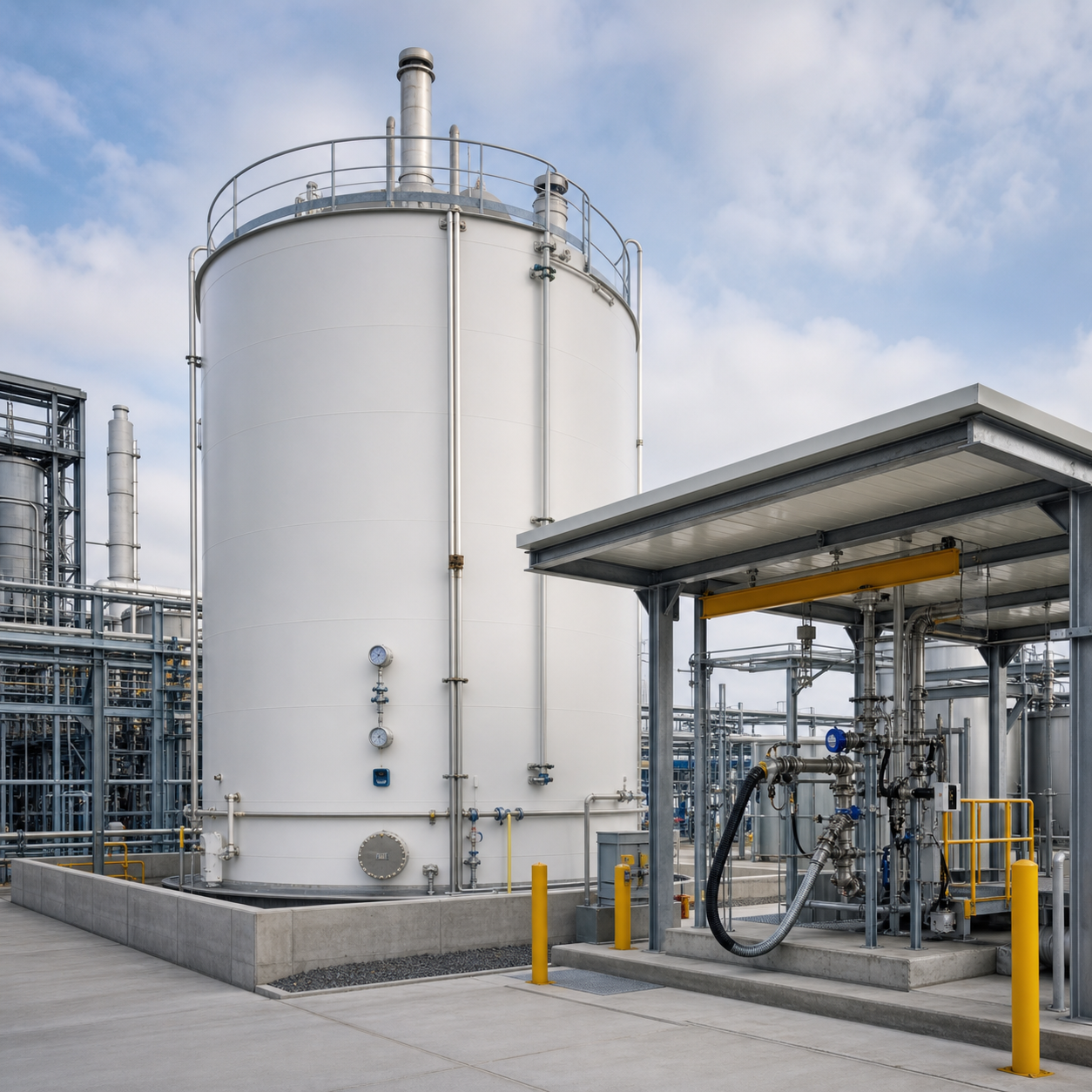
Hydrogen peroxide storage must be designed as a complete oxidizer-handling system, not as a generic liquid tank. Concentration, stabilizer package, temperature, contamination, residence time and equipment surface condition all influence decomposition. Hydrogen peroxide decomposes to water and oxygen while releasing heat. Contamination by incompatible metals, organics, alkalis or dirt can accelerate that reaction, and oxygen generation can pressurize blocked or inadequately vented equipment. The approved system therefore includes the tank, vent, overflow, fill connection, level measurement, piping, valves, pump, sample point, secondary containment and unloading controls. Materials described broadly as stainless steel or plastic are not automatically suitable; grade, fabrication, passivation, cleanliness and service conditions matter. A facility should obtain concentration-specific guidance from the chemical supplier and equipment manufacturers, then document its engineering basis through hazard review. Procurement must not substitute another concentration, package or stabilizer grade without management of change.
For B2B implementation of Hydrogen Peroxide Storage and Material Compatibility Guide, assign ownership across purchasing, quality, production, engineering, logistics and EHS before the first delivery. Approve the receiving test, compatible handling system, deviation response, retained-sample period and supplier-change process in writing. This shared control plan helps separate raw-material variation from equipment or operating changes and provides objective evidence for investigations.
Define the full service envelope
Record normal and maximum concentration, temperature, inventory, residence time, fill frequency and credible contaminants. Include startup, maintenance, water entry, cross-connection and loss-of-cooling scenarios. A material or vent suitable for dilute peroxide may not be approved for a stronger solution or hotter service.
Use concentration-specific compatibility evidence
Review supplier manuals, equipment data, recognized references and plant experience for the exact alloy, polymer, gasket and fabrication method. Confirm weld preparation, surface finish and passivation requirements. Coupon data can support selection but do not replace inspection of real equipment under operating conditions.
Protect peroxide from contamination
Use dedicated tanks, hoses, pumps and sampling tools. Keep combustible materials, reducing agents, incompatible metals and alkaline residues out of the system. Cleaning and maintenance procedures must specify approved materials and final-rinse verification before peroxide is introduced.
Control unloading connections and returns
Use keyed or otherwise controlled connections where practical, clear line identification and positive shipment verification. Prevent product or flush liquid from returning to the delivery container. Confirm receiving capacity, valve line-up, vent availability and emergency communication before transfer begins.
Design venting for oxygen generation
Normal decomposition produces oxygen, so vessels and packages require the approved vent arrangement. Do not isolate, plug or reduce a vent without engineering authorization. Evaluate vent discharge location, weather protection, contamination control and credible accelerated-decomposition cases.
Monitor temperature and inventory behavior
Trend tank temperature, level and consumption. An unexplained temperature rise, gas generation, package swelling or abnormal pressure requires immediate response under the site emergency plan. Define alarms, safe isolation and evacuation criteria before operation rather than improvising during an event.
Inspect before degradation becomes failure
Create risk-based inspection for tank surfaces, lining or passivation condition, gaskets, valves, pumps, vents, supports and containment. Record discoloration, corrosion, deposits, leakage and repeated maintenance. Establish engineering review and retirement thresholds.
Use authoritative hazard information
The NIOSH Pocket Guide entry for hydrogen peroxide identifies it as a powerful oxidizer and lists important incompatibilities. The NIH PubChem record describes decomposition to water and oxygen with heat release. Apply these references with the current supplier SDS and site-specific engineering review.
Connect procurement to the facility limit
The purchase specification should state approved concentration, grade, stabilizer expectations, package, connection and delivery temperature constraints. Require change notification for manufacturing site, stabilizer, packaging or loading point. Quarantine any load that does not match the approved configuration.
Prepare a storage-compatible RFQ
Provide concentration, annual volume, shipment size, package, approved connection, destination, delivery window, COA and SDS language. Review the Hiacid hydrogen peroxide supply page and the aseptic packaging guide, then confirm storage and delivery compatibility.
Related hydrogen peroxide resources
- Hydrogen Peroxide for Aseptic Packaging Sterilization
- High-Purity Hydrogen Peroxide for Semiconductor Cleaning
- Hydrogen Peroxide for Cyanide Destruction in Gold Mining
Frequently asked questions
Why must hydrogen peroxide storage be vented?
Peroxide naturally decomposes to water and oxygen; approved venting prevents oxygen from creating dangerous pressure.
Is every stainless steel tank suitable?
No. Alloy, fabrication, surface condition, passivation, concentration and contamination all matter.
Can a pump or hose be shared with another chemical?
Dedicated equipment is strongly preferred because incompatible residues can accelerate decomposition.
What signs require immediate investigation?
Unexpected temperature rise, gas generation, pressure, package swelling, contamination, discoloration or leakage.