
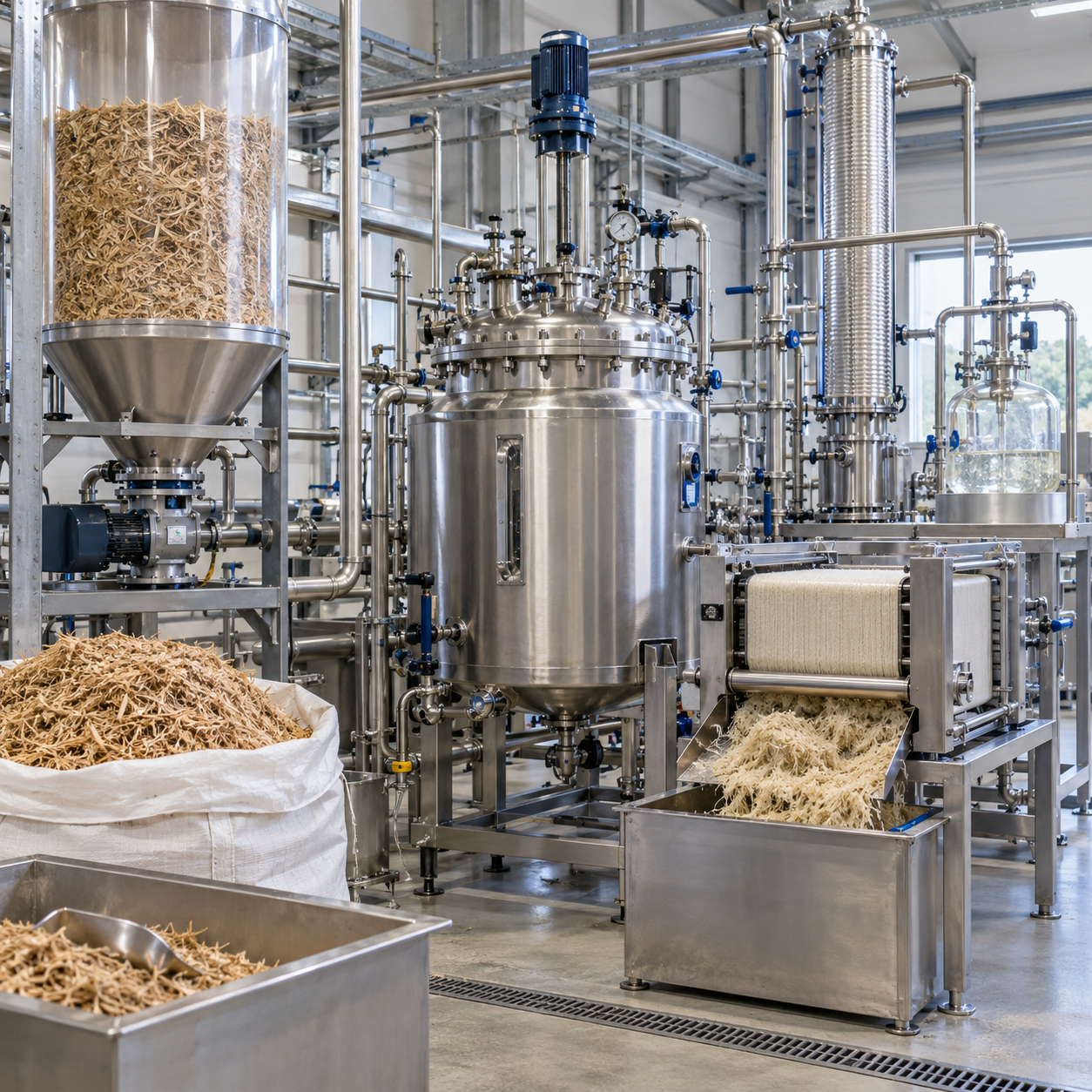
Lignocellulosic biomass contains cellulose, hemicellulose, lignin, acetyl groups, ash and extractives in proportions that vary by crop, wood species, harvest and storage. Acetic-acid-containing organosolv or combined pretreatments have been studied to open this structure before enzymatic hydrolysis, fermentation or material recovery. The process may improve accessibility but can also form fermentation inhibitors, consume solvent, corrode equipment and shift lignin or sugars into liquid streams. Procurement must connect acid quality and recovery to sugar yield, lignin quality, inhibitor control and solvent losses. This article outlines B2B qualification rather than pretreatment conditions.
For industrial qualification, assign purchasing, quality, engineering, operations, logistics and EHS ownership before the first commercial delivery. Approve glacial acetic acid assay, impurity limits, analytical methods, sampling, storage, dilution or dosing equipment, deviation response and release authority in writing. Compare representative lots under controlled conditions and record process performance, mass balance, waste, equipment observations and final product quality. This separates raw-material variation from changes in water, feedstock, equipment, operator or laboratory method.
Review the chain from supplier release through carrier, package, receiving connection and day tank because contamination or dilution can occur after final analysis. Reconcile ordered, received, stored and consumed quantities and investigate unexplained differences. Supplier scorecards should cover documentation accuracy, delivery condition, corrective-action quality and change notification as well as price. Qualify a contingency source before disruption using the same methods and process criteria. When buyer and supplier results differ, review sample representativeness, temperature, standards, calibration, detection limits and uncertainty before disposition.
Glacial acetic acid is corrosive, combustible and has a pungent vapor. Its freezing point is near ordinary cool-weather conditions, so crystallization can disrupt delivery or measurement if not controlled. Use the current SDS, compatible materials, ventilation, ignition control, secondary containment and an approved emergency plan. The NIOSH Pocket Guide entry and NIH PubChem record provide general identity and hazard context; local law, site procedures and the process hazard review remain controlling. Confirm emergency contacts, unloading hours and stop-work authority for every shipment.
Use published evidence as context
An open-access study on banana rachis pretreatment evaluated an acid-organosolv mixture containing glacial acetic acid and measured changes in biomass composition. Its feed and conditions are research-specific.
Translate research into site qualification
Define feed, equipment, analytical methods, acceptance criteria and stop conditions before trials. Scale only after replicated data, a reviewed hazard assessment and documented product and waste routes support the decision. Close qualification with an authorized report, approved-supplier status and a routine monitoring plan.
Characterize the biomass supply
Record species, part, harvest, storage, moisture, particle size, ash, cellulose, hemicellulose, lignin, acetyl groups and extractives. Build seasonal composites before estimating acid demand.
Define fraction quality targets
Specify recovered cellulose digestibility, lignin purity and molecular properties, hemicellulose sugars, inhibitor limits and overall dry-matter recovery.
Design complete fractionation balances
Analyze feed, pretreated solids, liquor, wash, recovered solvent and residue. Reconcile carbon and dry matter instead of reporting only enzymatic sugar yield.
Measure inhibitors before fermentation
Track acetic acid, furans, phenolics and other compounds that can affect enzymes or microorganisms. Validate washing or detoxification against actual fermentation performance.
Specify acid for reuse and recovery
Define assay, water, aldehydes, metals, nonvolatile residue and methods. Assess whether trace impurities accumulate when solvent is recycled.
Protect solvent identity through the loop
Measure recovered acid, water and co-solvents, and define purge criteria. Model evaporation and distillation energy with realistic biomass moisture.
Engineer heated acid-solvent service
Select compatible materials, seals, condensers, pumps, vents and relief systems from process data. Review flammable co-solvents and acid together under the site hazard study.
Validate washing and wastewater treatment
Quantify dissolved organics, acetate, lignin, sugars and suspended solids. Avoid moving recoverable material into a high-load wastewater stream.
Stage supply with scale-up evidence
Use trial packages for screening, campaign supply for pilot work and bulk only after stable recovery and consumption data. Require COA, SDS, lot genealogy and change control.
Prepare a biorefinery inquiry
Provide grade, assay, impurity limits, package, recovery assumptions, destination and forecast. Review the Hiacid glacial acetic acid page, then request a staged supply proposal.
Related glacial acetic acid resources
- Glacial Acetic Acid for Marine Collagen Extraction
- Glacial Acetic Acid for Lithium Battery Metal Recovery Trials
- Glacial Acetic Acid as a MOF Crystallization Modulator
Frequently asked questions
Why does biomass source affect acetic acid demand?
Moisture, ash, acetyl groups, lignin, particle size and extractives vary by feed and storage history.
Is high sugar yield enough to approve pretreatment?
No. Inhibitors, lignin quality, solvent recovery, energy, corrosion and dry-matter losses also matter.
Why analyze recovered acetic acid?
Water and dissolved compounds can accumulate during recycle and change reaction performance or corrosion.
Can laboratory solvent ratios be scaled directly?
No. Mixing, heat transfer, solids handling, recovery and safety require pilot and engineering validation.