
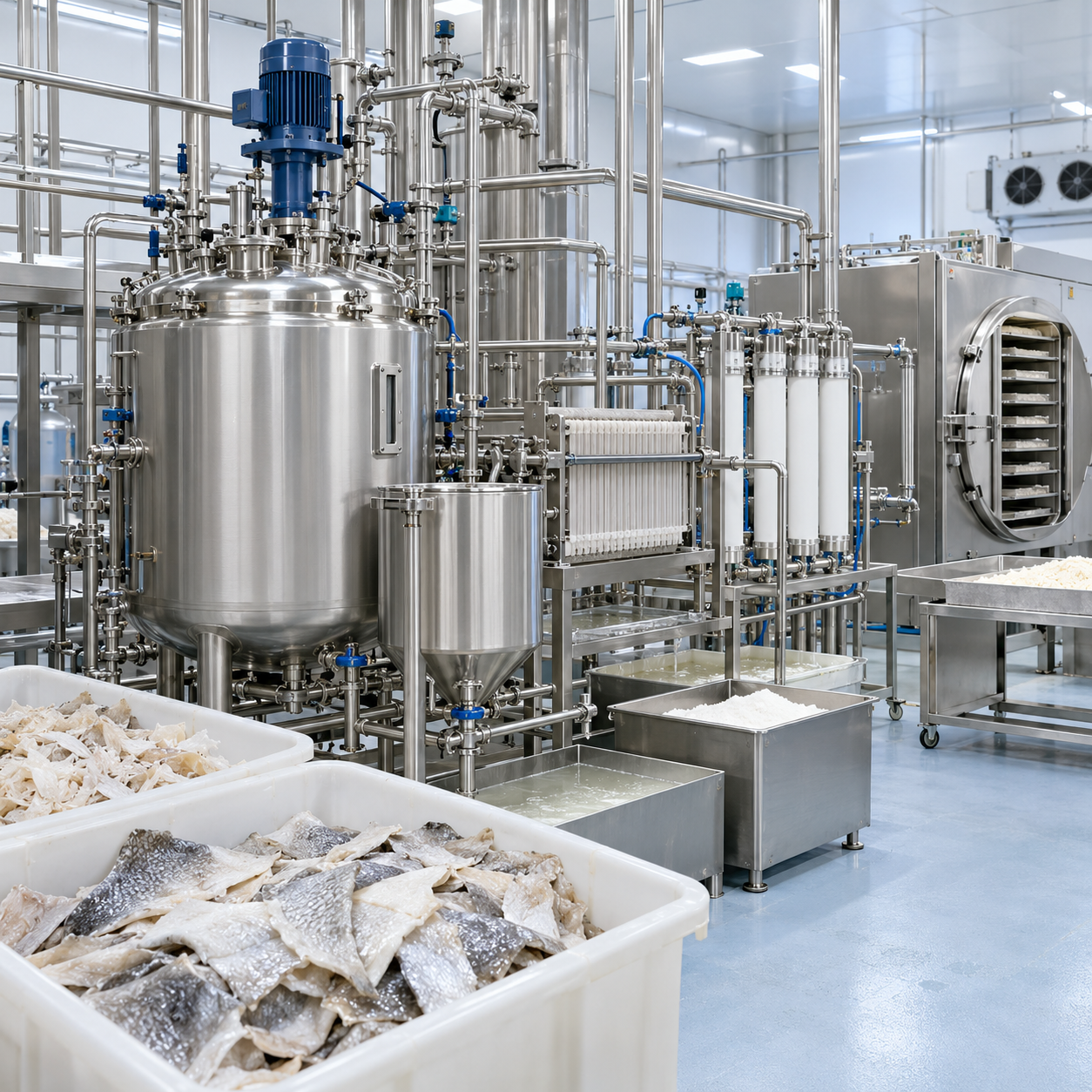
Fish skin, scales and other marine by-products can provide acid-soluble or pepsin-soluble collagen for research and selected commercial applications. Diluted acetic acid is commonly used to swell collagen-rich tissue and transfer collagen into solution under cold conditions. Yield and structural quality depend on species, tissue, pretreatment, fat removal, temperature, time and downstream purification. Buying glacial acetic acid for this use therefore requires more than a concentration value: the supplier specification, dilution water, traceability and impurity profile must connect to collagen identity, purity, residual acid and intended market. This guide addresses B2B qualification rather than an extraction recipe.
For industrial qualification, assign purchasing, quality, engineering, operations, logistics and EHS ownership before the first commercial delivery. Approve glacial acetic acid assay, impurity limits, analytical methods, sampling, storage, dilution or dosing equipment, deviation response and release authority in writing. Compare representative lots under controlled conditions and record process performance, mass balance, waste, equipment observations and final product quality. This separates raw-material variation from changes in water, feedstock, equipment, operator or laboratory method.
Review the chain from supplier release through carrier, package, receiving connection and day tank because contamination or dilution can occur after final analysis. Reconcile ordered, received, stored and consumed quantities and investigate unexplained differences. Supplier scorecards should cover documentation accuracy, delivery condition, corrective-action quality and change notification as well as price. Qualify a contingency source before disruption using the same methods and process criteria. When buyer and supplier results differ, review sample representativeness, temperature, standards, calibration, detection limits and uncertainty before disposition.
Glacial acetic acid is corrosive, combustible and has a pungent vapor. Its freezing point is near ordinary cool-weather conditions, so crystallization can disrupt delivery or measurement if not controlled. Use the current SDS, compatible materials, ventilation, ignition control, secondary containment and an approved emergency plan. The NIOSH Pocket Guide entry and NIH PubChem record provide general identity and hazard context; local law, site procedures and the process hazard review remain controlling. Confirm emergency contacts, unloading hours and stop-work authority for every shipment.
Use published evidence as context
An open-access study on type I collagen from tilapia scales evaluated dilute acetic acid with ultrafine bubbles and measured collagen structure and yield. Its laboratory method is technical context, not a universal production instruction.
Translate research into site qualification
Define feed, equipment, analytical methods, acceptance criteria and stop conditions before trials. Scale only after replicated data, a reviewed hazard assessment and documented product and waste routes support the decision. Close qualification with an authorized report, approved-supplier status and a routine monitoring plan.
Define the marine feed and intended product
Record species, tissue, freshness, storage temperature, moisture, ash, fat, non-collagenous protein and microbiological condition. Segregate scales, skin, bone and mixed material because pretreatment and yield differ.
Set structural and purity criteria
Specify collagen type, triple-helix retention, molecular profile, hydroxyproline, ash, color, moisture, bioburden and residual reagents. Include application-specific testing before changing acid source.
Control dilution and cold extraction
Prepare working acid with qualified water, calibrated equipment and traceable calculations. Verify concentration after dilution where risk warrants it.
Protect temperature and residence time
Monitor chilled storage, extraction, filtration and holding. Temperature excursions can denature collagen or increase microbial risk even when acid concentration remains in range.
Specify acetic acid for sensitive processing
Define assay, water, aldehydes, metals, color, nonvolatile residue and analytical methods based on the intended grade. Require advance notice for manufacturing, purification or package changes.
Separate regulated claims from chemistry
Food, cosmetic, medical or pharmaceutical use requires the correct raw-material grade, quality system, documentation and product validation. Industrial grade is not automatically suitable.
Validate salt-out dialysis and drying
Measure collagen recovery through precipitation, centrifugation or filtration, dialysis and freeze drying. Confirm removal of acetate and salts without unacceptable collagen loss.
Close water and protein balances
Track soluble protein, wash and dialysis water, spent acid, fat and solid residue. Use actual analysis to select reuse or treatment routes.
Qualify supply through representative runs
Compare traceable acid lots using the same marine feed composite and analytical plan. Review yield, structure, filtration, purification demand and final performance.
Prepare a collagen-process inquiry
Provide grade, assay, impurity limits, package, trial volume, destination and documentation needs. Review the Hiacid glacial acetic acid page, then request a qualification quotation.
Related glacial acetic acid resources
- Glacial Acetic Acid for Lignocellulosic Biomass Pretreatment
- Glacial Acetic Acid for Lithium Battery Metal Recovery Trials
- Glacial Acetic Acid as a MOF Crystallization Modulator
Frequently asked questions
Why is low temperature important in collagen extraction?
It helps limit collagen denaturation, unwanted hydrolysis and microbiological deterioration.
Can collagen be released by any acetic acid grade?
No. Grade, impurities, traceability and documentation must match the intended product and market.
Why measure residual acetate after purification?
Acetic acid can remain associated with collagen and affect odor, pH, drying and downstream performance.
Does this article define an extraction formula?
No. It provides supplier and process qualification guidance, not operating conditions.