
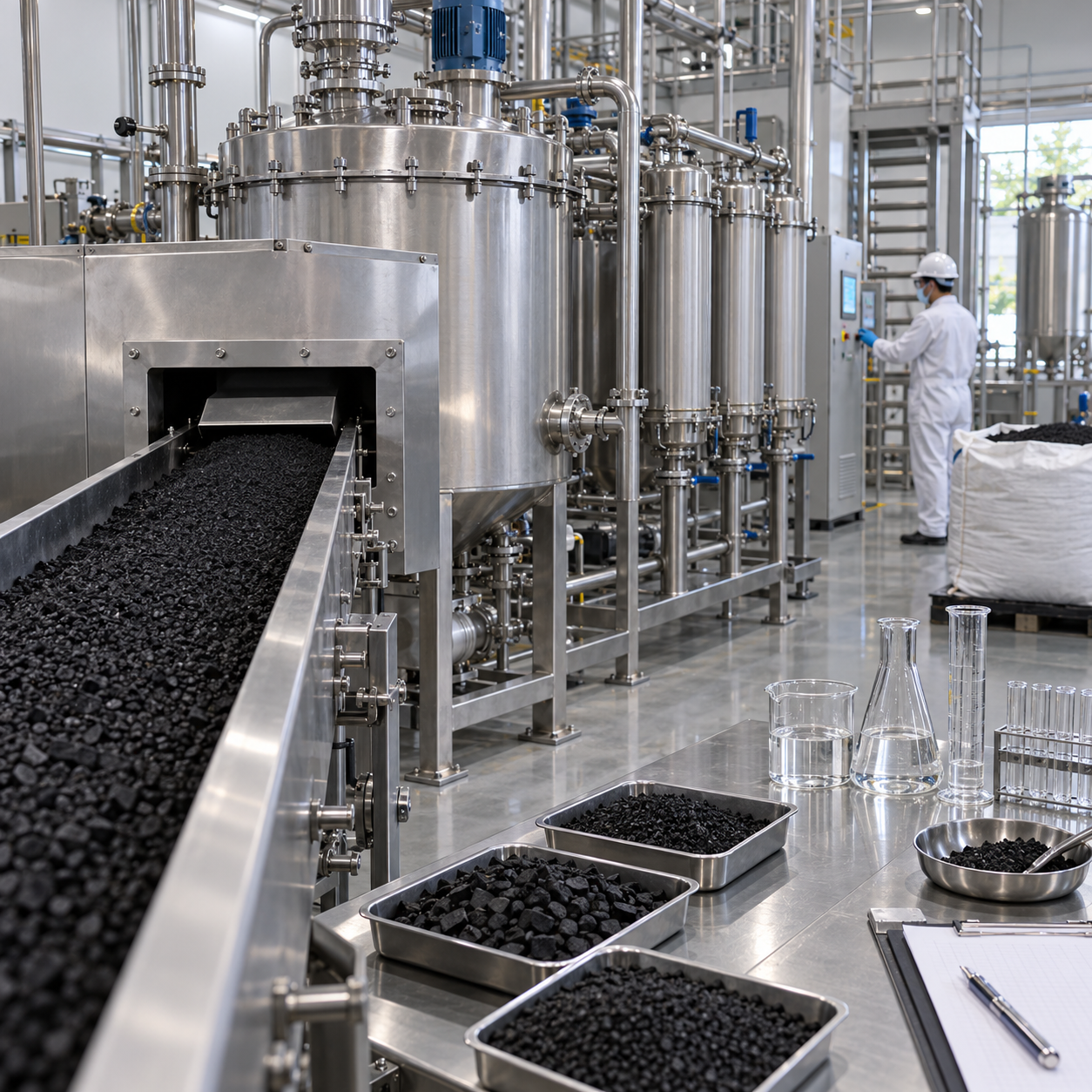
Acid treatment can remove ash-forming minerals and alter oxygen-containing groups on activated carbon, but the benefit depends on carbon source, activation history, pore structure and intended adsorbate. Oxalic acid has been investigated as a surface modifier and as part of regeneration pretreatment in defined systems. A treatment that improves one adsorption test may reduce strength, yield or performance in another service. Commercial qualification therefore needs representative carbon lots, a complete wash and water balance, application-specific adsorption testing and clear oxalic acid specifications.
For B2B implementation, assign purchasing, production, quality, engineering and EHS ownership before the first delivery. Approve receiving tests, sampling tools, storage, dosing basis, deviation response and retained-sample period in writing. Compare representative oxalic acid lots under the same operating conditions and record mass balance, product quality, waste load and equipment observations. Define who may approve a temporary deviation and what evidence is required before release. Review transportation, package integrity and unloading alongside laboratory results, because moisture or contamination can enter after the supplier’s final test. Close every trial with a written conclusion, an updated material specification and defined requalification triggers. This disciplined qualification separates raw-material variation from equipment or operating changes and provides objective evidence for buyer-supplier investigations. Procurement should also confirm lead time, minimum order, container loading, port documentation and contingency stock. Quality teams should trend incoming results rather than checking only pass or fail, while production records actual consumption per tonne of acceptable output. A periodic supplier review can then combine delivery performance, complaint response, COA trends and process results into one evidence-based decision.
Characterize the incoming carbon
Record coal, coconut, wood or other precursor, activation method, particle form, size distribution, ash, moisture, pH, iodine number, surface area, pore distribution and mechanical strength. Sample several production lots because mineral content can vary.
Define the performance objective
Specify the target contaminant, liquid or gas matrix, contact time, pressure drop, breakthrough criterion and regeneration plan. Generic surface-area gains do not prove better service performance.
Use research to frame the trial
A Processes study evaluates oxalic-acid modification of activated carbon and connects treatment with surface and adsorption properties. A separate Molecules study examines oxalic acid in a spent-carbon regeneration pretreatment.
Avoid copying one optimum condition
Carbon chemistry, mineral ash and adsorbate are system-specific. Screen concentration, liquid-to-solid ratio, temperature and time within an approved safety envelope, and include untreated and alternative-acid controls.
Measure chemistry and physical integrity
Analyze ash, metals, surface functional groups, pH, pore structure, particle-size loss and hardness after treatment. Track carbon yield so apparent adsorption improvements are not purchased with unacceptable attrition.
Test adsorption in the real matrix
Use isotherm or kinetic data for screening, then run fixed-bed or process-representative tests with actual water, solvent or gas. Competitive species often change performance compared with a single-solute laboratory solution.
Design washing and effluent treatment
Set analytical endpoints for residual acidity, conductivity, oxalate and extracted metals. Countercurrent washing can reduce water, but recycle may accumulate ions that redeposit on carbon. Characterize liquor before choosing precipitation or disposal.
Protect pores during drying and handling
Validate dewatering, drying temperature, dust control and storage humidity. Aggressive drying or mechanical transfer can create fines, change pore accessibility and increase downstream pressure drop.
Qualify reliable oxalic acid supply
Specify form, assay, iron, insolubles, residue and other metals indicated by the carbon application. Compare representative acid lots using the same carbon and retain samples for investigations.
Build a carbon-treatment RFQ
Provide acid grade, package, monthly demand, destination and documentation needs. Review the Hiacid oxalic acid page, then request trial material and commercial pricing.
Related oxalic acid resources
- Oxalic Acid for TiO2 Nanomaterial Synthesis
- Oxalic Acid Bag Unloading and Dust Control
- Oxalic Acid in Electro-Fenton Wastewater Treatment
Frequently asked questions
Will oxalic acid improve every activated carbon?
No. Feedstock, activation, ash, pore structure and target adsorbate determine the response.
Why measure carbon yield and hardness?
A treatment can improve laboratory adsorption while causing fines, attrition or unacceptable product loss.
When is washing complete?
Use defined pH, conductivity, oxalate and metal endpoints rather than a fixed number of washes.
What should the acid specification include?
State hydration form, assay, iron, insolubles, residue, relevant metals, methods, packaging and change control.