
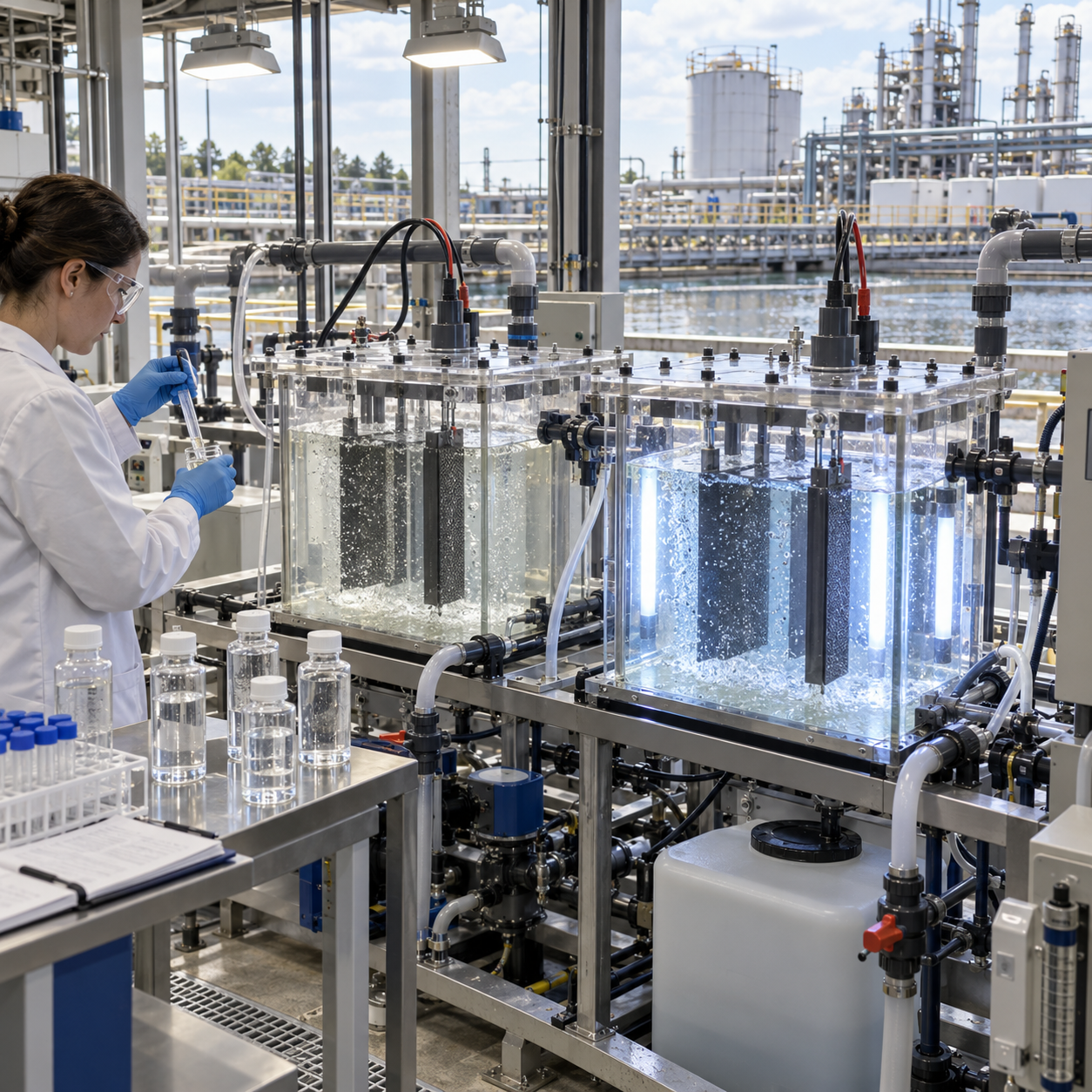
Oxalic acid can enter wastewater from cleaning, mineral processing, chemical production and hydrometallurgy. It complexes iron, changes speciation and may persist under conditions that readily remove other organic compounds. That makes it a treatment target and a process variable, not automatically a useful electro-Fenton reagent. Published work shows that performance can differ sharply between electro-Fenton and photo-assisted systems. Plants should characterize the real matrix, run controlled treatability tests and monitor oxalate directly instead of inferring removal from color or total organic carbon alone.
For B2B implementation, assign purchasing, production, quality, engineering and EHS ownership before the first delivery. Approve receiving tests, sampling tools, storage, dosing basis, deviation response and retained-sample period in writing. Compare representative oxalic acid lots under the same operating conditions and record mass balance, product quality, waste load and equipment observations. Define who may approve a temporary deviation and what evidence is required before release. Review transportation, package integrity and unloading alongside laboratory results, because moisture or contamination can enter after the supplier’s final test. Close every trial with a written conclusion, an updated material specification and defined requalification triggers. This disciplined qualification separates raw-material variation from equipment or operating changes and provides objective evidence for buyer-supplier investigations. Procurement should also confirm lead time, minimum order, container loading, port documentation and contingency stock. Quality teams should trend incoming results rather than checking only pass or fail, while production records actual consumption per tonne of acceptable output. A periodic supplier review can then combine delivery performance, complaint response, COA trends and process results into one evidence-based decision.
Characterize the wastewater before selecting a process
Measure oxalate, chemical oxygen demand, total organic carbon, iron, calcium, other metals, pH, alkalinity, conductivity, suspended solids and competing ligands. Record whether the stream changes by campaign or cleaning event.
Define treatment and discharge endpoints
Specify oxalate, COD, metals, toxicity, sludge, salinity and downstream biological-treatment requirements. A drop in one aggregate parameter may not demonstrate oxalate destruction or safe discharge.
Understand why oxalate can be difficult
Oxalate forms iron complexes and can change radical chemistry and electrode behavior. Calcium may create poorly soluble calcium oxalate, shifting material from water to sludge rather than destroying it.
Use published results cautiously
A PubMed-indexed study reported persistence of oxalic acid in electro-Fenton treatment and mineralization under photoelectro-Fenton conditions. The result supports comparative testing, not a universal equipment setting.
Compare treatment trains in controlled trials
Evaluate electrochemical, Fenton, photo-assisted, precipitation and biological options as the matrix requires. Include untreated controls, mass balances and energy, reagent and sludge measurements.
Monitor iron and oxalate speciation
Track dissolved and total iron, oxalate in liquid and solids, electrode deposits and filterable material. This distinguishes destruction, complexation, adsorption and precipitation.
Design safe and maintainable pilot equipment
Review electrical isolation, hydrogen or oxygen evolution, oxidant storage, UV shielding, ventilation, electrode cleaning, corrosion and emergency shutdown. Qualified engineers must approve the process and safeguards.
Plan solids and recycle management
Characterize iron-rich and calcium-oxalate solids, filterability and leachability where required. Recycle water can concentrate salts or ligands and should be tested over multiple cycles.
Prevent wastewater problems at the source
Optimize cleaning volumes, segregate concentrated streams, recover usable solution and avoid mixing oxalate with calcium-rich water before the intended treatment step. Source control often reduces cost more reliably than end-of-pipe treatment.
Coordinate raw material and treatment planning
For consistent incoming acid, define form, assay and impurities relevant to the process. Review the Hiacid oxalic acid page and use the contact page to request documented supply information.
Related oxalic acid resources
- Oxalic Acid for TiO2 Nanomaterial Synthesis
- Oxalic Acid for Activated Carbon Surface Modification
- Oxalic Acid Bag Unloading and Dust Control
Frequently asked questions
Does electro-Fenton always destroy oxalic acid effectively?
No. Iron complexation and matrix effects can make oxalate persistent; photo-assisted or other treatment may be required.
Does precipitation equal destruction?
No. Calcium or metal oxalates may transfer oxalate into a solid that still needs characterization and management.
Which measurements are essential in trials?
Measure oxalate, COD or TOC, dissolved and total metals, solids, energy, reagent use and mass balance.
Can a literature setting be copied to a plant?
No. Wastewater composition, reactor, electrodes, light, pH and regulatory endpoints require site-specific validation.