
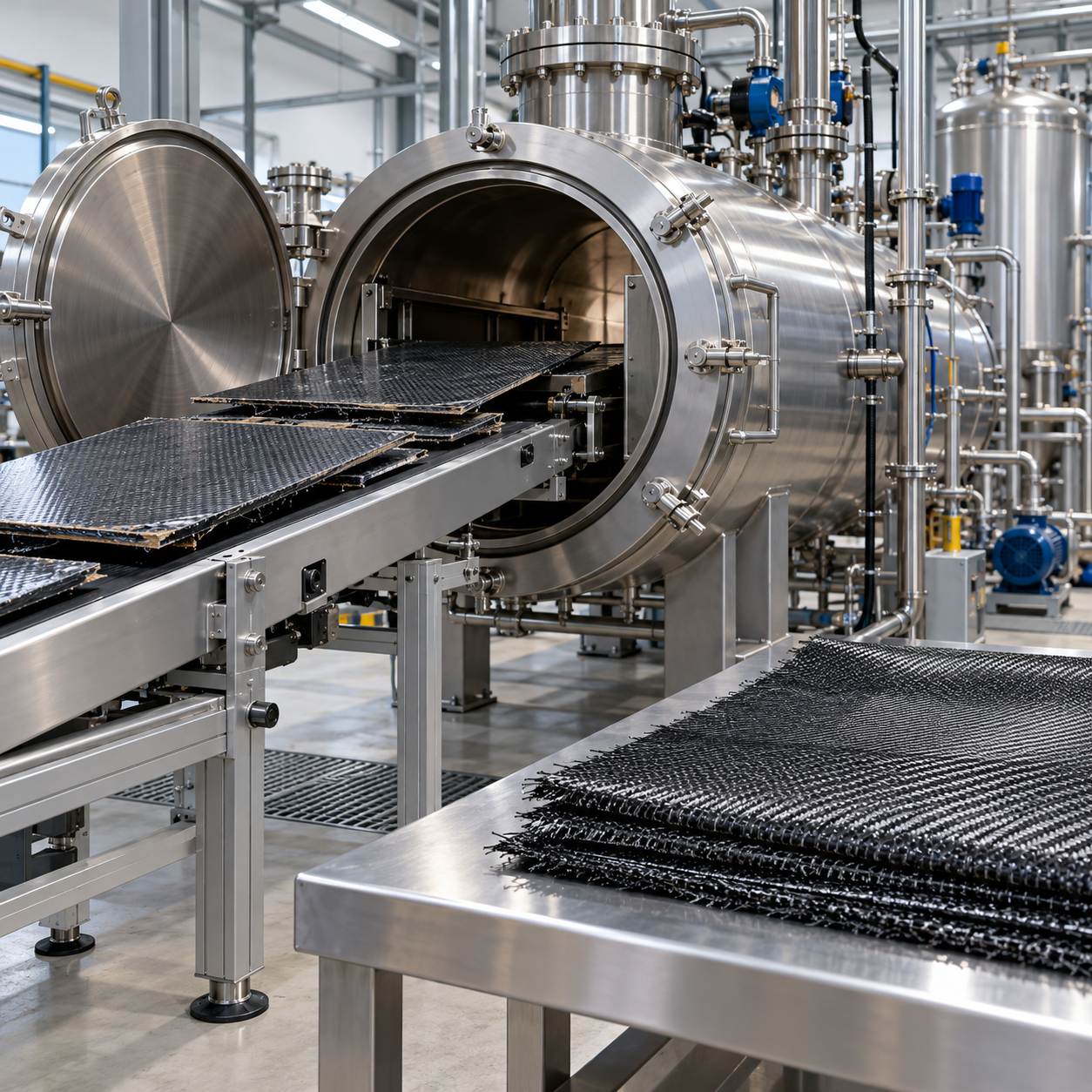
Carbon-fiber-reinforced polymer waste contains high-value reinforcement locked inside a cured resin matrix. A published mild solvolysis route used formic acid at room temperature and atmospheric pressure to separate large composite panels, then demonstrated new composites made from recovered fabric. This creates an attractive development path, but resin chemistry, cure, sizing, paint, core material and contamination vary widely among aerospace, automotive, wind and industrial scrap. A recycler must prove separation, solvent reuse and recovered-fiber performance for each feed family. This article describes a disciplined B2B qualification program rather than a universal treatment recipe.
A Scientific Reports study indexed by PubMed describes formic-acid separation of carbon-fiber composite panels under mild conditions and reports promising retained performance in newly manufactured composites using recovered fabrics.
Industrial qualification should have named ownership across purchasing, quality, engineering, operations, logistics and EHS. Approve the formic acid specification, test methods, sample points, retained-sample period, package or carrier, unloading connection, storage limits, release authority and deviation response before the first commercial lot. Compare representative lots under controlled conditions and record material balance, process performance, equipment observations, waste and final-product quality. This helps separate acid variation from changes in water, feedstock, equipment, operator or test method. Review the entire chain from supplier release through transport, receiving and point of use because contamination or misidentification can occur after manufacture. Reconcile ordered, received, stored and consumed quantities and investigate unexplained differences. Supplier scorecards should include document accuracy, delivery condition, corrective-action quality and change notification as well as price. Qualify contingency supply before a disruption using the same tests and process criteria. Where buyer and supplier results differ, review sampling, temperature, calibration, detection limits, units and measurement uncertainty before disposition. Confirm emergency contacts, unloading hours and stop-work authority for every shipment. Include warehouse and maintenance personnel in the trial review because they often identify seal, vent, hose or handling issues not visible on a certificate. Close qualification with an authorized report, approved-supplier status, routine monitoring and requalification triggers. Formic acid is corrosive and concentrated grades may introduce additional transport and fire considerations. Every plant should confirm ventilation, spill containment, compatible transfer connections, emergency showers, inspection frequency and trained response before receipt. Operators should use the current site procedure and stop work when package identity, seal condition, connection or documentation does not match the approved order. The NIH PubChem record for formic acid provides identity and broad hazard context; the current SDS, local law, permit conditions and site procedures remain controlling. Buyers should not infer regulatory approval or guaranteed process performance from a product description or published study.
Classify incoming composite waste
Identify fiber architecture, resin family, cure state, sizing, paint, adhesive, core, fasteners and service contamination. Use spectroscopy and thermal analysis where documentation is incomplete. Keep feed groups separate during early trials.
Set recovery objectives
Define intact fabric, chopped fiber, clean reinforcement or another target. Establish allowable residual resin, fiber damage, sizing loss, color and downstream mechanical properties before selecting process conditions.
Screen separation in closed equipment
Compare representative acid lots, concentration, panel thickness, edge preparation, agitation, temperature and residence time. Measure delamination progression, resin removal and a complete material balance.
Avoid visual-only acceptance
A clean-looking fabric can still have residual polymer or surface damage. Use microscopy, thermogravimetry, spectroscopy and mass measurements, then compare fiber tensile or composite performance against appropriate controls.
Protect recovered-fiber performance
Document washing, drying, handling and any re-sizing step because they can affect wet-out and interface strength. Manufacture test coupons with controlled resin and layup to isolate recycling effects.
Define reuse applications by evidence
Do not assume recovered material can return to its original safety-critical application. Establish fit-for-use pathways and traceability with designers, quality teams and relevant certification authorities.
Manage solvent and resin residues
Analyze used acid for dissolved resin fragments, water, solids and metals. Design filtration, recovery and purge around measured composition. Verify recycled acid before reuse and monitor impurity buildup across repeated cycles.
Review waste and exposure controls
Characterize concentrated resin residue, wash water, rejected laminate and emissions. Complete containment, ventilation, compatibility and authorized waste review before moving beyond pilot scale.
Specify supply for the pilot
Set acid assay, water, residue, metals and lot documentation connected to trial sensitivity. Qualify package, seals and transfer equipment for controlled receipt and dosing.
Prepare a composite-recycling inquiry
Provide resin and fiber description, panel size, trial volume, acid grade, package, destination and schedule. Review the Hiacid formic acid page, then contact Hiacid about pilot supply.
Related formic acid resources
- Formic Acid Feedstock for Dimethylformamide Manufacturing
- Formic Acid Feedstock for Formamide Production
- Formic Acid Pretreatment for Collagen Peptide Production
Frequently asked questions
Can formic acid recycle every carbon-fiber composite?
No. Performance depends on resin chemistry, cure, construction, coatings and contamination.
Is complete panel separation enough?
No. Residual resin, fiber surface condition and new-composite properties must also meet defined criteria.
Can used acid be recycled directly?
Not without analysis and a validated recovery process because water and resin fragments can accumulate.
Why keep feed families separate?
It makes trial results interpretable and prevents an incompatible resin or coating from contaminating a qualified stream.