
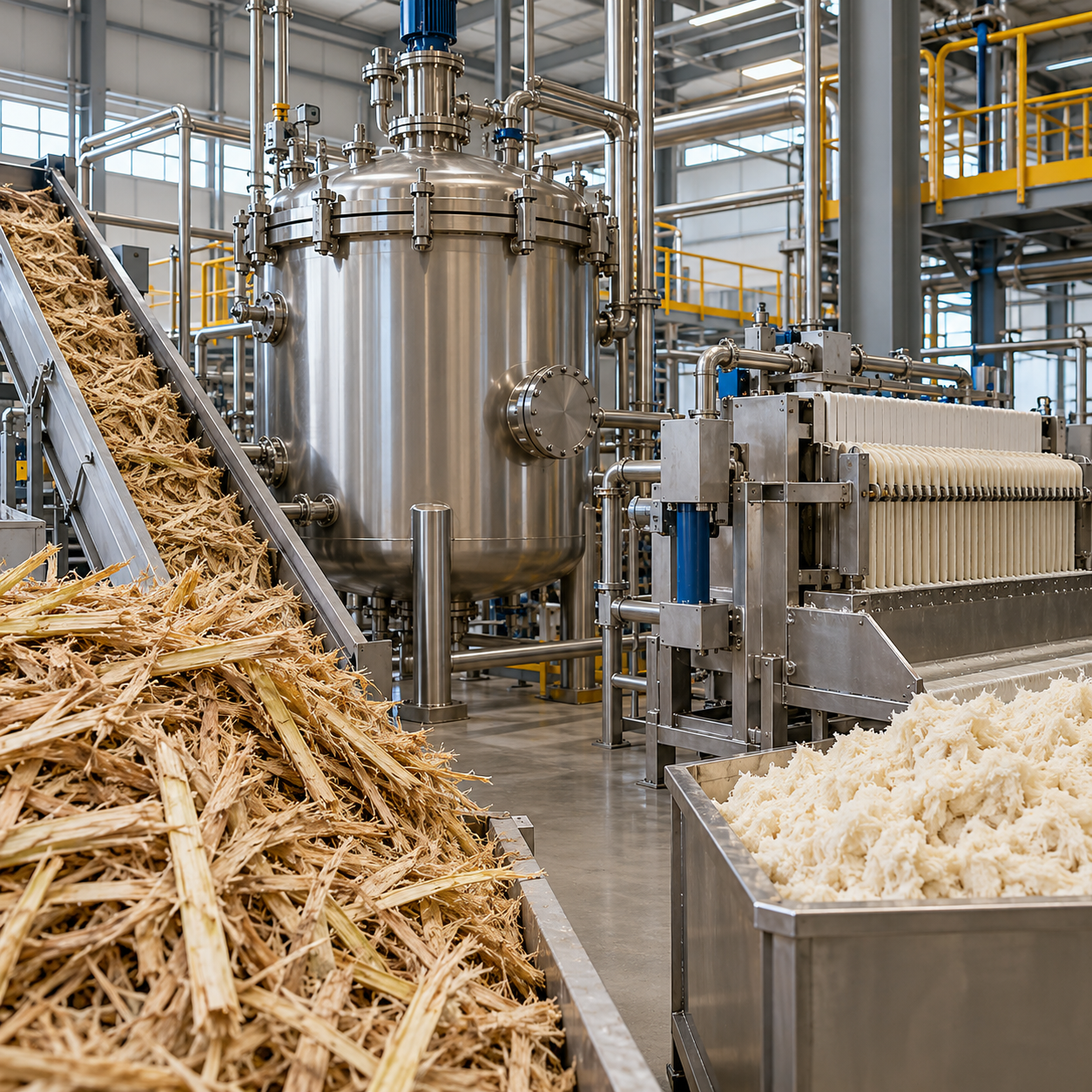
Sugarcane bagasse is an abundant fibrous residue that can become pulp, cellulose-rich intermediates or biorefinery feedstock after controlled delignification. Formic acid organosolv processing can remove lignin and hydrolyze part of the hemicellulose, but excessive severity may also degrade valuable carbohydrates. Research on bagasse pulping shows that acid concentration and residence time are tightly connected to delignification and carbohydrate preservation. Industrial teams therefore need a feed-specific trial program that integrates pulp targets, acid recovery, lignin and sugar streams, corrosion, wastewater and worker protection. This guide frames the qualification work for buyers and processors.
A peer-reviewed kinetic study indexed by PubMed investigated formic acid pulping of bagasse and reported that delignification approached completion under the studied conditions while extended treatment increased carbohydrate degradation.
Industrial qualification should have named ownership across purchasing, quality, engineering, operations, logistics and EHS. Approve the formic acid specification, test methods, sample points, retained-sample period, package or carrier, unloading connection, storage limits, release authority and deviation response before the first commercial lot. Compare representative lots under controlled conditions and record material balance, process performance, equipment observations, waste and final-product quality. This helps separate acid variation from changes in water, feedstock, equipment, operator or test method. Review the entire chain from supplier release through transport, receiving and point of use because contamination or misidentification can occur after manufacture. Reconcile ordered, received, stored and consumed quantities and investigate unexplained differences. Supplier scorecards should include document accuracy, delivery condition, corrective-action quality and change notification as well as price. Qualify contingency supply before a disruption using the same tests and process criteria. Where buyer and supplier results differ, review sampling, temperature, calibration, detection limits, units and measurement uncertainty before disposition. Confirm emergency contacts, unloading hours and stop-work authority for every shipment. Include warehouse and maintenance personnel in the trial review because they often identify seal, vent, hose or handling issues not visible on a certificate. Close qualification with an authorized report, approved-supplier status, routine monitoring and requalification triggers. Formic acid is corrosive and concentrated grades may introduce additional transport and fire considerations. Every plant should confirm ventilation, spill containment, compatible transfer connections, emergency showers, inspection frequency and trained response before receipt. Operators should use the current site procedure and stop work when package identity, seal condition, connection or documentation does not match the approved order. The NIH PubChem record for formic acid provides identity and broad hazard context; the current SDS, local law, permit conditions and site procedures remain controlling. Buyers should not infer regulatory approval or guaranteed process performance from a product description or published study.
Characterize bagasse variability
Measure moisture, ash, dirt, residual sugar, pith, fiber length, lignin, cellulose and hemicellulose across harvest and mill conditions. Document washing, depithing, drying and storage because they influence chemical demand and liquor contamination.
Define the desired pulp product
Set residual lignin, yield, viscosity, brightness, drainage, fiber strength and downstream use. A high delignification percentage alone may hide excessive cellulose or hemicellulose loss.
Build a severity matrix
Screen acid concentration, liquid-to-solid ratio, temperature, time and mixing using representative bagasse. Sample the solid and liquor at defined intervals and reconcile lignin, carbohydrates, acid and water.
Protect valuable carbohydrates
Analyze dissolved sugars, degradation products and pulp viscosity. Establish a stop point that meets delignification needs without unnecessary exposure. Longer processing is not automatically better.
Design separation and washing
Evaluate pressing, filtration and counter-current washing for acid removal and pulp recovery. Track fines and dissolved organics so apparent yield is not distorted by retained liquor or lost fibers.
Test pulp in its intended application
Run sheet, fiber, dissolution or conversion tests relevant to the customer. Compare against conventional pulp or a defined control using the same conditioning and analytical methods.
Plan acid and coproduct recovery
Characterize spent liquor for formic acid, water, lignin, sugars, furans, solids and minerals before selecting recovery. Verify recovered acid quality and define purge limits across repeated cycles.
Value lignin and sugar streams cautiously
Isolate and test coproducts before assigning revenue. Market claims require consistent purity, functionality, safe handling and a realistic customer specification.
Engineer safe commercial supply
Review corrosion at every concentration and temperature, including evaporators and condensers. Specify acid assay, water, residue and metals; qualify storage, unloading and emergency systems.
Prepare a bagasse-pulping inquiry
Share acid grade, trial volume, packaging, destination, documentation and forecast. Review the Hiacid formic acid product page, then request a supply quotation for controlled trials.
Related formic acid resources
- Formic Acid Feedstock for Dimethylformamide Manufacturing
- Formic Acid Feedstock for Formamide Production
- Formic Acid Pretreatment for Collagen Peptide Production
Frequently asked questions
Does longer pulping always improve bagasse delignification?
No. Extended exposure may add little delignification while increasing carbohydrate degradation.
Why depith and characterize bagasse?
Pith, ash, moisture and residual sugar change liquor demand, filtration and pulp quality.
Can recovered formic acid return directly to the reactor?
Only after analysis and validation show that accumulated water and organics remain within approved limits.
What proves a bagasse-pulping trial succeeded?
Pulp yield and properties, controlled lignin removal, material balance, recoverability, safety and waste performance all matter.