Hydrogen peroxide can be evaluated as an oxidant for selected cyanide-bearing mining waters, but performance cannot be assumed from a simple theoretical dose. Free cyanide, weak-acid-dissociable complexes, stronger metal complexes, thiocyanate, sulfide, suspended solids and other oxidant demand affect consumption and residual quality. pH, copper, temperature, mixing and residence time can change reaction rate and selectivity. A treatment program should begin with representative characterization and staged treatability tests, then progress through engineering, pilot and controlled commissioning. The objective must be defined by the site permit, receiving environment and downstream process; reducing one analytical fraction does not prove that all cyanide species or toxicity goals are met. Hydrogen peroxide storage and dosing also introduce oxidizer and decomposition hazards. Procurement must select a concentration, stabilizer grade, package and delivery schedule compatible with the engineered system.
For B2B implementation of Hydrogen Peroxide for Cyanide Destruction in Gold Mining, assign ownership across purchasing, quality, production, engineering, logistics and EHS before the first delivery. Approve the receiving test, compatible handling system, deviation response, retained-sample period and supplier-change process in writing. This shared control plan helps separate raw-material variation from equipment or operating changes and provides objective evidence for investigations.
Characterize water and the objective
Measure the cyanide fractions required by the governing method and permit, together with pH, metals, thiocyanate, sulfide, chemical oxygen demand, solids and flow variation. Use representative seasonal and operational samples rather than one convenient grab sample.
Define success beyond dose removal
Set effluent limits, monitoring frequency, toxicity or downstream criteria, sludge handling and upset response. A lower cyanide result must be interpreted with method detection limits, sampling preservation and possible interferences.
Run staged treatability testing
Begin with controlled bench tests covering realistic pH, peroxide dose, copper and residence time. Track reaction progress and residual peroxide, then confirm results in continuous or pilot conditions where mixing and mass transfer resemble the plant.
Avoid copying a universal dose
Theoretical stoichiometry is a starting point, not an operating setpoint. Competing oxidant demand and cyanide speciation can increase consumption, while overdosing raises cost and may affect downstream biology or measurements. Develop feed-forward and feedback limits from data.
Engineer mixing and dosing controls
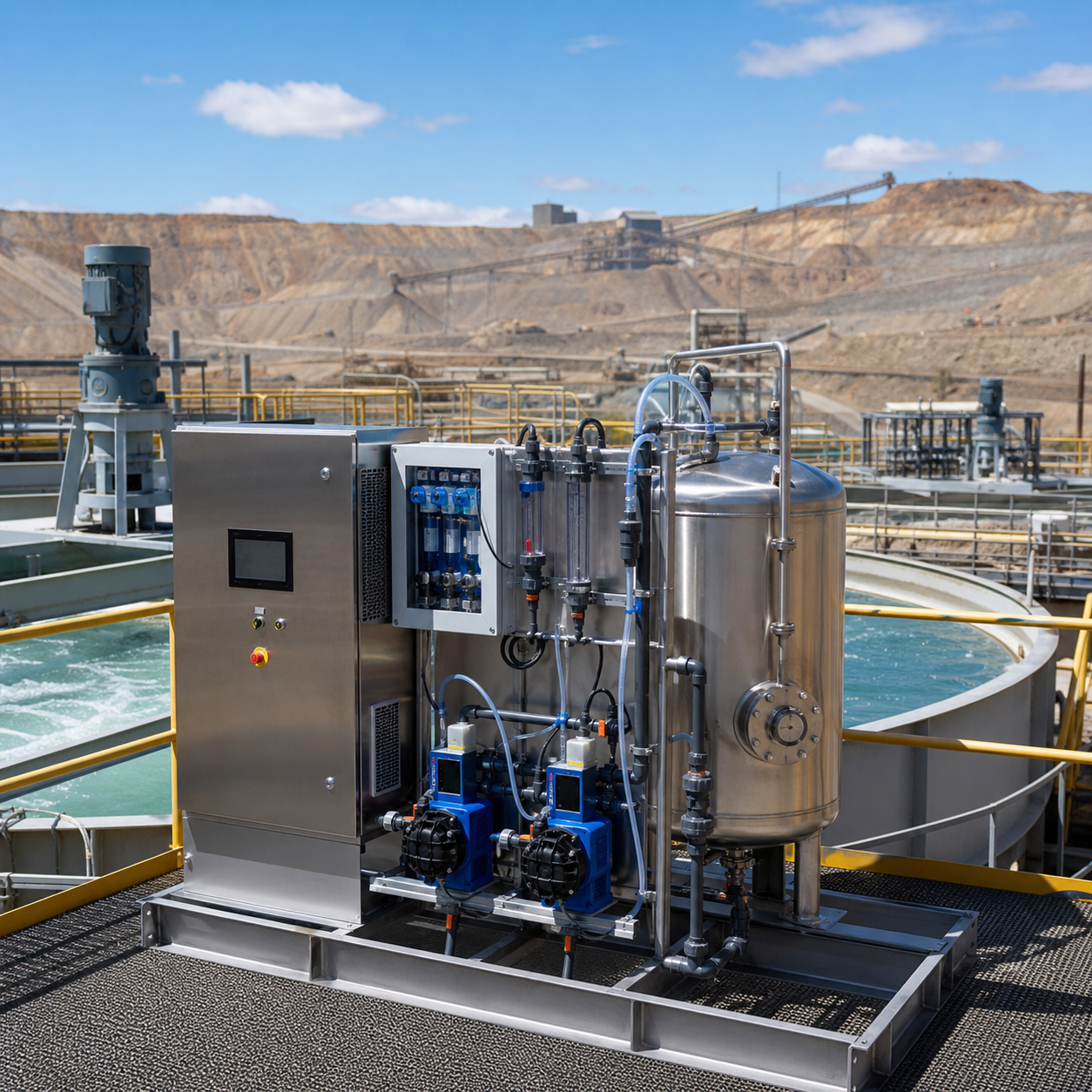
Use compatible storage, metering pumps, injection quill, backflow prevention and a validated mixing zone. Interlock dosing with water flow and define maximum output. Monitor pH and other validated indicators without relying on oxidation-reduction potential alone unless site data support it.
Manage heat, gas and catalysis
Peroxide decomposition releases heat and oxygen. Metals and contaminated surfaces can accelerate it. Evaluate reaction and decomposition together in hazard review, including loss of flow, blocked line, concentrated chemical contact and incorrect catalyst addition.
Verify residuals and by-products
Analyze the required cyanide species, residual peroxide and relevant metals or by-products after sufficient reaction time. Confirm that sample preservation does not create misleading results. Trend sludge or precipitate characteristics and downstream treatment performance.
Use mining references as context
The US EPA hardrock mining source book notes that peroxide dosage can depend on WAD cyanide, peroxide strength and mass transfer. It is historical technical context, not a substitute for current permits, treatability testing or professional process design.
Qualify supply and operating continuity
Specify concentration, assay range, stabilizer expectations, package, delivery volume and change notification. Plan inventory around remote-site logistics without exceeding approved residence time. Prequalify alternate supply before an interruption and train operators on the exact delivered grade.
Prepare a mining-treatment RFQ
Provide application, peroxide concentration, consumption profile, package, site access, receiving connection, delivery schedule, COA and SDS language. Review the Hiacid hydrogen peroxide supply page and storage guide, then request a logistics and specification proposal.
Related hydrogen peroxide resources
- Hydrogen Peroxide Storage and Material Compatibility Guide
- Hydrogen Peroxide for Aseptic Packaging Sterilization
- High-Purity Hydrogen Peroxide for Semiconductor Cleaning
Frequently asked questions
Is there one standard peroxide dose for cyanide destruction?
No. Cyanide species, competing demand, pH, catalyst, mixing and treatment objectives vary by site.
Why measure residual peroxide?
It helps evaluate dose utilization and potential effects on downstream treatment or analysis.
Can ORP alone control the process?
Only if site data validate its relationship to the required cyanide and residual results.
What should precede full-scale use?
Representative characterization, bench testing, hazard review, pilot or controlled commissioning and permit review.