Hydrochloric acid can react with selected metals, oxides, hydroxides or carbonates to produce industrial metal chloride solutions or crystals. The route must be developed for the specific metal and oxidation state. Feed reactivity, heat release, hydrogen or carbon dioxide generation, insoluble matter and impurity transfer can differ substantially. A process suitable for ferric chloride is not automatically suitable for zinc, calcium, aluminum or another chloride. Producers should complete stoichiometric, calorimetric, materials and off-gas assessments before scale-up. Hydrochloric acid concentration determines both chloride input and water balance, affecting reaction control, final solution strength, evaporation duty and crystallization. Acid impurities such as iron, sulfate, free chlorine or trace metals can transfer into the product or interact with the metal feed. A purchasing specification should therefore be derived from finished-product limits and purification capability. Supplier qualification should cover several lots and connect acid COAs to reaction behavior, filtration, color, assay and downstream customer performance.
For B2B implementation of Hydrochloric Acid for Industrial Metal Chloride Manufacturing, assign ownership across purchasing, quality, production, engineering, logistics and EHS before the first delivery. Approve the receiving test, compatible handling system, deviation response, retained-sample period and supplier-change process in writing. This shared control plan helps separate raw-material variation from equipment or operating changes and provides objective evidence for investigations.
Define product and feed chemistry
Specify target chloride, oxidation state, solution or crystal form, assay, acidity, insoluble matter, color and trace impurities. Select the metal-bearing feed for purity, reactivity, availability and waste profile. Confirm whether oxidation or reduction is required and which gases can form under normal and upset conditions.
Complete stoichiometric and water balances
Calculate acid demand on pure-HCl basis and include water entering with commercial acid, wet solids, washes and recycle. Establish practical endpoint and residual-acidity ranges through controlled trials. Water balance can determine whether the product meets concentration directly or needs evaporation.
Engineer controlled reaction and feed
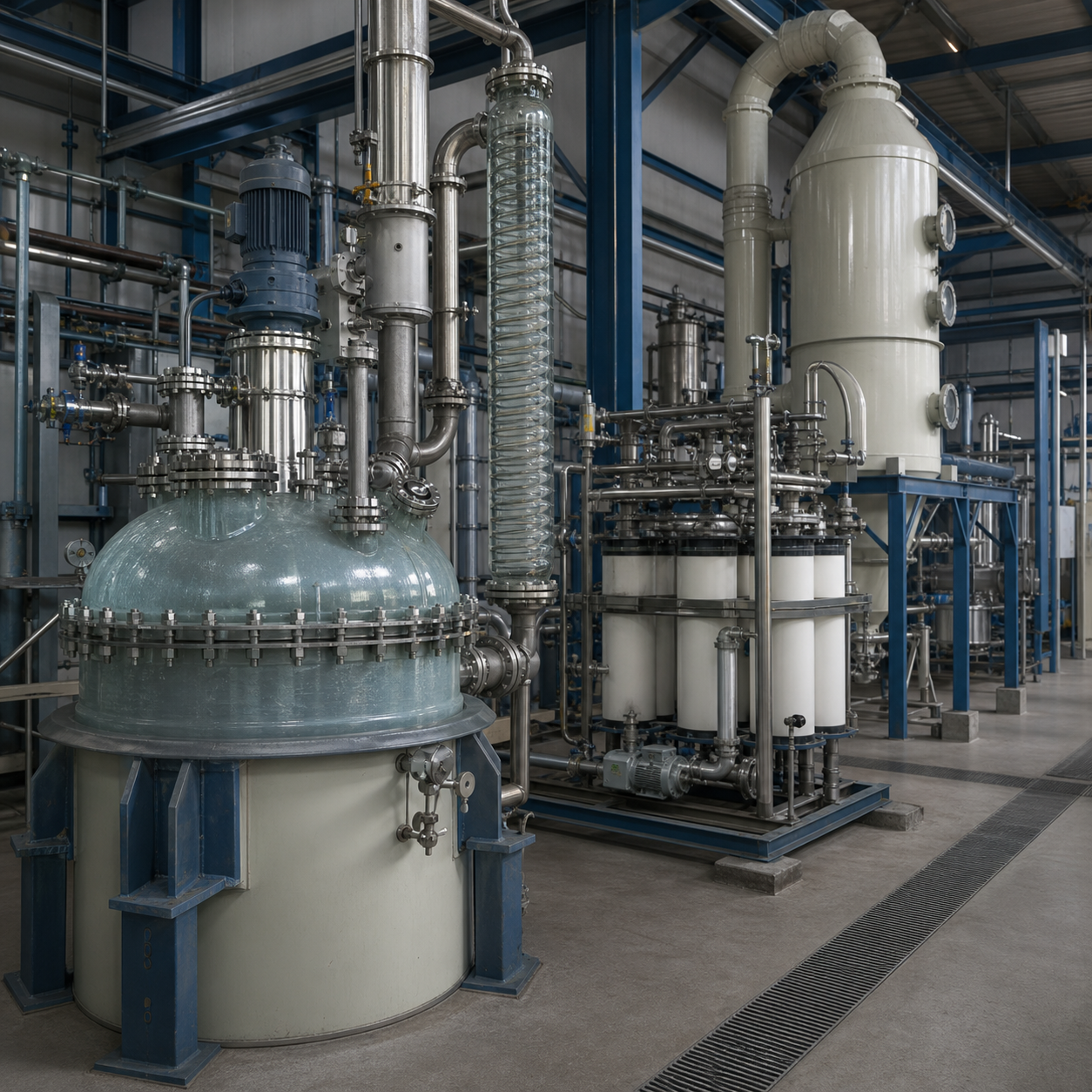
Use compatible closed equipment, agitation, metered feed, temperature monitoring, cooling and emergency isolation designed for the reaction. Define the safe charge sequence and permissible accumulation through hazard analysis. Scale-up must consider heat and gas transfer rather than vessel volume alone.
Handle gas as a process stream
Metal routes may release hydrogen; carbonate routes can release carbon dioxide; some impurity or oxidation systems may produce other gases. Identify composition and maximum credible rate, then design ventilation, inerting, scrubbing and monitoring as appropriate. Never rely on odor or visible vapor as the control method.
Link acid quality to product purity
Map transfer of iron, sulfate, free chlorine, heavy metals and residue from every raw material. Set incoming limits where data show a product or process risk. Analyze several acid and feed lots because a low impurity in one stream can become significant when evaporation or recycle concentrates it.
Control endpoint and representative sampling
Define safe sampling locations, conditioning and analytical timing. Hot, reactive or slurry systems may be difficult to sample uniformly. Use validated measures for residual acid, metal assay, oxidation state or density, and retain raw-material and product samples for investigations.
Plan filtration, concentration and crystallization
Filtration removes feed residue but may not remove dissolved contaminants. Evaporation and crystallization redistribute impurities between crystals and mother liquor. Establish wash, recycle and purge limits using mass-balance data so contamination does not accumulate over successive campaigns.
Protect materials and product color
Evaluate reactor, piping, filter, evaporator and dryer materials for acid concentration, temperature, chloride stress and contaminants. Track corrosion products because equipment degradation can change color or metals results. Include inspection findings in product-quality investigations.
Qualify supply and manage changes
Review acid manufacturing site, loading point, analytical methods, traceability, packaging and change control. Confirm dedicated compatible transport and define lot documentation. Trial an alternate source before an interruption rather than making an unqualified emergency substitution.
Prepare a metal-chloride RFQ
Provide product application, acid concentration, impurity limits and methods, consumption, package, destination, COA, delivery schedule and change notification. Review the Hiacid hydrochloric acid supply page and buying specification, then request a qualified supply proposal.
Related hydrochloric acid resources
- 31–37% Hydrochloric Acid Buying Specification for Industry
- Hydrochloric Acid for Steel Pickling Process Control
- Hydrochloric Acid for Industrial pH Control and Dosing
Frequently asked questions
Can one reaction design make every metal chloride?
No. Feed chemistry, oxidation state, gas generation, heat release and purification needs vary by product.
Why does hydrochloric acid concentration matter?
It changes both HCl input and water balance, affecting reaction, product strength and evaporation duty.
Which acid impurities require limits?
Select limits through impurity-transfer studies and final-product requirements rather than a generic list.
Why control mother-liquor recycle?
Recycle can improve yield but may accumulate dissolved contaminants and alter crystallization.