
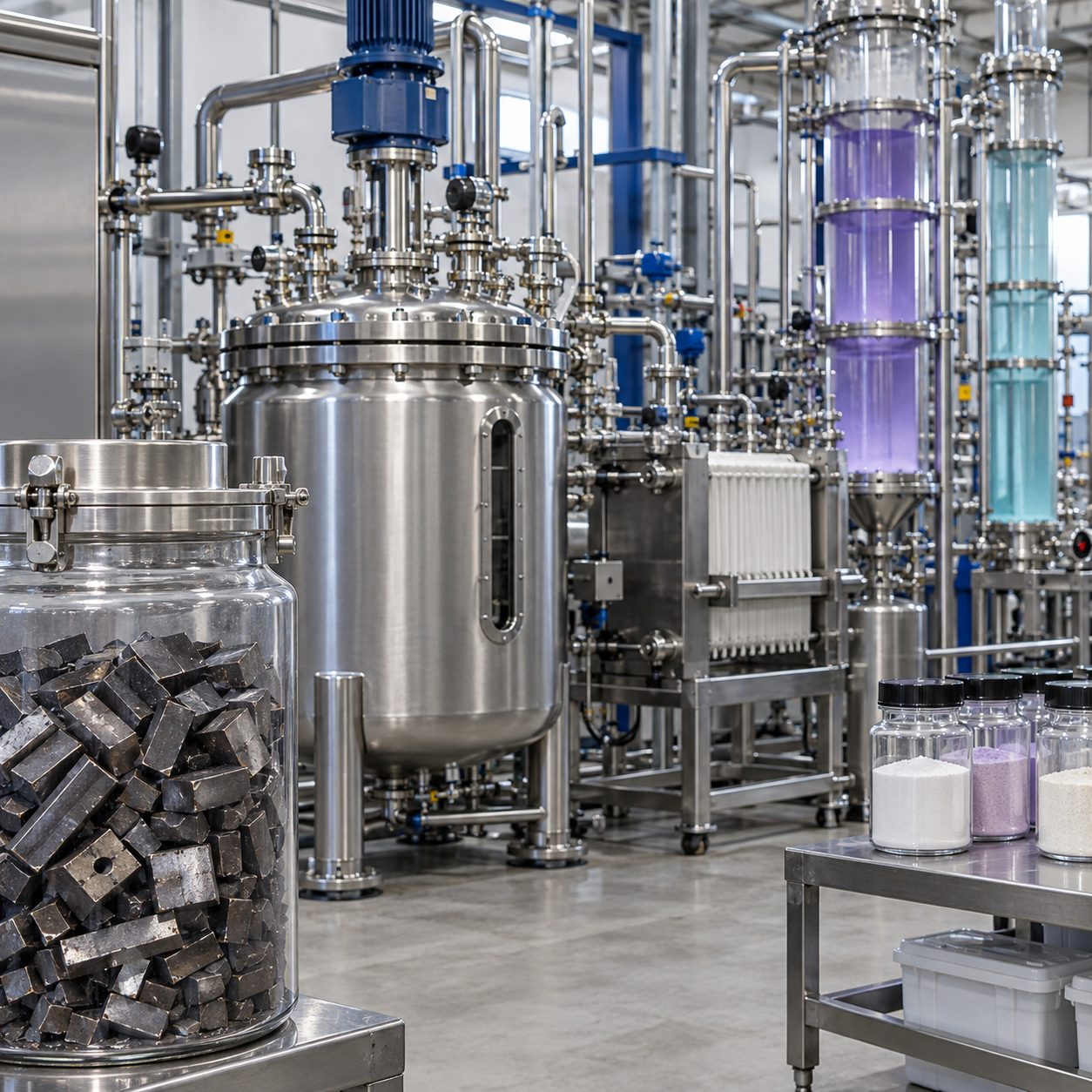
End-of-life NdFeB magnets contain neodymium, praseodymium, dysprosium, iron, boron and sometimes cobalt or protective coatings. Acetic acid has been studied as an organic leachant for transferring rare-earth elements into solution before separation and recovery. Selectivity can be limited because iron and cobalt may co-dissolve, while coating, oxidation, demagnetization, roasting and particle size change the response. Procurement must connect acid quality and consumption to feed preparation, rare-earth yield, impurity removal, solvent extraction, acetate recycle and residue. This guide presents qualification evidence rather than leaching conditions.
For industrial qualification, assign purchasing, quality, engineering, operations, logistics and EHS ownership before the first commercial delivery. Approve glacial acetic acid assay, impurity limits, analytical methods, sampling, storage, dilution or dosing equipment, deviation response and release authority in writing. Compare representative lots under controlled conditions and record process performance, mass balance, waste, equipment observations and final product quality. This separates raw-material variation from changes in water, feedstock, equipment, operator or laboratory method.
Review the chain from supplier release through carrier, package, receiving connection and day tank because contamination or dilution can occur after final analysis. Reconcile ordered, received, stored and consumed quantities and investigate unexplained differences. Supplier scorecards should cover documentation accuracy, delivery condition, corrective-action quality and change notification as well as price. Qualify a contingency source before disruption using the same methods and process criteria. When buyer and supplier results differ, review sample representativeness, temperature, standards, calibration, detection limits and uncertainty before disposition.
Glacial acetic acid is corrosive, combustible and has a pungent vapor. Its freezing point is near ordinary cool-weather conditions, so crystallization can disrupt delivery or measurement if not controlled. Use the current SDS, compatible materials, ventilation, ignition control, secondary containment and an approved emergency plan. The NIOSH Pocket Guide entry and NIH PubChem record provide general identity and hazard context; local law, site procedures and the process hazard review remain controlling. Confirm emergency contacts, unloading hours and stop-work authority for every shipment.
Use published evidence as context
An open-access study of mobile-phone magnets evaluated acetic and citric acids for neodymium and praseodymium leaching and documented iron co-dissolution. Its feed and methods are research-specific.
Translate research into site qualification
Define feed, equipment, analytical methods, acceptance criteria and stop conditions before trials. Scale only after replicated data, a reviewed hazard assessment and documented product and waste routes support the decision. Close qualification with an authorized report, approved-supplier status and a routine monitoring plan.
Characterize and segregate magnet scrap
Record source, magnet grade, coating, corrosion, adhesives, nickel, cobalt, dysprosium and particle size. Remove incompatible components and document demagnetization or thermal history.
Define recovery and selectivity targets
Set acceptable extraction for Nd, Pr and Dy together with limits for iron, cobalt, nickel and boron. Specify the intended rare-earth product and residue route.
Compare pretreatment pathways
Evaluate intact pieces, milled, oxidized or roasted material using complete mass balances. Pretreatment can improve leaching but add energy, dust and impurity effects.
Measure kinetics without hiding co-dissolution
Track rare earths and impurities over time across representative lots. A faster result is not better if downstream separation becomes impractical.
Specify acid for separations
Define assay, water, metals, aldehydes and residue with approved methods. Evaluate whether acid impurities interfere with solvent extraction or precipitation.
Link all reagents and samples
Record magnet lot, acid lot, water, pretreatment, temperature and analytical samples. Retain matched feed, liquor and residue for investigations.
Engineer iron and acetate management
Map impurity removal, solvent extraction, stripping, precipitation, washing and acid recovery. Model acetate accumulation and reagent demand across recycle.
Control powder and gas hazards
Enclose magnet powder handling and evaluate hydrogen or other gas generation, heat and pressure under the process hazard review. Use compatible reactors and ventilation.
Stage commercial acid supply
Use small documented lots for screening and larger deliveries only after representative campaigns establish net demand and equipment compatibility. Require COA, SDS and change control.
Prepare a magnet-recycling inquiry
Provide assay, impurity limits, package, trial volume, destination and forecast. Review the Hiacid glacial acetic acid page, then request a staged supply proposal.
Related glacial acetic acid resources
- Glacial Acetic Acid for Marine Collagen Extraction
- Glacial Acetic Acid for Lignocellulosic Biomass Pretreatment
- Glacial Acetic Acid for Lithium Battery Metal Recovery Trials
Frequently asked questions
Why is iron co-dissolution important?
It increases purification load and can reduce rare-earth product purity and solvent-extraction efficiency.
Does every NdFeB magnet respond the same way?
No. Grade, coating, oxidation, dysprosium, particle size and pretreatment cause major variation.
Why evaluate pretreatment and leaching together?
Pretreatment changes mineral phases, surface area, selectivity, energy use and safety.
Can organic-acid leaching eliminate residues?
No. Impurity solids, wash water and separated metals still require qualified recovery or treatment routes.